
BIM Procurement and Sustainable E-Procurement in Construction
Discover how BIM and sustainable procurement integrate informational requirements, materials, suppliers, costs, and traceability in construction contracts

Building Information Modeling (BIM) is transforming the construction industry not only in design and construction phases but also in procurement processes, that is, in the acquisition of goods and services and, more generally, in the management of contracts and the information necessary for their execution.
In the context of construction, in fact, BIM procurement does not only involve the purchase of materials and components: it also includes the definition of informational requirements, bidding documentation, selection of operators, management of information exchanges, and control of the data produced during the execution of the contract.
The digital management of project information allows for improved coordination among the actors involved, optimizes procurement activities, and supports more informed decisions at the various stages of the intervention.
To effectively manage these information flows, it is essential to adopt specific tools such as a BIM management system, a system that enables organizing, sharing, and updating project data within a coordinated digital environment.
In this article, we will explore how the integration of sustainability and digital innovation is changing the way procurement is managed in construction, with benefits in terms of efficiency, cost control, and quality of design choices.
Contents
- Sustainable BIM procurement and BIM: principles and objectives
- What is BIM Procurement?
- How BIM Renovates Procurement: Data, Standardization, and Collaboration
- The Importance of BIM in Material Management
- The Influence of Digital Technologies: The Rise of E-Procurement
- BIM and Sustainable Procurement Throughout the Project Lifecycle
- Towards a more sustainable and digital construction procurement
- FAQ – BIM procurement and sustainable procurement
Sustainable BIM procurement and BIM: principles and objectives
Sustainable procurement is an approach to purchasing and contracting that considers, along with price and performance, the environmental, social, and economic effects associated with goods, services, and suppliers throughout their lifecycle. Internationally, one of the primary references is ISO 20400, which provides guidelines for integrating sustainability into procurement processes.
In the construction sector, this approach assumes a particularly important role, as every purchasing decision can affect the quality of the work, the costs of production and management, and the environmental impact of the intervention.
Sustainable procurement can contribute to the reduction of environmental impact through the selection of more efficient materials, optimization of resource use, decrease in construction waste, and greater collaboration among stakeholders involved in the project. It also promotes the adoption of innovative technological solutions and can help create value for the entire construction supply chain.
However, the application of these principles requires a careful assessment of the environmental and social impacts of materials, production processes, and procurement methods.
BIM, on its own, does not determine the environmental impact of a product or construction solution: it can, however, organize and link technical, economic, and environmental data from sources such as EPD, LCA analyses, or other databases, facilitating comparison among alternatives.
The meaning of sustainable procurement for constructions and BIM
Understanding the meaning of sustainable procurement means considering the procurement process as a tool capable of generating environmental, economic, and social value in addition to satisfying project needs.
In the construction sector, sustainable procurement includes strategies that integrate efficiency objectives, environmental protection, and social responsibility in the various phases of the project.
With BIM, this approach gains further effectiveness because every procurement decision can be based on reliable and continuously updated data. The informational model allows for the advance evaluation of performance, costs, maintenance requirements, and environmental impacts of the components planned in the project.
Sustainable procurement supported by BIM allows for the achievement of several strategic objectives, including:
- selection of materials with a reduced environmental impact accompanied by certified documentation;
- selection of qualified suppliers capable of ensuring transparency, traceability, and compliance with required standards;
- reduction of waste and unnecessary processing through more accurate planning;
- improvement of building performance throughout its useful life;
- compliance with ESG (Environmental, Social and Governance) criteria and increasingly stringent regulatory requirements in contracts.
Thus, BIM helps transform procurement from a mere administrative task into a process more integrated with design, control, and information management. It does not replace economic or environmental assessment methodologies but can facilitate their application by providing structured and shared information.
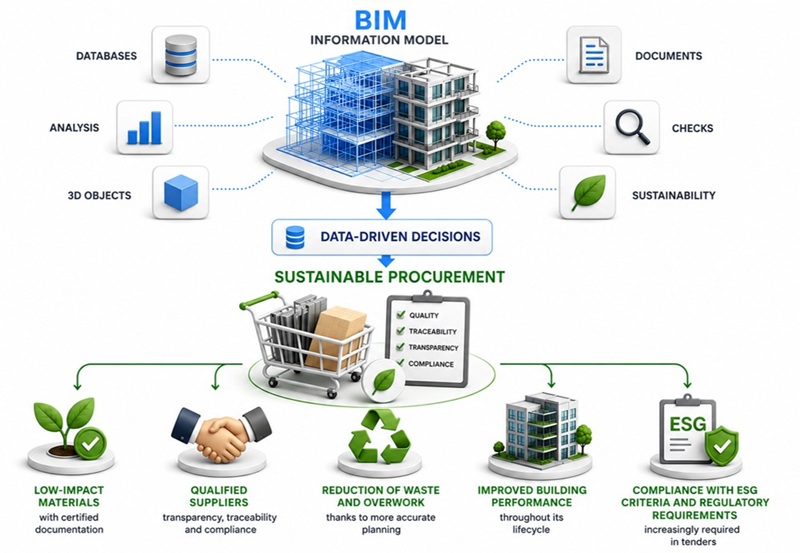
Sustainable procurement for construction and BIM
How a Sustainable Procurement Policy Supports BIM-Based Decision-Making
An effective sustainable procurement policy defines criteria, procedures, and responsibilities that guide purchasing decisions throughout all phases of the project.
When this policy is integrated with BIM, alternatives can be compared based on technical, economic, and environmental data available in the information process.
For example, already in the early design phases, the team can compare different construction solutions while simultaneously evaluating:
- initial costs and life cycle costs;
- characteristics and environmental impacts, when supported by LCA data, EPD, or equivalent sources;
- sourcing times;
- availability of products on the market;
- energy performance;
- durability and maintenance requirements.
The result is a more transparent and documented decision-making process, in which designers, companies, and clients share the same updated information.
The integration between BIM and GIS in public procurement further expands the possibilities for analysis and planning, as it allows for associating territorial, infrastructural, and environmental elements with the data of the informational model. This synergy improves the assessment of project needs, procurement programming, and coordination of activities on an urban scale.
What is BIM Procurement?
BIM procurement can be defined as the integration of procurement processes with BIM information management methods and tools. It therefore includes not only the selection and purchase of products but also the definition of what must be produced from an informational perspective, by whom, in what manner, within what timelines, and with what quality requirements.
In this sense, BIM procurement can involve:
- informational requirements included in the tender documentation;
- selection and evaluation criteria for operators;
- production and data exchange methods;
- informational responsibilities;
- use of the data sharing environment;
- verification of delivered informational content;
- linking project information, supplies, and project management.
The UNI EN ISO 19650 series represents one of the main references for the organization and management of BIM information throughout the life cycle of the project.
How BIM Renovates Procurement: Data, Standardization, and Collaboration
BIM plays a strategic role in renewing procurement because it changes the way the construction sector manages the acquisition of materials, services, and resources, along with the production and sharing of the information necessary for contract awards.
The use of specific BIM management tools allows for a more effective management of project information and facilitates sharing among the stakeholders involved. This promotes clearer communication within the procurement process, increases the transparency of activities, and reduces the risk of errors and conflicts during the acquisition phase.
BIM can also support the analysis of different sustainable procurement strategies. Through the association between the information model and data from external sources, it is possible to compare alternatives in terms of technical performance, costs, timelines, and, when adequate indicators are available, environmental characteristics.
An additional advantage concerns the standardization and rationalization of procurement processes. The availability of digital libraries of standardized components and materials allows for quicker identification of the products and solutions best suited for the project, resulting in a reduction of time and costs associated with procurement procedures.
In a process increasingly focused on managing the entire lifecycle of the work, sustainable procurement also integrates with asset management strategies and contributes to the availability of reliable information even in the subsequent phases of operation and maintenance of the building.
Finally, BIM encourages collaborative procurement models based on shared objectives. Access to updated information models and data improves coordination among designers, suppliers, subcontractors, and clients, fostering collaborative relationships based on transparency and shared goals.
The Importance of BIM in Material Management
Materials are one of the main components of any construction project, and effective management of them helps improve sustainability, economic efficiency, and control of project phases. Choices made during the procurement phase affect not only the costs of the work but also resource consumption, the amount of waste produced, and the building’s performance over time.
In sustainable procurement, it therefore becomes necessary to have clear criteria for evaluating materials, suppliers, and procurement methods. Effective management enables the selection of solutions consistent with the environmental goals of the project and improves control of the information associated with the products used.
BIM offers a significant contribution in this process because it links the characteristics of materials to the information model of the work. This integration facilitates the analysis of design alternatives, improves information traceability, and supports more informed decisions in the selection, purchase, and management of materials.
Procurement and Sustainability Criteria for Material Selection
The choice of materials represents one of the most sensitive aspects of sustainable procurement. Defining appropriate sustainable procurement criteria allows for the identification of products that ensure techniques consistent with the project without neglecting their environmental and economic impacts.
Thanks to BIM, such criteria can be directly associated with the objects of the information model, making information such as the following immediately available:
- environmental product declarations (EPD), when available;
- content of recycled material;
- possibility of reuse or recycling at end of life;
- incorporated CO₂ emissions;
- durability and maintenance requirements;
- environmental and quality certifications.
The presence of this information in the model does not automatically equate to an environmental assessment. To reliably compare the impacts of design alternatives, consistent data and appropriate methodologies must be used, such as Life Cycle Assessment (LCA). EPDs can serve as one of the data sources usable in analyses, while BIM primarily serves to organize quantities, characteristics, and relationships between components.
In this way, it becomes possible to build a decision-making process that considers together sustainability, technical performance, and overall costs.
Requirements for Sustainable Procurement for Suppliers and Subcontractors
The effectiveness of sustainable procurement also depends on the ability to involve suppliers and subcontractors throughout the entire supply chain.
For this reason, it is increasingly common to define specific sustainable procurement requirements already during the preparation of the tender documentation or contracts.
Among the most frequently requested aspects are:
- compliance with current environmental regulations;
- quality and environmental management certifications;
- availability of digital data related to the supplied products;
- traceability of materials along the supply chain;
- compliance with ethical standards and occupational safety;
- ability to collaborate in shared BIM environments.
The inclusion of such requirements helps to build a more transparent and reliable supply chain, thus reducing operational risks and improving the quality of information available throughout the project.
Sustainable Procurement Operations: From Design Choices to Material Delivery
Sustainable procurement operations are not limited to the purchasing phase, but accompany the entire development of the work, from design to the delivery of materials on site and the management of as-built information.
Through BIM, it is possible to coordinate every procurement activity with the evolution of the project and the schedule, reducing the risk of uncoordinated orders, supply delays, or accumulations of unnecessary materials.
The main activities include:
- defining needs based on project data;
- scheduling purchases according to the timeline;
- selecting suppliers based on defined criteria;
- verifying supplies and related documentation;
- monitoring deliveries and the quantities actually used;
- updating project and construction information.
| Phase | BIM Information | Procurement Decision |
| Definition of Requirements | Informational and performance requirements | Award criteria and supply |
| Design | Quantities, components, materials, and performance | Comparison of alternatives |
| Tender | Informational specifications and other project requirements | Evaluation of bids |
| Procurement | Quantities and technical specifications | Orders and product selection |
| Site | Progress, deliveries, and changes | Logistics and supply verification |
| As-built and Management | Updated information on components | Maintenance and asset management |
This approach allows for effective coordination of procurement with the various phases of building construction, leading to better site organization and waste reduction.
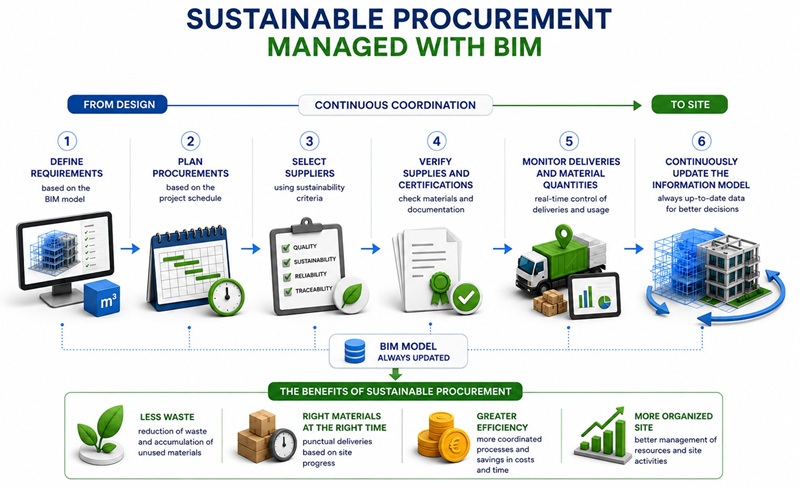
Sustainable procurement operations
The Influence of Digital Technologies: The Rise of E-Procurement
Digital technologies have revolutionized the way we manage procurement in construction: BIM acts as a bridge between design and lifecycle management of buildings, allowing for an integrated and collaborative view of the process.
BIM and e-procurement are therefore not the same technology, and one does not necessarily represent the evolution of the other. They are distinct systems that can be integrated through interoperable data and processes.
The main advantages of digitalization applied to procurement can be summarized in the following points:
- Improvement of communication: BIM facilitates real-time sharing of information among all actors involved in the procurement process, reducing delays and ambiguities;
- Optimization of planning: BIM models provide an accurate digital representation of the project, allowing for more precise planning of the timing and resources needed for procurement;
- Reduction of errors and costs: thanks to the three-dimensional visualization of projects, it is possible to identify and resolve any conflicts or issues before they occur during the construction phase, avoiding costly delays and modifications;
- Traceability and control: the use of BIM in procurement allows for complete traceability of materials and components used in construction, improving regulatory compliance and risk management.
E-Procurement in the Context of BIM
E-procurement, or electronic procurement, represents a natural evolution in the context of BIM. This practice involves the use of digital platforms to manage the procurement process, from request for quotes to supplier selection and contract management. In the context of BIM, e-procurement offers a number of specific advantages:
- Access to a global database of suppliers: e-procurement platforms provide access to a vast network of qualified and certified suppliers, allowing for more accurate and targeted selection;
- Automation of processes: digitalization can reduce reliance on repetitive manual activities and limit some data entry errors;
- Monitoring of costs and environmental indicators: e-procurement platforms integrate tools for monitoring costs and analyzing environmental impact, allowing for more accurate and sustainable resource management;
- Traceability of materials: through integration with BIM, e-procurement platforms allow for complete traceability of materials used in construction, improving transparency and regulatory compliance.

Software for Sustainable Procurement: Traceability, Cost Control, and ESG Reporting
The digital evolution of the sector has facilitated the spread of specific software that integrates various functions useful for sustainable procurement, management of purchases, and performance analysis.
These platforms allow you to centralize all information related to suppliers, materials, and contracts and ensure continuous control over procurement activities.
The functionalities vary significantly from solution to solution and may include:
- digital management of purchase requests;
- cost monitoring;
- management of documentation and environmental certifications;
- traceability of the supply chain;
- ESG reporting features;
- integration with BIM models and corporate management systems.
The use of these solutions fosters a greater transparency in decision-making and simplifies the collection of necessary data to demonstrate the achievement of sustainability objectives.
In more advanced BIM flows, open standards can also be used to improve interoperability and requirement verification. An example is the Information Delivery Specification (IDS) by buildingSMART, which allows for the expression of certain informational requirements in a format interpretable by both people and applications and to verify their delivery.
BIM and Sustainable Procurement Throughout the Project Lifecycle
Sustainable procurement is one of the tools through which the construction sector can reduce resource consumption, limit environmental impacts, and promote more responsible practices throughout the supply chain.
The selection of materials and services, efficiency of production processes, and management of information related to the products can contribute to greater environmental and economic sustainability of the project.
The construction industry, supported by well-structured BIM processes, therefore plays an important role in implementing strategies that consider the entire lifecycle of the project.
Sustainable Procurement Practices to Reduce Waste and Impact Throughout the Lifecycle
The best practices of sustainable procurement aim to minimize waste from the very first design decisions, considering the entire lifecycle of the building rather than just the initial cost of materials.
BIM can support this approach thanks to the availability of continuously updated information, which allows for the assessment of the effects of design choices before their execution.
Among the most effective examples of sustainable procurement are:
- design oriented towards prefabrication to reduce processing waste;
- selection of recyclable or easily recoverable materials;
- optimization of quantities through accurate informational models;
- delivery planning to limit transport and storage;
- reuse of components from selective demolitions;
- monitoring of environmental performance throughout the lifecycle of the project;
- evaluation of Life Cycle Costing (LCC) to compare alternatives considering initial costs, management, maintenance, and replacement.
The systematic adoption of these practices can contribute not only to reducing emissions and construction waste but also to a greater economic and managerial efficiency. This approach confirms how procurement and sustainability are today closely interconnected elements in the development of truly digital and responsible construction.
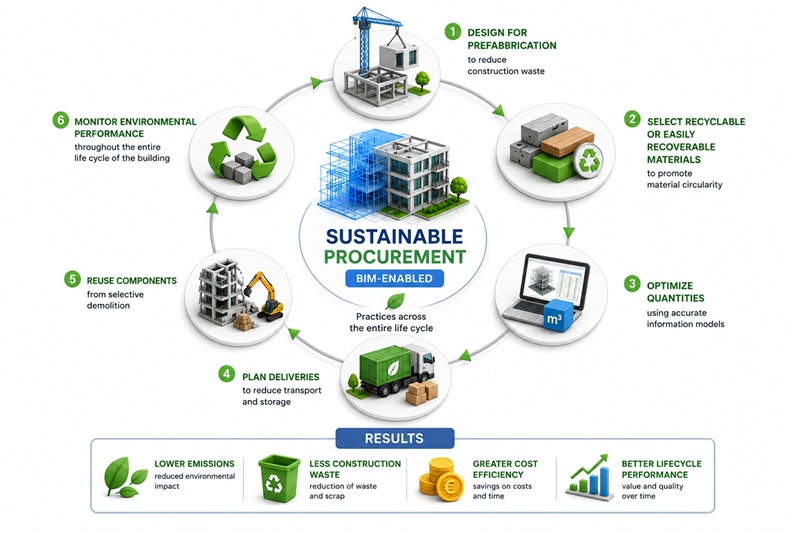
Best practices for sustainable procurement
Towards a more sustainable and digital construction procurement
The integration of sustainable and digital practices in procurement through BIM represents a significant evolution for the construction sector.
The increasing focus on sustainability requires new procurement management models that can combine efficiency, information control, and environmental responsibility.
The BIM provides concrete tools to improve decision-making quality, optimize resource use, and encourage greater collaboration among all stakeholders involved in the project.
At the same time, BIM procurement shows that the digitization of contracts cannot be limited to three-dimensional modeling: information requirements, Information Specifications, ACDat, material data, CAM, LCA, costs, and supply chain information must be considered as parts of a single informational process.
For this reason, understanding the potential of sustainable procurement and adopting appropriate digital solutions represents a fundamental step in addressing the new needs of the construction sector.
A BIM management system can help you manage project information more effectively, coordinate activities among designers, contractors, and suppliers, and improve sustainable procurement processes through a shared digital environment.
FAQ – BIM procurement and sustainable procurement
What is BIM procurement?
BIM procurement is the integration of contracting and procurement processes with BIM information management. It includes the definition of requirements, data management, supplier and operator selection, information exchanges, and the verification of required content during the project.
How can BIM support sustainable procurement?
BIM can link quantities, technical characteristics, costs, and environmental data related to project components. Integrated with sources such as EPD, LCA methodologies, or Life Cycle Costing tools, it allows for the comparison of alternatives and supports more documented decision-making.
What is the difference between BIM and e-procurement?
BIM primarily concerns the information management of the work and its life cycle. E-procurement, on the other hand, digitizes purchasing and contracting procedures. The two systems can be integrated but serve different functions.
Are BIM and EPD sufficient to perform an LCA?
No. The BIM model and EPD can provide useful data, but a Life Cycle Assessment requires a specific methodology, consistent system boundaries, reliable quantities, and comparable environmental data. BIM facilitates primarily the organization and processing of the information necessary for the analysis.
What is Green Public Procurement (GPP) and how is it related to BIM?
Green Public Procurement (GPP) is the approach through which public administrations include environmental criteria in the procurement procedures for goods, services, and works. In the construction sector, BIM facilitates the application of these criteria because it allows for the centralized collection, organization, and verification of the information required during tenders and the subsequent management phases of the work.
What skills are needed to manage a digital procurement based on BIM?
The evolution of procurement requires professionals capable of combining technical, digital, and managerial skills. Among the most important are:
- knowledge of BIM processes and information standards;
- ability to analyze economic and environmental data;
- use of e-procurement platforms and management software;
- knowledge of procurement regulations and sustainability;
- interdisciplinary collaboration skills and management of information flows.
How do open standards facilitate digital procurement?
The use of open standards, such as the IFC format, allows different software used by designers, companies, and suppliers to exchange information without relying on a single proprietary platform. This improves interoperability, reduces the risk of data loss, and simplifies collaboration between different organizations.
What role can artificial intelligence play in construction procurement?
Artificial intelligence represents a complementary technology to BIM and can support numerous activities, including:
- predictive cost analysis;
- delivery time forecasting;
- identification of risks in the supply chain;
- automatic comparison of offers and suppliers;
- decision support through the analysis of large amounts of data.
Its use does not replace human decision-making but enhances analytical and planning capabilities.
When is it advisable to digitalize procurement?
Digitalization of procurement is recommended whenever the project involves multiple parties, requires careful monitoring of costs, time, and documentation, or involves numerous supplies to coordinate. In these cases, digital tools and BIM models help make the process more efficient and reduce manual activities.


