
Hybrid Inverter: What It Is and How It Works
Maximize the use of solar energy, reduce electricity withdrawal from the grid, and optimize your bill costs with a hybrid inverter

If you need to design a complete photovoltaic system, to make targeted choices and avoid mistakes, I recommend delving into how the various components of the system work (inverter, storage battery, type of panels, etc.) and analyzing the habits (types of appliances and electrical devices usually used, time slots of use, etc.) and needs of your client.
You can certainly obtain valuable support by using a solar photovoltaic calculation software that assists you in sizing, economic analysis, defining the single-line diagram, etc.
Moreover, if you desire intelligent management of the electrical energy produced by renewable sources, you need to plan from the very beginning the type of inverter and storage batteries to be used.
In this article, I will talk about the advantages of the hybrid inverter, a device for photovoltaic systems that converts the direct current from the panels into alternating current and simultaneously manages the energy stored in the batteries. Discover what it is, what it is used for, and how it works.
Contents
- What is a hybrid inverter and what is it used for in photovoltaic systems
- Difference between hybrid inverter and traditional photovoltaic inverter: how to choose when designing a photovoltaic system
- How Hybrid Inverters Integrate Storage Systems in Residential and Commercial Projects
- Applications in on-grid and off-grid systems
- How to choose a hybrid inverter: technical characteristics to evaluate
- Aspects to Consider for Installing a Hybrid Inverter on Roof and Ground Photovoltaic Systems
- Advantages of Hybrid Inverters in the Energy Strategies of NZEB and Smart Buildings
- FAQ- Hybrid Inverters
What is a hybrid inverter and what is it used for in photovoltaic systems
A hybrid inverter is an electronic device used in solar energy systems or other renewable energy generation applications that combines the functionalities of a photovoltaic inverter (used to convert the electricity produced by solar panels into alternating current ready for domestic use) with those of a storage inverter (used to manage storage batteries).
In other words, a hybrid inverter allows you to manage both solar energy production and energy storage in batteries. This type of inverter is designed to optimize self-consumption of the energy generated by solar panels, storing it in storage batteries and making it ready for use when the sun is not available (evenings, rainy days, etc.). Additionally, a hybrid inverter can be configured to operate in backup mode, providing emergency power in case of a power grid interruption.
The integration of these functionalities into a single device offers a more compact and convenient solution for solar energy systems with storage, allowing for more efficient management of the electricity generated and stored.
To learn more, read also “What are photovoltaic inverters“.
How does a hybrid inverter work?
The operation of a hybrid inverter follows a precise operational flow that maximizes the efficiency of solar energy and optimizes its use based on external conditions. The process typically unfolds as follows:
- morning: the hybrid inverter directs the energy produced by the photovoltaic modules directly to the household appliances to meet real-time consumption needs. Any excess production that is not immediately used flows towards the storage battery, if present. This phase is crucial for maximizing self-consumption, minimizing the withdrawal of energy from the grid;
- fully charged battery: when the battery reaches its maximum charge capacity, the excess energy produced is directed to the power grid. In many situations, this surplus can be sold to the grid operator in a net metering scheme;
- evening: as the sun sets and the direct production from the photovoltaic modules decreases, the hybrid inverter activates. It uses the storage battery to provide energy for the household needs during the nighttime hours. In case the energy stored in the battery is completely depleted, the hybrid inverter automatically activates the withdrawal of energy from the national grid. This ensures a continuous supply of energy even when direct solar production is limited or absent.
In summary, the hybrid inverter offers intelligent energy management, enabling optimization of self-consumption, sale of excess energy, and continuous energy supply, ensuring a smooth transition between the various available sources. This process contributes to maximizing the overall efficiency of the system and making the use of solar energy more practical and convenient for domestic users.

Operation of hybrid inverter
Difference between hybrid inverter and traditional photovoltaic inverter: how to choose when designing a photovoltaic system
Choosing between a traditional inverter and a hybrid inverter means finding the right balance between budget, energy consumption profile, and project goals, such as self-consumption, future flexibility, or service continuity.
The main difference between a normal inverter and a hybrid inverter lies in the advanced functionalities offered by the latter. A traditional photovoltaic inverter converts direct current (DC) produced by a photovoltaic system into alternating current (AC) for domestic use. In fact, photovoltaic panels produce direct current, but since the household electrical system uses alternating current, the inverter’s function is to transform it into alternating current. It is necessary that this operation is carried out with maximum efficiency, which is why the inverter’s efficiency rating is one of the main parameters to consider in the choice. It can take different forms, such as a centralized inverter for large photovoltaic parks, a string inverter for residential and commercial systems, or a microinverter for smaller systems.
In addition to this basic function, the photovoltaic inverter must ensure that the system operates at peak performance. The MPPT (Maximum Power Point Tracker) system allows extracting the maximum possible power from the panels under specific conditions. In any case, generally speaking, we could say that its main role is to optimize the production and extraction of energy from the solar panels and automatically manage energy flows to the loads or the grid.
On the other hand, a hybrid inverter is an enhanced photovoltaic inverter that goes beyond simple current conversion. It also functions as a Battery Management System (BMS), meaning it manages and intelligently coordinates, through specific software, the energy flows coming from the photovoltaic system, the battery, and the grid.
The hybrid inverter offers different operating modes. It can send electricity directly to the load for immediate consumption, store it in batteries for later use when the sun is not available, or release it into the grid when the batteries are fully charged. This flexibility allows maximizing the self-consumption of solar energy, optimizing the overall system efficiency, and providing a complete solution for renewable energy management and energy storage.
Finally, some hybrid inverters also have the EPS mode (Emergency Power Supply) or anti black-out function, which provides electrical power to priority loads even in case of a power outage from the grid.
| Traditional inverter | Hybrid inverter |
| Converts direct current to alternating current | Manages production and storage in an integrated way |
| Works only with the electrical grid | Also works in backup mode |
| Does not manage storage systems | Optimizes self-consumption and reduces waste |
| Suitable for simple or daytime-only systems | Ideal for advanced and flexible systems |
| Lower initial cost | Higher investment but more advantageous over time |
How to choose the right inverter for the project?
The choice between the two types depends on various technical and economic factors:
- consumption profile: if consumption mainly occurs during the day, a traditional inverter may be sufficient; if it concentrates in the evening, the hybrid is more suited;
- stability of the electrical grid: in areas prone to frequent outages, a hybrid inverter with backup function is preferable;
- initial budget: the traditional inverter has a lower cost, but the hybrid is more advantageous in the long run if battery addition is expected;
- future flexibility: the hybrid inverter allows for the integration of a storage system later on without structural modifications;
- energy goals: those aiming to minimize grid withdrawal and increase self-consumption will find the hybrid to be the most efficient solution.
If in your project you are also considering the integration of hybrid solar panels (which combine electrical and thermal production), learn more here: Hybrid solar panels: operation, types, benefits.

Sizing photovoltaic system with Solarius-PV
How Hybrid Inverters Integrate Storage Systems in Residential and Commercial Projects
The integration of a storage system in a photovoltaic plant today represents one of the most strategic choices in the energy design of buildings, both residential and commercial. The hybrid inverter is the key element of this process because it allows to manage energy production, consumption, and storage in a coordinated manner on a single smart platform.
The advantage of adopting a hybrid inverter focuses on the main goal of maximizing self-consumption of energy. Integrating such a device in a photovoltaic system with storage allows to fully exploit the potential for energy self-generation and, consequently, to minimize the costs associated with the electricity bill.
In residential buildings, this technology allows the use of energy produced during the day at night, reducing the draw from the grid and increasing the home’s energy autonomy. In commercial or office projects, however, hybrid inverters become energy management tools, allowing to stabilize load peaks, optimize battery usage, and reduce energy demand costs during the most expensive time slots.
The advantages of the hybrid photovoltaic inverter are fully manifested in the presence of a storage system, which allows to store the energy generated by the photovoltaic system but not immediately consumed. Currently, there are also “hybrid” storage systems on the market that integrate the functionalities of a hybrid inverter into a single device. This integration encapsulates all the necessary electronics in a single enclosure, improving the aesthetic aspect and reducing the overall footprint of the system. Additionally, the unit is governed by unified software that enhances overall operational efficiency.
From a design perspective, a hybrid inverter allows:
- the scalability of the system: it is possible to add batteries later without changing the main hardware;
- intelligent energy management: the system autonomously decides whether to consume, store, or feed the produced energy into the grid;
- remote supervision, useful for monitoring and predictive maintenance, especially in commercial contexts.
The control software not only enables remote monitoring of the photovoltaic system and storage batteries but also offers the possibility of updates and troubleshooting remotely, further improving the reliability and management of the system.
In summary, in today’s buildings—where energy flexibility is a central objective—the hybrid inverter represents a digital heart capable of harmonizing production and consumption, reducing costs and environmental impact.
Applications in on-grid and off-grid systems
The hybrid inverter is an extremely versatile technology that finds application in various system configurations, both on-grid (connected to the electric grid) and off-grid (standalone). Its ability to manage multiple energy flows simultaneously — solar production, storage, and grid — makes it the ideal solution in contexts where one wants to maximize the efficiency and stability of the system.
In summary, the hybrid inverter offers a smart energy management, allowing for the optimization of self-consumption, the sale of excess energy, and the continuous supply of energy, ensuring a smooth transition between the various available sources. This process helps to maximize the overall efficiency of the system and makes the use of solar energy more practical and convenient for domestic users.
Grid-connected systems (on-grid)
In grid-tied systems, the hybrid inverter acts as an advanced energy manager. It coordinates the flows between photovoltaic systems, batteries, and the public grid, ensuring that energy is used as efficiently as possible.
- During daylight hours, it powers domestic or commercial loads with solar production, storing excess energy in the batteries.
- When the batteries are full, residual energy is fed back into the grid, generating an economic credit through net metering or dedicated withdrawal.
- In the event of a blackout, the hybrid inverter can disconnect from the grid and activate the EPS function, ensuring service continuity for priority loads.
This logic not only reduces dependence on the grid but also improves the overall efficiency of the system, minimizing waste and energy costs.
Off-grid systems (off-grid)
In off-grid systems, where a connection to the public grid is not available, the hybrid inverter becomes the central element for autonomous energy management.
In these cases:
- the energy produced by the panels directly powers the loads and recharges the batteries;
- when solar production is insufficient, the inverter can start a support generator or use accumulated energy;
- the system maintains a constant balance between generation and consumption, ensuring voltage stability and equipment protection.
Thanks to these features, hybrid inverters are now widely used in rural residences, mountain lodges, agricultural systems, or off-grid tourist facilities, where reliability of supply is essential.
From a design perspective, the ability to use a single device to manage production, storage, and backup reduces the complexity of the system and greatly simplifies the maintenance phase.

Main application areas of hybrid inverters
How to choose a hybrid inverter: technical characteristics to evaluate
Choosing the most suitable hybrid inverter for a photovoltaic project — whether residential or commercial — requires the evaluation of several technical, functional, and managerial parameters. The goal is to ensure maximum conversion efficiency, compatibility with the storage system, and intelligent energy management under all operating conditions.
Let’s see together what the main characteristics to consider are:
Conversion efficiency
The performance of a hybrid inverter is measured through two main parameters:
- maximum efficiency (peak value that can exceed 97-98%);
- European or weighted efficiency, which indicates the average behavior of the device under various load conditions. An efficient inverter reduces conversion losses and improves the economic return of the system over time.
Number of MPPT and input voltage
The MPPT (Maximum Power Point Tracker) determine the inverter’s ability to optimize the output of the modules even in the presence of partial shading or strings with different exposures.
In complex residential contexts or roofs with multiple orientations, it is preferable to choose models with two or more independent MPPTs to maximize the yield of the system.
Compatible storage capacity and type
The hybrid inverter must be compatible with the battery technology used (lithium, lead-gel, LFP, etc.) and support the respective operating voltages.
The ability to manage modular batteries and allow for future expansions is an important advantage, especially in projects where a gradual increase in consumption is expected or new loads are introduced, such as charging stations or heat pumps.
Backup function and continuity of service
Many models include the EPS (Emergency Power Supply) mode, which ensures supply to critical loads in case of network interruptions. This function is particularly useful in buildings with servers, security systems, or automation systems that require continuous power supply.
Management and monitoring software
A good hybrid inverter must have an advanced monitoring system, accessible via app or web, to visualize in real-time the energy flows, battery charge status, and system performance.
Some software also allows for remote updates, anomaly management, and detailed energy reports, improving the system’s operational efficiency over time.
Compatibility with smart buildings and home automation
In more advanced projects, compatibility with communication protocols such as Modbus or KNX allows for the integration of the inverter into the building’s automation system.
This enables coordination of photovoltaic production with other systems (lighting, HVAC, programmable loads), optimizing self-consumption and improving overall energy comfort.
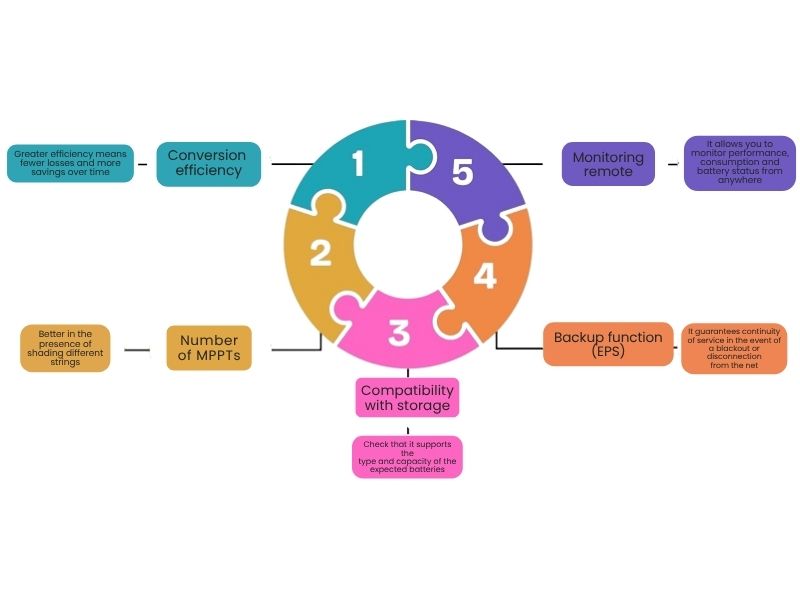
Key factors to consider when choosing a hybrid inverter.
Aspects to Consider for Installing a Hybrid Inverter on Roof and Ground Photovoltaic Systems
A correct installation is essential to ensure the optimal performance and longevity of a hybrid inverter. Its position, environmental conditions, and the quality of electrical connections directly affect the safety and efficiency of the entire photovoltaic system.
The main aspects to consider are:
- positioning and ventilation: the inverter must be installed in a dry, well-ventilated environment and protected from heat sources or direct sunlight. The ideal location is a technical room or a covered external wall, with sufficient space to ensure air circulation around the device. Good ventilation prevents overheating and helps maintain stable conversion efficiency, especially during the warmer seasons. In ground-mounted systems or large-scale installations, it is recommended to provide cabinets or protective structures that reduce exposure to rain, dust, or weather conditions. The inverter must also be mounted at an appropriate height to allow proper cable inspection and safe periodic maintenance;
- electrical connections and protection: proper wiring is essential to ensure safety and reliability. It is important to:
- comply with the cable cross-sections specified by the manufacturer;
- install DC- and AC-side protection switches;
- check the polarity of the connections to the modules and batteries;
- provide a grounding system that complies with current regulations.
Modern hybrid inverters are often equipped with integrated diagnostic systems that report any anomalies or installation errors. A thorough check during start-up prevents damage to electronic components and ensures correct synchronization with the power grid or the energy storage system.
- accessibility and maintenance: it is good practice to provide a clear and safe access area for routine maintenance, firmware updates, or component replacements. Periodic checks should include:
- cleaning the ventilation filters;
- checking the terminals and connections;
- verifying proper communication with remote monitoring systems.
In projects involving sloped roofs or complex roofing structures, it is advisable to position the inverter in an easily accessible location, even if this requires the use of extensions for the DC cables. This simplifies maintenance activities and reduces system downtime;
- safety and regulations: every installation must comply with CEI technical standards and local provisions concerning grid connection. It is important to verify the device’s compatibility with the electricity grid operator and use inverters with CE certification and compliance with CEI 0-21 or CEI 0-16, depending on the power of the system.
Advantages of Hybrid Inverters in the Energy Strategies of NZEB and Smart Buildings
In new generation buildings, such as NZEB (Nearly Zero Energy Buildings) and smart buildings, intelligent energy management is a fundamental aspect of design. In this context, the hybrid inverter plays a strategic role: it is the element that enables real-time coordination of production, storage, and consumption, transforming a simple photovoltaic system into a dynamic and adaptive system.
Thanks to its ability to manage energy flows bidirectionally, the hybrid inverter allows for:
- maximizing self-consumption, reducing withdrawals from the grid and optimizing operating costs;
- stabilizing the building’s internal grid, maintaining a constant voltage even in case of variations in solar production;
- reducing the overall environmental impact, promoting energy self-sufficiency and reducing CO₂ emissions;
- integrating smart functions such as load scheduling, priority management of batteries or electric vehicles, and remote consumption monitoring.
From the designer’s perspective, a hybrid inverter represents an open and scalable solution, perfectly integrable with BEMS (Building Energy Management Systems) and home automation systems.
In an NZEB building, for example, it can help ensure the nearly zero energy balance required by regulations, while in a smart building, it can become an active part of a network of interconnected devices that communicate with each other to optimize comfort and performance.

Main benefits of using a hybrid inverter in photovoltaic systems.
In conclusion, the hybrid inverter is the technological key that makes it possible to move from a “traditional” photovoltaic system to an advanced energy ecosystem capable of combining sustainability, efficiency, and digital intelligence.
To design photovoltaic systems with energy storage in a simple and professional way, try the complete, intuitive photovoltaic software, designed for today’s professionals.
FAQ- Hybrid Inverters
What is a hybrid inverter?
A hybrid inverter is a device used in photovoltaic systems that converts the direct current generated by the panels into alternating current for household use and simultaneously manages the energy stored in the batteries. In this way, it coordinates energy production, storage, and consumption within the same system.
What is a hybrid inverter used for in a photovoltaic system?
It is used to intelligently manage the energy produced by solar panels. The energy can be used directly by the building’s loads, stored in batteries for later use, or fed into the electrical grid when production exceeds consumption.
What is the difference between a hybrid inverter and a traditional photovoltaic inverter?
The main function of a traditional photovoltaic inverter is to convert the direct current from the panels into alternating current. In addition to performing this function, a hybrid inverter also manages the energy storage system and coordinates energy flows between the panels, batteries, loads, and electrical grid.
How does a hybrid inverter work during the day?
During solar production hours, the energy generated by the panels directly supplies the building’s loads. Any excess energy is stored in the batteries. When the batteries are fully charged, the energy can be fed into the grid. In the evening or when solar production is insufficient, the inverter uses the stored energy or draws energy from the electrical grid.
Can a hybrid inverter also operate in the event of a blackout?
Some models are equipped with an EPS (Emergency Power Supply) function, which allows priority loads to be powered even when there is no supply from the electrical grid. This function ensures continuity of power supply for essential devices or systems.
What types of systems are hybrid inverters used in?
Hybrid inverters can be used both in photovoltaic systems connected to the electrical grid (on-grid) and in standalone systems (off-grid). Thanks to their ability to simultaneously manage production, storage, and the grid, they are particularly suitable for more advanced energy systems.
What are the advantages of a hybrid inverter?
The main advantages include the ability to increase self-consumption of the energy produced, reduce electricity drawn from the grid, integrate energy storage systems, and intelligently manage energy flows between production, consumption, and the grid.
What technical features should be considered when choosing a hybrid inverter?
It is important to consider several technical aspects, including conversion efficiency, the number of MPPTs for optimizing photovoltaic module production, compatibility with energy storage batteries, the availability of backup functions, and remote monitoring and management capabilities.
Are hybrid inverters suitable for NZEB buildings and smart buildings?
Yes. In NZEB buildings and smart buildings, the hybrid inverter plays a central role in energy management because it enables the coordination of photovoltaic production, energy storage, and consumption, helping to improve energy efficiency, energy independence, and sustainability.


