
PV Inverter: Understanding Photovoltaic Inverters
Discover all the features of photovoltaic inverters and use this guide to choose the best one for your project
In the vast landscape of solar energy, PV inverters play a crucial role, acting as the pulsating heart in photovoltaic systems. In this article, we will delve into the fundamental role of inverters in the solar energy generation process and their necessity in converting direct current (DC) into usable alternating current (AC).
At the end of this article, you can also watch two short videos showing you how to operate with a tool for the design of photovoltaic systems and, consequently, how to choose and configure an inverter.

Photovoltaic system with 3D BIM modeller
Contents
What is a Photovoltaic System
Before delving into the inverter and all its features, let’s provide a brief introduction to the photovoltaic system.
A photovoltaic system is an advanced electrical system that harnesses an inexhaustible resource like the sun and can be mainly divided into two categories:
- Grid-connected systems
- Integration with residential or industrial conventional electrical systems;
- Alternate or combined use with the electrical grid to meet the energy needs of the end user;
- Stand-alone systems
- Designed with battery systems to ensure service continuity, ensuring energy delivery even during nighttime or insufficient solar irradiance.
Electricity Production from a Photovoltaic System
A photovoltaic panel contains photovoltaic cells that convert solar energy into electricity. These cells, made of semiconductors like silicon, form solar modules. When they absorb sunlight, they release electrons, the basis of electricity. Electrons moved through the semiconductor create a charge imbalance, generating a voltage potential similar to a battery.
Main Components of a Photovoltaic System
The photovoltaic system consists of the following elements:
- Photovoltaic modules – capture solar energy to produce electricity;
- Module support structures – support and fix modules to the roof, optimizing solar exposure;
- Inverter – transforms the direct current (DC) produced by the modules into usable alternating current (AC) for residential or industrial use. It uses protection devices to ensure the safety of the system;
- Electrical cables – transport energy from the system to end users.
Additionally, there are additional components such as the following:
- Monitoring system – enables remote monitoring of production, consumption, and inverter status;
- Storage system – an innovative system to improve efficiency, allowing the storage of energy produced during the day for use during periods without solar production, maximizing self-consumption.
Photovoltaic systems, in addition to generating sustainable energy, incorporate additional technologies to optimize performance and offer innovative solutions in the field of energy production and storage.
What is a PV Inverter
The photovoltaic inverter, also known as a solar inverter, represents an essential component of a photovoltaic system. Without it, the electrical energy generated by solar panels would be inherently incompatible with the domestic electrical grid and the devices we intend to power through self-consumption.
Its main function is to convert the direct current (DC) produced by solar panels into alternating current (AC), making it suitable for daily use in our homes. Without this transformation, the generated energy would remain impractical for domestic use.
But the inverter is not just a current converter; it is much more. It optimizes the overall energy production, ensuring that the photovoltaic system operates at its maximum potential. This optimization not only maximizes the system’s efficiency but also allows for a smarter use of solar energy, reducing waste and maximizing performance.
Moreover, the inverter is necessary to fulfill other crucial aspects, such as:
- Optimization of energy production: This optimization is essential to maximize the overall performance of the system;
- Provision of integrated protection devices: Every PV inverter is equipped with integrated protection devices. These components are essential to ensure the safety of the solar system in case of faults or short circuits. The presence of such safety mechanisms is fundamental for the long-term protection of the entire system;
- Advanced monitoring function: The PV inverter is not just a converter and a protection device. It also performs a comprehensive monitoring function of the solar system. Thanks to this advanced feature, we can promptly identify faults or malfunctions in electricity production, allowing for timely interventions to maintain system efficiency.
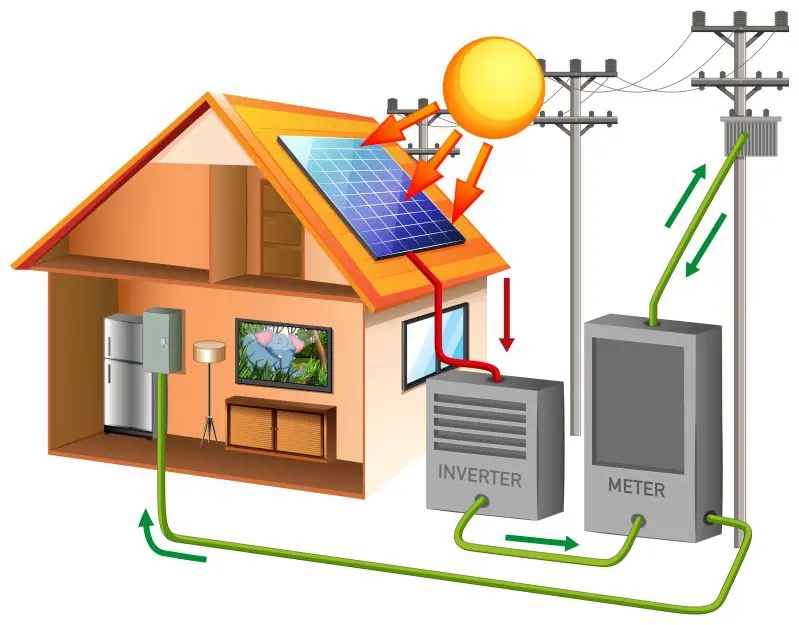
Photovoltaic energy production scheme
How Does a PV Inverter Work
Now that we have outlined the fundamental functions of photovoltaic inverters, let’s take a closer look at their operational process and the requirements for correct installation.
Photovoltaic solar panels convert sunlight into electricity, but this is direct current, unsuitable for domestic use. The photovoltaic inverter becomes the protagonist, being vital for solar installations as it converts direct current into alternating current. This process allows integrating solar energy into our homes.
Some key aspects to consider before installing a PV inverter include:
- Proper operation of domestic electrical circuits: Ensure that domestic electrical circuits are in excellent condition to ensure effective integration of the inverter;
- Optimal placement of the PV inverter: The placement of the inverter is critical to ensure optimal performance. The choice of location must be carefully evaluated;
- Electrical connections between inverter and home electrical panel: Correct connection between the inverter and the home electrical panel is essential to ensure safe energy distribution;
- Adequate sizing of the inverter: Proper sizing of the inverter is crucial to adapt to the specific needs of the photovoltaic system.
To fully understand the operation of the photovoltaic inverter, it is essential to consider that the domestic grid uses alternating current with specific parameters: 230 volts and 50 Hz.
The operation of the inverter can be likened to a combination of an alternator and a transformer, with the addition of a circuit involving transistors, Mosfet, or IGBT. Components such as microcontrollers, oscillators, and amplifiers are essential to maximize efficiency and safety in converting from direct current to alternating current, preventing issues such as overvoltage and short circuits.
Types of Photovoltaic Inverters
Let’s further explore the different types and specific applications of each model.
Single-phase and three-phase inverters
Single-phase and three-phase inverters represent two distinct solutions for energy management in a photovoltaic system, differing mainly in the number of electrical phases they operate with and their capacity for energy distribution.
Single-phase inverters, designed to operate with a single phase at 230V, are ideal for homes and small offices, offering simple installation and a low cost. However, these inverters have limits in terms of deliverable power, generally not exceeding 6 kW, making them less suitable for large-scale systems.
In contrast, three-phase inverters, operating with three phases and a voltage of up to 400V, ensure a more balanced and efficient energy distribution, reducing losses and improving the stability of the electrical grid. These devices are the ideal choice for commercial, industrial installations, or large residential buildings that require greater load management capacity. Furthermore, thanks to the division of power across three lines, three-phase inverters allow for a more homogeneous use of energy, avoiding overloads on a single phase and optimizing the overall performance of the system. Although the installation of a three-phase inverter involves a higher cost and greater technical complexity compared to a single-phase model, its use can lead to significant long-term benefits, especially in contexts with high energy consumption.
The choice between single-phase and three-phase inverters therefore depends on the specific needs of the system: for a house with standard energy requirements, a single-phase inverter may be sufficient, while for larger systems or future expansions, a three-phase inverter represents a more efficient and sustainable solution.
Grid-Tie Inverter
Grid-tie inverters represent an essential technology for the integration of renewable energy into the electrical grid, aligning the voltage and frequency with those of the public network.
One of the key features of grid-tie inverters is their ability to perfectly synchronize with the electrical grid, ensuring a safe and efficient injection of energy. Additionally, these inverters are equipped with an automatic disconnection mechanism that shuts them down in the event of a blackout to avoid the risk of electrocution for technicians working on the grid.
From an economic perspective, grid-tie inverters allow for reduced energy costs thanks to net metering systems, which enable owners of photovoltaic systems to sell excess energy back to the grid, receiving credits or compensations on their bills.
There are different types of grid-tie inverters:
- with transformer – provide galvanic isolation between the DC and AC sides
- without transformer – more compact and efficient but with specific safety measures to prevent failures.
Some advanced models integrate MPPT (Maximum Power Point Tracking) technology, which optimizes energy production based on environmental conditions, increasing the overall efficiency of the system. Thanks to their ease of installation, reliability, and high efficiency, grid-tie inverters are an ideal choice for residential and commercial applications, contributing to the spread of solar energy and the reduction of dependence on fossil fuels.

Photovoltaic system with Grid-Tie inverter
Stand-Alone Inverter
Stand-alone inverters (also known as off-grid inverters) are essential devices for energy conversion in the absence of a connection to the electrical grid.
These systems are used in various contexts, including remote homes, campers, boats, and renewable energy systems such as solar and wind. Their main function is to ensure a stable and reliable power supply by autonomously creating the voltage and frequency necessary for the operation of electrical devices.
There are several types of stand-alone inverters, including:
- square wave – economical but not suitable for sensitive devices
- modified sine wave – which represent a compromise in terms of quality and cost
- pure sine wave – which offer high-quality energy, similar to that of the electrical grid.
Among the main advantages of these inverters are independence from the grid, the ability to integrate renewable sources, and flexibility of use. However, the reliability of these systems depends on the capacity of the batteries and their management, as well as the efficiency of the conversion process.
To ensure safety and optimal performance, many modern models include protections against overloads, short circuits, and overheating, making them a robust solution for off-grid energy.

Photovoltaic system with Stand-Alone inverter
Hybrid Inverter
The hybrid inverter is an advanced solution for solar energy management, combining the functionalities of a traditional inverter with a storage system.
This device is capable of converting the energy produced by photovoltaic panels into alternating current for domestic use, while regulating the storage of energy in batteries, ensuring a more efficient use of solar production.
Its operation dynamically adapts to energy needs:
- in case of production surplus, the inverter charges the batteries;
- when the batteries are full, excess energy can be fed into the grid.
If, on the other hand, solar production is not sufficient to cover consumption, the stored energy is used to supplement the demand, thus reducing dependence on the electrical grid.
Among the main advantages of the hybrid inverter are the optimization of self-consumption, the reduction of energy costs, and the possibility of integrating off-grid systems for areas not served by the grid. There are different types of hybrid inverters:
- with integrated charger – they intelligently manage the charging process
- inverters specifically designed for interfacing with the public grid.
Their versatility allows for both residential and commercial applications, with models ranging from 1.5 kW to over 10 kW. Additionally, some advanced systems allow for powering charging stations for electric vehicles, further contributing to energy sustainability.
Thanks to their ability to balance production, consumption, and storage, hybrid inverters represent a fundamental technology for maximizing the efficiency and convenience of renewable energy.
Microinverter
Microinverters represent a significant innovation in photovoltaic systems, offering an efficient and flexible alternative to traditional string inverters. These devices are installed directly on each individual solar panel, converting direct current (DC) into alternating current (AC) immediately, without having to pass through a centralized inverter. This approach allows for the optimization of energy production for each panel, regardless of shading conditions, dirt, or degradation, improving the overall efficiency of the system.
One of the main advantages of microinverters is the ability to monitor the performance of each panel in real time, facilitating the diagnosis of any issues and reducing maintenance costs. Furthermore, operating at lower voltages compared to string inverters, microinverters enhance the safety of the system, reducing the risk of electrical failures and fires.
Another crucial aspect is the increased design and installation flexibility: thanks to microinverters, panels can be oriented in different directions without compromising overall efficiency, making them ideal for complex or partially shaded roofs.
Although the initial cost is generally higher than that of string inverters, microinverters offer greater longevity (with warranties often exceeding 20 years) and improved energy yield over the long term, resulting in a quicker return on investment. For these reasons, microinverters are becoming an increasingly popular choice for both residential systems and small commercial installations, where optimizing produced energy and system scalability are key factors.
How to Configure a PV Inverter
Below, you can find two videos showing you how to choose and configure an inverter, using a software for the design of photovoltaic systems.
Inverter Selection
Inverter Configuration
FAQ
What is a photovoltaic system?
A photovoltaic system is a system that converts solar energy into electricity through photovoltaic modules. There are two main types: grid-connected systems, which integrate solar energy with the electrical grid, and stand-alone systems, equipped with batteries to operate independently even in the absence of sunlight.
How does a photovoltaic system work?
Solar panels capture sunlight and, thanks to silicon photovoltaic cells, convert it into electricity in the form of direct current (DC). This is then converted into alternating current (AC) by an inverter, making it usable for residential or industrial appliances.
What is a photovoltaic inverter and what is it used for?
The photovoltaic inverter is the fundamental component that converts the direct current (DC) generated by solar panels into alternating current (AC), necessary to power electrical devices. Additionally, it optimizes energy production, ensures the safety of the system, and allows for performance monitoring.
What are the main types of photovoltaic inverters?
- Single-phase and three-phase inverters – the former are suitable for residential users with standard consumption, while the latter are ideal for larger or commercial systems.
- Grid-tie inverters – connected to the electrical grid, they allow for the sale of excess energy.
- Stand-alone inverters – designed for isolated systems, they provide energy even without an electrical grid.
- Hybrid inverters – combine the functions of a traditional inverter with a battery storage system to maximize self-consumption.
- Microinverters – installed directly on each panel, they improve efficiency and energy management in shading or dirty conditions.
How to choose the most suitable inverter for your system?
The choice of inverter depends on various factors, including the power of the system, the type of connection to the grid, and self-consumption needs. A single-phase inverter is sufficient for small homes, while a three-phase is more suitable for buildings with high consumption. If you want to maximize energy independence, a hybrid inverter with a storage system may be the ideal solution.
Does the inverter need maintenance?
Yes, periodic maintenance is essential to ensure the efficiency and longevity of the system. It is advisable to regularly check the status of connections, ventilation, and the performance of the inverter through the integrated monitoring system.
What happens in case of a blackout?
Grid-tie inverters automatically shut down for safety, while stand-alone and hybrid inverters with batteries allow you to continue using the stored energy, ensuring service continuity.


