
Electrical Grid Design: Complete Guide with BIM & GIS Integration
Designing electrical grids with BIM-GIS technologies allows for improved planning, management, and operation of infrastructures. Here is the complete guide

The design of an electrical grid requires an integrated approach that combines technical skills, regulatory knowledge, and advanced digital tools. The evolution towards more efficient, resilient, and sustainable systems necessitates moving beyond traditional methods and adopting technologies capable of managing large amounts of data and ensuring accuracy at every stage of the project.
Among these, BIM (Building Information Modeling) and GIS (Geographic Information System) enable the coordinated representation of electrical infrastructures and enhance analysis, planning, and maintenance activities.
This guide provides a comprehensive overview of electrical grid design: from reference regulations to innovations such as smart grids and microgrids, to the integration of BIM and GIS as a key to more efficient and sustainable design.
For advanced geospatial management of buildings and infrastructures, rely on a Geospatial Digital Twin platform. This solution integrates technical and territorial data into a single digital environment and offers a complete view of electrical grids, with more effective control over activities and decision-making processes.
Contents
- What does electrical grid design mean?
- Regulations for electrical grid design
- Components and architecture in electrical grid design
- Innovations and Modernization in Electrical Grid Design
- Tools and Methodologies for Electrical Grid Design
- Integration between BIM and GIS in electrical grid design
- Advantages of optimal electrical grid design
- FAQ on electrical grid design
What does electrical grid design mean?
The design of an electrical grid represents a sophisticated, multidimensional engineering endeavor that integrates complex technical, economic, and environmental considerations. This holistic approach encompasses comprehensive planning, advanced modeling, and strategic implementation of energy distribution infrastructure, with the paramount objectives of ensuring safe, efficient, and uninterrupted power transmission. By meticulously analyzing technological capabilities, economic feasibility, and ecological impact, engineers develop resilient grid systems that not only meet current energy demands but also anticipate future technological and sustainability requirements.
Designing an advanced electrical grid involves a multifaceted approach that encompasses:
- configuration of transmission and distribution lines;
- selection of components (cables, transformers, electrical panels);
- management of loads and energy losses;
- safety measures to prevent failures and blackouts.
Regulations for electrical grid design
The design of an electrical grid must comply with a set of technical and safety regulations that ensure the reliability of the system and the protection of people, property, and the environment.
These regulations establish specific criteria for the construction, maintenance, and verification of electrical infrastructures, which vary based on the country and the context of application (civil, industrial, or public).
The regulations cover aspects such as:
- sizing and installation of cables;
- protection against overvoltages and short circuits;
- safety in workplaces and accessibility of systems;
- energy efficiency and environmental compatibility.
Worldwide, technical standards represent an essential reference for every professional in the electrical sector.
Components and architecture in electrical grid design
Electrical grid design requires a comprehensive view that considers both the physical components and the architecture of the system, meaning how these elements are connected and interact with each other to ensure continuity and quality of service.
An electrical grid consists of different functional levels, each with a specific role:
- production: includes traditional power plants and renewable energy sources, such as photovoltaic or wind;
- transmission: deals with the transport of high-voltage energy over long distances, through lines and switching stations;
- distribution: manages the delivery of energy to end users (civil, industrial, or commercial) via medium and low voltage networks;
- utilization and control: includes monitoring, protection, and automation systems, which ensure the stability and safety of the entire grid.
The network architecture can be designed according to different configurations (radial, ring, or mesh), based on the needs for reliability, service continuity, and cost. Effective design optimizes energy losses, improves maintenance, and minimizes the risk of interruptions.

Functional levels of the electrical network
Innovations and Modernization in Electrical Grid Design
In recent years, electrical grid design has undergone a profound evolution thanks to the spread of digital technologies, automation, and renewable sources. The goal is no longer just to ensure energy supply but to create intelligent, sustainable, and resilient systems capable of adapting in real-time to changes in demand and operational conditions.
The main innovations concern two key directions: smart grids and microgrids.
Smart Grids and Digitalization
Smart grids represent the evolution of traditional electrical networks in a digital and interactive key. Thanks to the integration of sensors, communication systems, and data analysis platforms, smart grids allow for:
- real-time monitoring of production and energy consumption;
- optimizing the balance between supply and demand;
- quickly identifying faults or inefficiencies;
- supporting the integration of distributed renewable sources.
Digitalization, combined with the use of artificial intelligence and predictive analytics, enables grid operators to make faster and more informed decisions, aiming to improve the reliability, efficiency, and sustainability of the grid.
Microgrids and Integration of Renewables
Microgrids are local electrical networks, either autonomous or connected to the main grid, that integrate production, storage, and energy consumption into a single intelligently managed infrastructure. They are particularly useful in industrial, residential, or isolated contexts, where they can ensure service continuity even in the event of interruptions to the general grid.
The main advantages of microgrids include:
- greater energy autonomy and supply security;
- the possibility of integrating renewable sources (such as solar and wind);
- reduction of transmission losses and operational costs;
- contribution to decarbonization and the energy transition.
These innovations make electrical grid design increasingly intelligent, flexible, and sustainable, fostering the emergence of new energy management models.

Potential of Smart Grid and Microgrid
Tools and Methodologies for Electrical Grid Design
The design of an electrical grid increasingly relies on the use of integrated digital tools, which allow for the coordinated management of data, models, and territorial information.
Among the most innovative and widespread are BIM (Building Information Modeling) and GIS (Geographic Information System), two technologies that, although developed for different purposes, both contribute to improving accuracy, efficiency, and collaboration in the design process.
BIM for Modeling and Data Management
BIM represents a transformative digital design methodology that transcends traditional engineering approaches by creating comprehensive, intelligent three-dimensional models of electrical infrastructure. Some key strategic advantages of BIM in Electrical Grid Design include:
- accurate representation of various components (substations, cable ducts, equipment, etc.);
- integration between electrical systems and civil works;
- coordinated management of time, costs, and maintenance;
- reduction of errors thanks to interdisciplinary collaboration.
Thanks to BIM, the project becomes a digital twin of the real infrastructure, useful not only during the design phase but also during the management and operation of the system.
GIS for Territorial Analysis and Planning
GIS is a tool that allows for analyzing, managing, and visualizing geospatial data. In the design of an electrical grid, GIS is essential for:
- identifying optimal routes for lines and connections;
- assessing territorial and environmental constraints (protected areas, existing infrastructure, terrain morphology);
- supporting urban and energy planning;
- monitoring over time the state of infrastructures and areas of intervention.
The integration of GIS into design processes allows for decisions based on real data, improving the safety, sustainability, and coherence of the project with the territorial context.

BIM and GIS for electrical grid design
Integration between BIM and GIS in electrical grid design
The integration between BIM and GIS represents one of the key steps in the digitalization of electrical grids. Combining the technical data of BIM with the geographical information of GIS allows for a comprehensive view of the infrastructure, both from a construction and territorial perspective.
In practice:
- BIM provides the detailed three-dimensional model of electrical components and civil works;
- GIS integrates these models into the real geographical context, analyzing environmental constraints, existing networks, and territorial scenarios.
The union of the two environments allows for:
- improving coordination among designers, authorities, and network operators;
- optimizing planning and maintenance of infrastructures;
- simplifying the lifecycle management of the work, from design to decommissioning;
- promoting more informed decisions in terms of sustainability and resilience of the electrical system.
The interoperability between BIM and GIS marks the evolution towards an integrated digital environment, where technical and geographical data communicate in real-time to support decisions based on complete and updated information.
Advantages of optimal electrical grid design
A careful and innovative electrical grid design represents a strategic investment for companies, authorities, and energy system operators. A well-planned project ensures safety, efficiency, and sustainability, reducing costs and improving long-term performance.
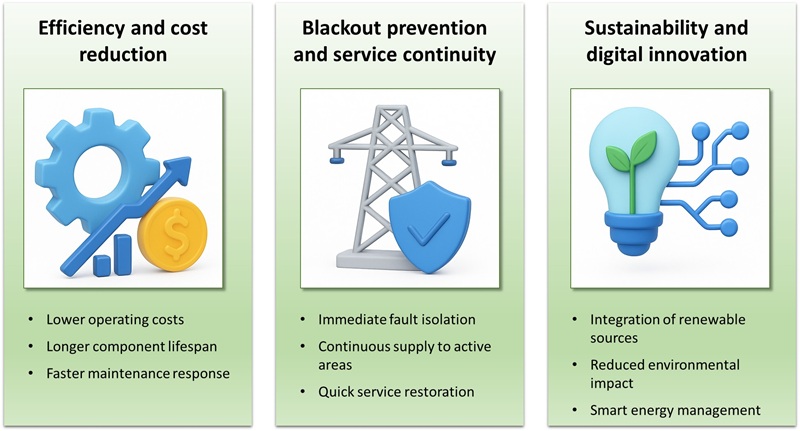
The main advantages concern three fundamental areas: operational efficiency, service continuity, and sustainable innovation.
Efficiency and reduction of operational costs
A well-conceived electrical project allows for optimizing energy flows and minimizing losses, waste, and unplanned maintenance. Through accurate load analysis, the choice of suitable materials, and the correct configuration of lines, it is possible to:
- decrease operating and maintenance costs;
- increase the lifespan and reliability of components;
- reduce response times in case of failure.
Design efficiency thus translates into concrete economic savings and a more sustainable management of energy resources.
Blackout prevention and service continuity
A well-designed electrical grid is essential to ensure service continuity and reduce the risk of interruptions or blackouts. Through careful planning of alternative routes, protection systems, and monitoring, it is possible to:
- quickly isolate fault zones;
- keep unaffected areas active;
- restore service in short times.
The introduction of digital and automated solutions also allows for predicting anomalies before they occur, improving the overall resilience of the electrical system.
Sustainability and digital innovation
Today, the design of electrical grids is increasingly oriented towards environmental sustainability and digital innovation. The adoption of technologies such as BIM, GIS, smart grids, and storage systems enables:
- promoting the integration of renewable sources;
- reducing the environmental impact of infrastructures;
- improving overall energy management;
- promoting a more efficient and responsible development model.
Advantages of optimal electrical grid design
The integration between BIM and GIS is just the first step towards the complete digitalization of the electrical sector. With a Geospatial Digital Twin platform, the electrical grid becomes a living system, updated in real-time and capable of predicting, analyzing, and optimizing every intervention. Discover how this solution can revolutionize the management of energy infrastructures.
FAQ on electrical grid design
What is the design of an electrical grid?
The design of an electrical grid encompasses all the activities necessary to plan, model, and implement the infrastructure that distributes energy safely and efficiently. It involves technical, economic, and environmental analyses to ensure reliability, sustainability, and continuity of service.
Which regulations govern the design of electrical grids?
Electrical grids must comply with technical and safety standards issued by bodies such as CEI, UNI, and ISO. These define criteria for sizing, protection, energy efficiency, and maintenance.
What is the difference between BIM and GIS in electrical grid design?
BIM manages the technical and three-dimensional data of the infrastructure, allowing for accurate and interdisciplinary modeling. GIS, on the other hand, analyzes and visualizes geographic and territorial information, which is useful for planning, tracing lines, and assessing environmental constraints. Integrated, BIM and GIS provide a comprehensive — technical and geospatial — view of the electrical grid.
How does BIM-GIS integration improve electrical design?
By combining BIM models with GIS data, a unique information system is created, updated in real-time and capable of linking infrastructures and territory. This approach improves coordination among professionals, optimizes maintenance, and promotes decisions based on accurate and contextualized data.
What role do smart grids and microgrids play in modern design?
Smart grids introduce digital technologies and sensors that enable monitoring and dynamic management of the grid. Microgrids, on the other hand, are local networks that integrate production, storage, and consumption, ensuring continuity even in the event of disruptions. Both make infrastructures more efficient, flexible, and sustainable.
What are the main advantages of digital electrical design?
The use of digital technologies such as BIM, GIS, and Geospatial Digital Twin platforms allows for reduced errors, improved maintenance, cost optimization, and increased safety. Furthermore, it supports the energy transition through the integration of renewable sources and intelligent energy management.


