
Digital restoration of St Peter’s Basilica: the 2025 Jubilee case study
Discover the digital restoration of the Fabbrica di San Pietro through 3D surveying, BIM, digital twins, and documentation for future preservation

The digital restoration applied to architectural heritage is not simply about creating a 3D model. It is a process that integrates surveying, historical information, diagnostic analyses, documentation of interventions, and monitoring within a searchable digital environment. The case of the Basilica of San Pietro concretely demonstrates how these technologies can support the knowledge of restorers and craftsmen without replacing it.
In this article, we will see how the Fabbrica di San Pietro has utilized 3D surveys, photogrammetry, point clouds, BIM methodology, and digital twins to document and support some of the most complex restoration activities of the Basilica. From the digital model of Bernini’s Baldachin to the mapping of diagnostic information, up to the ability to preserve the memory of interventions and plan future maintenance, the project shows how digital architectural restoration can accompany all phases of the process, from initial knowledge to the management of the asset over time.
The journey is inspired by the Study Day “The Fabbrica di San Pietro: Works in Preparation for the Jubilee Between Memory and Transition,” held on May 14, 2025, at FERRARA EXPO. Organized and curated by Alberto Capitanucci and Pietro Zander, key figures of the Fabbrica di San Pietro, the conference featured the participation of authoritative representatives from the academic, ecclesiastical, and monumental restoration worlds: among the institutional greetings, those from Alessandro Ippoliti, Alessandro Bozzetti, Marco Mulazzani, Massimo Manservigi, Renata Picone, and Arianna Cajano emphasized the strategic and symbolic importance of this intervention, which is not only technical but also cultural, spiritual, and identity-related.
The presentations followed one another in an immersive journey between tradition and innovation: from Peter’s Tomb to Bernini’s Baldachin, from the painted ceilings to the papal altars, each intervention was presented with methodological rigor and an openness to the new digital frontiers of restoration. The talks by experts such as Sante Guido, Giorgio Capriotti, Fabio Morresi, Guido Cianciulli, Giovanni Nicoli, and Giovanni Cavallo outlined a detailed picture of the work done and the future challenges, with particular attention to sustainability, scientific diagnosis, and three-dimensional documentation.
This conference was not just a technical update, but a true methodological manifesto: it showed how the Fabbrica di San Pietro is profoundly renewing the way it conceives, documents, and communicates restoration, marking an epochal transition towards an integrated model of protection, enjoyment, and knowledge. A Fabbrica that, in anticipation of Jubilee 2025, not only restores stone and metal but also rewrites the way to tell and protect history.
Contents
- Digital Architectural Restoration: What It Means
- Restorations for the Jubilee 2025: A New Era for the Fabbrica di San Pietro
- Digital Technologies for Restoration: From Photogrammetry to Digital Twins
- From artisanal tradition to sustainable solutions
- Plasters and decorations: experimental protocol for Michelangelo’s dome
- A cultural and technological transition: the future of restoration at St. Peter’s
- FAQ – Digital Restoration
Digital Architectural Restoration: What It Means
In digital architectural restoration, BIM, 3D surveying, photogrammetry, and digital twins become tools to build and preserve the memory of the asset. The model does not only represent geometries: it can relate every element to historical documents, photographs, diagnostic investigations, material information, degradation phenomena, and interventions carried out.
As highlighted by the experience of the Fabbrica di San Pietro, this memory can be directly associated with the represented object and made queryable. A particularly important aspect because no restoration can be considered definitive: being able to know in the future what has been done, where, and why means transferring to future generations an essential part of the conservation process.
Restorations for the Jubilee 2025: A New Era for the Fabbrica di San Pietro
The construction site for the Jubilee 2025 marks the entry of the Fabbrica di San Pietro into a new era of conservation, where the protection of heritage is based on three pillars: respect for the material, methodological innovation, and cognitive accessibility. A replicable model that makes St. Peter’s Basilica not only a place of worship but a living laboratory of science, history, and future.
St. Peter’s Basilica represents a logistical and scientific challenge with its 22,000 m² of surface area and 1 million m³ of volume and requires interventions at “high altitude.” The telescopic and suspended scaffolding, designed not to interfere with the liturgies, symbolizes a constant attention to the spiritual function of the place. This is where technique meets devotion.
In this context, the restorations are structured in a series of targeted interventions, affecting some of the most symbolic and complex places in the Basilica. Each action is the result of a synergy between advanced technical skills and deep historical awareness, embodying a conservation that is both respect and innovation.
Key Interventions: From the Baldachin to the Tomb of Peter
Among the works involved, some emblematic interventions stand out that tell the story of the material-specific approach adopted in the Jubilee construction site:
- the Baldachin by Bernini – material-specific restoration:
a baroque icon standing 30 meters tall, subjected to a sophisticated restoration: micro-sandblasting with walnut shells, selective cleanings with green solvents, and consolidations with microcrystalline waxes. While cleaning the surfaces, surprising details such as carved insects re-emerged, testimonies of Bernini’s theatricality; - the Chair of Peter – light and structure in balance:
thanks to micro-injections of resins and laser cleanings, the gilding has returned to interact with the light of the alabaster of the glory window. An operation carried out without replacing the original wooden anchoring points; - the papal tombs and the Pietà – protection and transparency:
the tombs of Paul III and Urban VIII have been treated with chelate technologies and bacterial biocleaning. Michelangelo’s Pietà is now protected by a UV-resistant laminated glass case, ensuring protection without losing the emotional impact of the artwork.
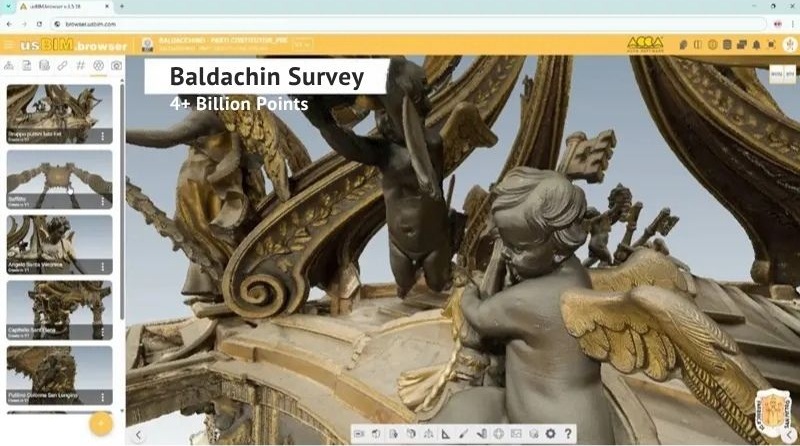
Survey of the Baldachin – Restorations for the Jubilee 2025
Digital Technologies for Restoration: From Photogrammetry to Digital Twins
The technological evolution applied to restoration has opened new possibilities for knowledge, preventive conservation, and the enhancement of heritage. At the Fabbrica di San Pietro, digital technologies are not just simple support tools but components of an integrated strategy that allows for the detection, documentation, and monitoring of the asset over time.
From 3D Survey to the Point Cloud of the Basilica
The process starts from the survey. For the Basilica, laser scanning, LiDAR, and photogrammetry techniques were used, with traditional and drone photography acquisitions. The result is a three-dimensional representation of extremely high precision on which to build subsequent knowledge and restoration activities.
The overall survey of the Basilica includes over 22 billion points and allows exploration of both the exterior and interior of the monument. For the Baldacchino di Bernini alone, a cloud composed of over 4 billion points was created. The model was subsequently organized into 71 parts, identified through names and codes, so that different elements of the project can be consulted and analyzed separately.
It is at this stage that the survey ceases to be merely a geometric representation: through segmentation and association of information to individual elements, the point cloud progressively becomes a informational model of the heritage.
Digital Documentation of Restoration: A Queryable Archive
One of the most significant applications concerns the digital documentation of restoration. The model can function as a true archive: to each object, information, data sheets, photographs, and historical documentation from the archives of the Fabbrica di San Pietro can be associated.
In the case of clouds obtained through photogrammetry, it is also possible to trace back to the photographs that generated the model. By selecting a specific portion or even a specific point, the operator can retrieve the shots that document that area in greater detail. In this way, geometry and photography remain connected within the same knowledge environment.
The results of diagnostic analyses can also be transformed into informational layers and mapped directly onto the model. Construction photographs, sampling points, investigation results, annotations, and other information do not remain distributed in separate documents but can be associated with the position and the element to which they refer. In a collaborative platform, models and information also become accessible to operators involved in the process.
BIM and 3D Model for Designing the Scaffolding of the Baldachin
The digital model is not only used to document what exists. In the restoration of the Baldachin, the point cloud has been related to the BIM model of the custom-designed scaffolding. This has allowed for the assessment of possible interferences between the temporary structures and the work, checking the pathways for operators, and performing dimensional controls directly on the digital environment.
It is a concrete example of how BIM applied to restoration can evolve from simple representation to simulation and preventive verification of construction activities.
Mapping Degradation, Techniques, and Interventions Directly on the Model
For restorers, the digital model can also become the support on which to map materials, execution techniques, and conservation status. The different areas can be segmented and associated with non-geometric data, transforming traditional two-dimensional documents into three-dimensional thematic views that can be queried.
In cases where the project has a predominantly two-dimensional development, such as for some decorated surfaces, documentation can be carried out directly on ultra-high-resolution photographs. Through mobile devices, operators can map the manifestations of degradation on-site and link detailed photographs, documents, reports, schedules, audio notes, or other materials produced during the intervention.
From Digital Twin to Future Maintenance
Thanks to high-resolution photogrammetry and 3D modelling, restored elements can be documented with millimetre-level precision. The resulting digital twins — from the Chair to the Baldachin — provide a detailed record of each work and enable its conservation status to be monitored over time.
Once restoration is complete, the digital model can be updated to reflect the post-restoration state and compared with the pre-intervention version. This makes it possible to document every transformation and clearly visualise the before-and-after results, as demonstrated by the Baldachin and the Chair.
Beyond documentation, this digital information provides a foundation for maintenance planning and the integration of environmental sensor data, such as temperature and humidity, directly into the model. The vision outlined by the Fabbrica di San Pietro is one of BIM-enabled asset management that supports routine maintenance, reporting, and operational coordination through shared monitoring tools.
These developments go hand in hand with other conservation technologies already in use. In the heart of the Vatican Necropolis, advanced tunable-white LED lighting (2700–5700 K) discreetly guides visitors, while microclimatic sensors and HEPA filtration systems help safeguard both visitor health and the preservation of historic materials.
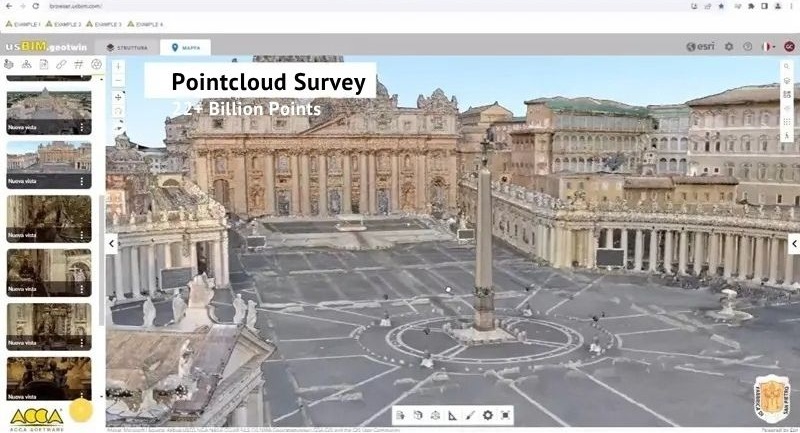
Point cloud survey – Jubilee restorations 2025
From artisanal tradition to sustainable solutions
The restoration of St. Peter’s Basilica stands out not only for the use of advanced technologies but also for the enhancement of artisanal knowledge and the adoption of sustainable solutions. Tradition and innovation meet in a multidisciplinary approach that centers on the compatibility of materials, respect for the environment, and the continuity of historical skills.
- Sanpietrini, restorers, engineers, and chemists: alongside the Sanpietrini, direct heirs of the craftsmanship since 1814, work chemists, physicists, architects, and university restorers creating a synergy of excellence. Each intervention is a mediation between material memory and methodological innovation.
- Sustainable and compatible restoration: solvents with low environmental impact, enzymatic bio-cleanings, nano-structured consolidation mortars: St. Peter’s Basilica becomes a case study of operational sustainability.
The relationship between artisanal tradition and digital technology is therefore not a contradiction. Digital technology also allows manual skills to leave behind structured and transmissible knowledge and facilitates comparison between operators working on the same asset, even at a distance.
Plasters and decorations: experimental protocol for Michelangelo’s dome
The restoration of the plasterwork of Michelangelo’s dome required a experimental approach based on advanced scientific analysis and the use of compatible materials. The operations were conducted with extreme caution to preserve the integrity of the work and ensure fully reversible interventions. In detail:
- advanced diagnostics and compatible materials: under Michelangelo’s dome, SEM-EDX, FTIR, and PLM investigations guided the consolidation with nano-lime and ammonium caseinate. Cleaning techniques, from deionized water to “synthetic saliva,” were selected to ensure maximum reversibility;
- prevention, monitoring, and climate modeling: the data loggers positioned in the dome defined the optimal thermo-hygrometric intervals, while tests on experimental tiles provided practical indications for the phases of re-adhesion and plastering.
To see up close how tradition and innovation take shape in the preservation and restoration of St. Peter’s Basilica, watch the video below:
A cultural and technological transition: the future of restoration at St. Peter’s
The restoration in view of the Jubilee is not simply a return to the past, but a profound transformation in the way heritage is interpreted, documented, and handed down. It is not just about conserving the material but developing new languages to read, manage, and narrate it. It is a transition that combines artisanal knowledge with digital precision, paving the way for a replicable model of protection and enhancement of the existing.
The central point is the continuity of knowledge. Each intervention produces information that can prove decisive for the subsequent restoration: digitally preserving the documentation, associating it with the exact location to which it refers, and making it searchable means transforming the work done today into an operational tool for those who will take care of the asset tomorrow.
For those working in the field of restoration, historical construction, or design, these contents represent a concrete resource for tackling the challenges of upgrading the built environment. Download the complete PDF of the Study Day The Fabric of St. Peter: works in preparation for the Jubilee between memory and transition to delve deeper into the content, protagonists, and cutting-edge methodologies applied to the Vatican site.
But understanding is not enough: it is also necessary to act with appropriate tools. Those involved in the recovery of historic buildings today have available hbim software with integrated modeling environments, capable of transforming surveys from point clouds, DWG/DXF files, or IFC into intelligent digital models. Through specific parametric objects (vaults, domes, wooden floors, niches, ribs), it is possible to accurately represent the current state, identify damages, reconstruct areas of deterioration, and automatically produce technical documentation, executive drawings, and 3D renders.
In a context where the existing heritage is a resource to be enhanced with intelligence and respect, having digital tools designed for recovery is not just an advantage: it is a professional necessity. Try the software to digitize and model historic buildings using HBIM tools now!
You might also be interested in usBIM.bSDDeditor, the BSDD BIM application
FAQ – Digital Restoration
What is digital restoration in architecture?
It is the integrated use of 3D surveying, photogrammetry, BIM/HBIM, information models, and documentation systems to support the knowledge, design, conservation, and maintenance of historic buildings and assets. The digital aspect supports material restoration and allows for the organization and preservation of the information produced throughout the entire process.
What is BIM used for in restoration?
BIM allows for associating information with the elements of the building or work and linking geometry, historical documentation, investigations, deterioration, and interventions. In the case of St. Peter’s Basilica, it was also used to relate the survey of the Baldachin with the scaffolding project and to pre-verify interferences and working spaces.
How is the digital documentation of a restoration created?
The digital documentation of restoration can integrate 3D surveys, photographs, BIM/HBIM models, diagnostic analyses, information on materials, and data related to interventions performed. This information can be directly associated with the model elements, creating a searchable and updatable digital archive over time.
What is the use of the point cloud in architectural restoration?
The point cloud allows for a very detailed three-dimensional representation of the current state of a building or work. In digital architectural restoration, it serves as a geometric basis for analyses, measurements, BIM modeling, deterioration mapping, and project planning. In the case of St. Peter’s Basilica, the overall survey includes over 22 billion points, while that of Bernini’s Baldachin exceeds 4 billion.
What is the role of photogrammetry in digital restoration?
Photogrammetry allows for the digital reconstruction of geometries and surfaces from photographic images. In restoration, it can be used to produce point clouds and 3D models, but also to maintain a connection between the model and the original photographs: the operator can thus consult high-resolution images related to specific areas of the work and use them for analysis and documentation.
What is a digital twin in restoration?
A digital twin is a digital representation of an asset that can integrate geometry and information related to its conservation status, interventions, and monitoring. In restoration, its value is not just representational: it can become a tool to compare the state of the asset before and after work, preserve the memory of interventions, and plan future maintenance activities.


