
IoT technology in construction: Key Applications
newsletter 471IoT technology in construction boosts productivity while reducing time and costs. Explore the primary IoT applications in the construction sector.

IoT technology is slowly making its way into the construction world, where companies and project managers are increasingly aware of its advantages in the construction workflow. But what are its applications in the construction realm? And what benefits would its implementation bring to the construction process?
Let’s discover together in this article.
Contents
What is IoT?
The Internet of Things (IoT) is a network of physical devices equipped with sensors, an internet connection, and the ability to communicate with each other. These devices can collect data from the surrounding environment and exchange information with other devices or a central system. This innovative technology is revolutionizing numerous sectors, including construction.
Imagine, for instance, a crane at a construction site equipped with sensors to monitor load, temperature, and maintenance status. These data are continuously collected and transmitted to a BIM IoT platform that allows real-time analysis and informed decision-making.
Let’s delve into how IoT offers significant potential in construction, enhancing construction project management, worker safety, and operational efficiency within the construction sector.
What are the primary IoT applications in construction?
The construction sector is known for its complex challenges, including tight deadlines, limited budgets, and the need to ensure worker safety. This is where IoT comes into play, bringing a significant wave of chan471ge.
IoT provides the construction sector with the opportunity to overcome these challenges innovatively. With the ability to connect and monitor a wide range of equipment, machinery, and structures in real-time, IoT offers project operators and managers the possibility of more efficient resource management, better planning, and enhanced workplace safety.
So, what are the latest IoT applications in construction? Let’s explore them together:
- Site monitoring: This application involves using a set of sensors to continuously and dynamically record conditions at construction sites and workplaces. Installed sensors monitor and record real-time data related to factors like temperature, humidity, noise, and vibrations. Through IoT application, it becomes possible to prevent accidents and malfunctions, thereby increasing workplace safety and compliance;
- Fleet management: It refers to managing vehicles, machinery, and equipment owned by the construction company. Such management can significantly improve efficiency through automatic monitoring of vehicles, including automatic data collection regarding their position, speed, fuel consumption, and maintenance requirements. Automating vehicle management through IoT reduces the possibility of errors and simultaneously enhances operator safety;
- Wearable IoT technologies: As the name suggests, wearable IoT technology includes devices worn by operators, such as smartwatches, AR glasses, smart helmets, etc. These devices monitor personal data and wirelessly transmit it in real-time.
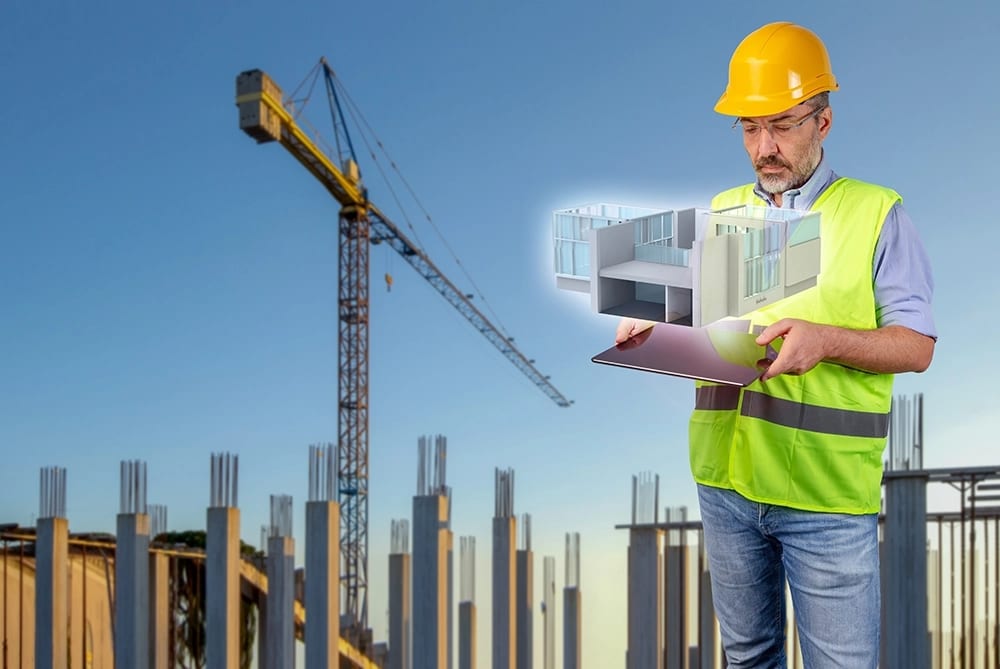
IoT in the construction sector
Site Monitoring
One of the main applications of the Internet of Things (IoT) in the construction sector is the continuous monitoring of on-site activities. Sensors, cameras, GNSS devices, and localization systems enable the real-time collection of data on site conditions, operational activities, and project progress.
Sensors can monitor a wide range of parameters, including temperature, humidity, vibrations, noise levels, particulate matter, water presence, and variations in soil conditions. The collected data is transmitted to a centralized platform, where it can be processed, visualized, and monitored through dashboards and supervision systems.
The integration of IoT data with the Building Information Model (BIM) enables the collected information to be associated with specific building elements and construction activities. This integration supports the development of an up-to-date digital representation of the construction site, allowing the actual site conditions and progress to be compared with the planned project configuration and schedule. In this way, deviations from the expected conditions can be identified more easily, supporting more informed decision-making and timely corrective actions.
Furthermore, IoT systems can generate automatic alerts whenever monitored parameters exceed predefined thresholds. For instance, sensors can notify site managers when particulate matter concentrations exceed established limits or when microclimatic conditions become unsuitable for a specific construction activity. These capabilities contribute to improving site supervision, environmental monitoring, and the overall efficiency and safety of construction operations.
Management of Equipment and Construction Gear
IoT enables better management of operating machines, construction vehicles, trucks, and equipment through localization systems and sensors installed on board.
Telematics devices can collect data related to position, operating hours, consumption, speed, engine use, and operational conditions of the machine. The information is then transmitted to software platforms that allow for monitoring the entire fleet from a single environment.
One of the most relevant aspects is the possibility of applying predictive maintenance strategies. The analysis of operating parameters can highlight abnormal variations compared to the normal behavior of the machine, allowing for scheduling an intervention before a failure occurs.
Monitoring usage also allows identifying periods of inactivity or underutilization of equipment, optimizing the assignment of machines to various operations and reducing unproductive times, energy consumption, and operational costs.
Worker Safety
In the field of occupational health and safety, IoT technologies can be employed to develop monitoring systems that support the supervision of working conditions and the localization of personnel on construction sites.
Wearable devices, such as smart helmets, smart vests, wristbands, and other connected equipment, can incorporate sensors capable of detecting various parameters, including worker position, movement, ambient temperature, and potentially hazardous conditions or abnormal events. Depending on the technology adopted, these devices can also communicate with indoor positioning systems based on Bluetooth Low Energy (BLE), Ultra-Wideband (UWB), Radio Frequency Identification (RFID), or other wireless communication technologies.
One possible application involves the implementation of geofencing systems, which define virtual boundaries around specific areas of the construction site. When a wearable device or connected asset enters or exits one of these predefined areas, the system can automatically record the event and, where configured, generate an alert. This functionality can be particularly useful for monitoring access to restricted zones and ensuring that personnel remain within authorized working areas.
IoT technologies can also support the identification and monitoring of potentially hazardous situations, such as unauthorized access to dangerous areas, proximity to operating machinery, or exposure to adverse environmental conditions. The information collected can be integrated into broader safety management systems, improving site supervision, facilitating the timely identification of critical situations, and supporting more effective safety-related decision-making.
However, it is essential to distinguish technological monitoring from the preventive and protective measures required by occupational health and safety regulations. IoT devices represent complementary tools for supporting risk management and safety supervision, but they cannot replace formal risk assessments, the implementation of appropriate protective measures, or worker training.
Material Tracking and Inventory Management
Material management represents another area where IoT can provide significant advantages. The principle is to associate digital identifiers with materials, components, equipment, or load units to allow their recognition and tracking throughout the supply chain.
Usable technologies include RFID, QR codes, NFC, and IoT sensors. Each item can be associated with relevant information, such as type, quantity, supplier, batch, delivery date, location, and status.
In this way, it is possible to more accurately know which materials are available, where they are located, and how they are moved. The system can also automatically log entry and exit operations from the warehouse, reducing manual inventory activities.
Integration with BIM and project management systems allows linking logistical data to objects present in the digital model. An installed component can thus be associated not only with its physical location but also with technical documentation, supply information, and later with data useful for maintenance.
Environmental Monitoring and Emissions
IoT sensors can be used to continuously monitor the environmental conditions of the site and the emissions generated by construction activities.
Monitored parameters include temperature, relative humidity, atmospheric pressure, noise, vibrations, and concentration of atmospheric particulate. Depending on the system’s configuration, other specific parameters can also be monitored in relation to the site characteristics and control requirements.
The main advantage lies in the possibility of transitioning from sporadic measurement campaigns to distributed and continuous monitoring, with automatic data acquisition.
The data can be represented through time series and dashboards, allowing for identifying correlations between certain activities and variations in environmental parameters. For example, a system can relate the increase in particulate concentrations to specific operations or the passage of construction vehicles.
IoT can also support monitoring energy and fuel consumption, helping quantify environmental performance and defining strategies for reducing consumption and emissions.
Monitoring of Structural Health
One of the most advanced applications of the Internet of Things (IoT) in the construction sector is Structural Health Monitoring (SHM), which involves the assessment of a structure’s condition through permanent or temporary sensor-based monitoring systems.
The underlying principle consists of installing sensors at selected locations on a structure to measure physical quantities associated with its structural behavior. These measurements may include deformations, displacements, accelerations, inclinations, vibrations, temperature variations, and crack openings. The selection and positioning of sensors depend on the structural characteristics of the asset, the monitoring objectives, and the specific phenomena to be investigated.
The collected data are recorded over time and analyzed to identify deviations from established reference conditions. In structures subjected to dynamic loads, for example, vibration monitoring can provide valuable information about the dynamic characteristics of the structural system, such as its natural frequencies and modal properties, as well as possible variations that may indicate changes in its structural behavior.
The objective of SHM is not merely to collect and store measurements, but rather to interpret them to identify significant trends, anomalies, or potential indicators of structural deterioration that may require further investigation. To this end, monitoring systems can incorporate data-processing algorithms, statistical methods, and numerical models to support the interpretation of measurements and provide valuable information for structural assessment and maintenance planning.
Furthermore, the integration of SHM data with Building Information Modeling (BIM) and digital twin technologies makes it possible to associate recorded measurements with the corresponding structural elements represented in the digital model. This creates a continuous connection between the physical structure and its digital representation, facilitating the visualization of monitoring results, the assessment of structural performance over time, and the development of more informed maintenance strategies.
Quality Control and Progress Monitoring
IoT can also support quality control and construction progress monitoring, creating a continuous link between what is physically realized on site and the BIM project model.
Cameras, 3D scanners, GNSS devices, sensors, and data acquisition systems can provide information on the actual state of work. This data can be compared with the BIM model and the timeline to check for any discrepancies.
For example, periodic acquisition of the geometry of a work allows for comparing the detected configuration with the one designed, identifying dimensional or geometric irregularities. Similarly, monitoring activities can provide insights into the actual completion of planned work.
The integration between IoT data, BIM, and project management tools allows for creating a continuous informational flow: the sensor acquires the data, the platform processes it, the digital model contextualizes it, and the management system uses it to support decision-making.
This approach helps to make site activities more traceable and improve the management of information related to time, resources, materials, and work quality.
What is the future of IoT in the construction sector?
The process of digitalization and technological development in the AECO sector is slowly gaining ground after years of slow progress. Forward-thinking companies recognize the power of digital innovations and new design approaches involving IoT applications in the BIM world and with Digital Twin. However, the level of technological and digital implementation is still low, and many construction companies fail to fully grasp the potential of new technologies like AI, IoT, and BIM software.
However, one thing is certain: the construction site of the future could appear vastly different from what we see today. Therefore, it is necessary that:
- construction companies accelerate their digitalization process and recognize the benefits brought by these innovations;
- industry operators enhance their digital skills, which will be increasingly in demand.
Despite the relatively slow pace, we already see how IoT-enabled tools are used to:
- improve maintenance;
- monitor real-time status of equipment and machinery;
- monitor site conditions;
- plan activities;
- reduce project delays;
- optimize budgets.
As digitalization and technology make their way into construction, these innovations continue to improve and enhance. Better sensors, improved data analysis, and increased automation are expected to further brighten the future of IoT in construction. Within the next 3-5 years, the most forward-thinking companies will be well on their way to realizing this future where construction processes are more efficient, safety is heightened, and costs are reduced.
What are the advantages of implementing IoT in the AECO sector?
The benefits that the implementation of the Internet Of Things brings to construction processes are manifold and vary depending on the project’s specifics. However, some are more evident and universally valid, including:
- Enhanced safety: IoT use in construction helps identify potential hazards before breakdowns and accidents occur. Connected sensors and devices can detect temperature variations, humidity, air quality, and other parameters that could compromise workplace safety. These real-time data allow the construction manager to take corrective and preventive actions;
- Increased efficiency: IoT enhances the productivity of construction processes and project management. IoT devices can automate activities like monitoring and adjusting environmental conditions, equipment tracking, and inventory management. This minimizes potential errors and allows for more efficient resource utilization;
- Real-time monitoring and data analysis: IoT devices provide real-time construction progress data, enabling better decision-making, improved planning, and resource allocation, thereby reducing project timelines and overall costs;
- Cost reduction: Connected devices can monitor material and equipment usage, alerting managers to potential inefficiencies and under or over-utilization. This enables managers to take corrective measures and reduce costs associated with waste and excessive consumption;
- Better quality control: IoT devices can monitor activities, materials, and processes in real-time, ensuring that the final product meets quality standards and customer expectations.
How to integrate IoT into the construction sector?
After seeing the advantages that this technology brings to construction processes, let’s explore how to implement this technology in the workflow.
The process is relatively straightforward, thanks primarily to the software at our disposal. Once the IoT sensors and devices are physically installed, it is sufficient to associate the physical IoT device with its digital twin within BIM.

Integration of IoT sensors and BIM model – usBIM.iot
The BIM model acquires and analyzes real-time data sent by the sensors, altering its characteristics based on the information each sensor transmits. This enables detailed control even over vast environments with thousands of devices.
All this wouldn’t be possible without the mediation of the BIM IoT platform, which automatically associates physical IoT devices with their digital counterparts. All that remains is for you to start with many applications and 10 GB of free cloud space, then configure usBIM according to your needs!
Read also Iot in BIM
You may be interested in “GeoAI“
FAQ about IoT in the Construction Industry
What is IoT in the construction industry?
IoT (Internet of Things) in the construction industry consists of the use of sensors, devices, and connected systems to collect, transmit, and analyze real-time data during various phases of a project. An example is a construction crane equipped with sensors capable of detecting load, temperature, and operational conditions, sending this information to an IoT platform integrated with the BIM model. This way, it is possible to continuously monitor the conditions of the site, machinery, and structures, improving control and project management.
What are the main applications of IoT on construction sites?
The main applications of IoT on construction sites concern site monitoring, management of machines and fleets, worker safety, material and inventory management, environmental monitoring, structural health monitoring, and quality control and work progress monitoring. Sensors, cameras, GNSS systems, wearable devices, RFID, and other connected devices allow for continuously collecting data and making it available through digital dashboards and platforms, also integrated with BIM.
How is IoT used for worker safety?
IoT can support worker safety through wearable devices such as smart helmets, vests, and connected bracelets that can detect position, movement, ambient temperature, and anomalies. Localization systems based on, for example, BLE, UWB, or RFID can also allow identifying workers’ locations and creating geofencing systems to signal access to restricted areas or proximity to machinery. The collected data can be integrated into safety management systems. IoT supports but does not replace risk assessment, safety measures, and worker training.
What benefits does IoT offer in managing a construction project?
The use of IoT allows for continuous monitoring and greater availability of real-time data, facilitating a more efficient site management. The main benefits include enhanced safety, optimization of activities and resources, reduction of operational costs, quality control, and the possibility of promptly identifying anomalies or critical situations. Monitoring of machines, materials, environmental conditions, and work progress also supports planning and helps reduce project delays.
How is IoT integrated with BIM?
The integration of IoT and BIM makes it possible to link data from physical objects on the construction site to their corresponding digital elements. IoT sensors and devices are physically installed and associated with the relevant element in the BIM model or digital twin. The model can then receive and analyse sensor data in real time, enabling the status of machinery, structures and environments to be visualised directly within the digital environment. BIM IoT platforms can automate the linking of physical devices to digital elements and enable even very large sites to be monitored via a single 3D BIM model.


