
Constructability Review: How to Evaluate Buildability and Prevent Construction Issues
A constructability review helps identify potential construction challenges before work begins. Discover when and how to assess project buildability to reduce risks, prevent costly rework, and avoid delays and changes during construction.
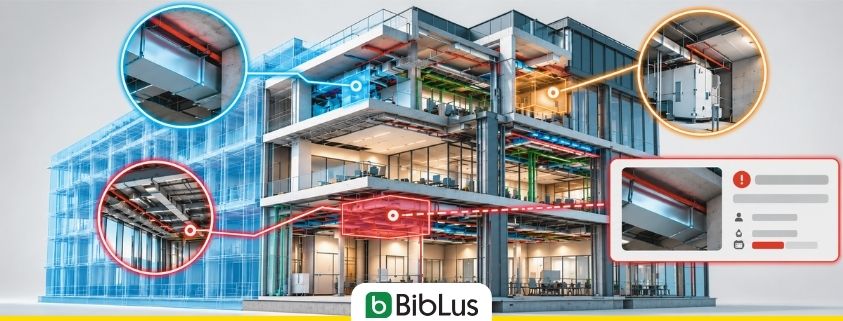
A project can be technically correct and complete, but difficult to execute. Unworkable operational sequences, insufficient space for work processes, components that are difficult to install, or interferences between activities can lead to delays, rework, and costly changes during construction.
The constructability review is specifically designed to identify these aspects during the project development phase and before the execution of the works. The project is examined from the perspective of those who will have to realize it, with particular attention to construction methods, sequences, timing, safety, accessibility, logistics, procurement, costs, and quality.
To be effective, the review must follow a clear analysis method that establishes evaluation criteria, responsibilities, priorities, and management modalities for observations. A BIM issues tracking platform allows the registration of each issue, associating it with project elements, assigning it to the responsible party, and tracking its progress until resolution. Observations do not remain confined to meeting minutes but become traceable and verifiable actions that facilitate coordination among the various parties involved in the project.
In this article, we will see what constructability review means, when to perform it, who should participate, and which documents to use. We will also analyze how to conduct a constructability review step by step, what checks to include in a checklist, how to classify and close observations, and how to use BIM and digital tools to make the process more effective.
Contents
- What does constructability mean?
- Why perform a constructability review?
- How to perform a constructability review
- Constructability review, design review, and project verification: differences
- When to perform the constructability review?
- Who participates in the review?
- What documents are needed?
- How to classify the observations?
- BIM and digital tools for the constructability review
- Practical example: review of an interior fit-out project
- How to measure the effectiveness of the review?
- FAQ – Constructability review
What does constructability mean?
The term constructability refers to the integration of knowledge and construction experience in the various phases of the project, aiming to make the work practically realizable in an efficient manner, consistent with the objectives of timing, costs, quality, and safety.
The Construction Industry Institute (CII) indeed defines constructability through the use of knowledge and construction experience in the planning, design, procurement, and execution phases to achieve the overall project objectives.
Constructability thus introduces into the design process the perspective of those who will have to realize the work. A project may be correct from a geometric, structural, or system perspective and still present difficulties related to the installation of components, material handling, availability of space, or sequencing of operations.
The central question of the constructability review is, therefore, simple: can the project be built as it has been designed?
To answer this, one must consider aspects that often emerge only in the execution phases:
- access to work areas and elements to be installed;
- availability of necessary space for assembly, handling, and maintenance;
- sequence of operations;
- compatibility between teams, means, and activities;
- modalities for procurement and storage of materials;
- production and delivery times of components, especially for materials or equipment with long procurement times;
- tolerances and installation possibilities;
- time and logistical constraints;
- safety conditions;
- possibilities for inspection, maintenance, and replacement of components;
- needs for temporary works, scaffolding, bracing, access systems, or lifting means;
- possibilities for prefabrication, preassembly, and modularization;
- consistency among project, specifications, bills of quantities, and execution modalities.
Constructability does not coincide with a simple check of the documents. It requires a critical assessment of design choices in light of the real construction conditions.
An important support can come from the WBS (Work Breakdown Structure), which allows activities of construction to be linked to parts of the work and to clarify responsibilities, sequences, and control points.
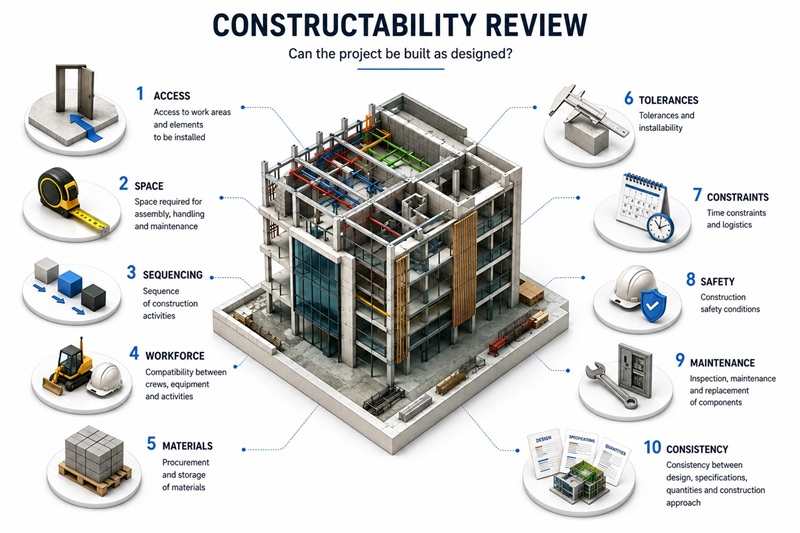
Aspects considered in the constructability review
Why perform a constructability review?
The constructability review allows for the identification of critical issues during the design phase that, if discovered during execution, could lead to RFI, changes, reworks, delays, increased costs, or safety problems.
Let’s see what the main results that a constructability review can produce are.
Identify problems before the construction site
The first objective is to identify difficult or impossible solutions to implement before they become construction site problems.
For example, a ceiling may meet the project specifications but not leave enough space for laying and connecting ductwork, cables, and equipment. A piece of equipment may be dimensionally compatible with the designated area but may be difficult to transport to the installation point due to door sizes, hallways, or maneuvering space. A prefabricated element may require a lifting device or a maneuvering area for assembly that the construction project has not planned for.
The review allows for verifying these conditions while changes are still manageable, before a critical issue translates into a design change, rework, or construction delays.
Reduce RFIs and variations
Many RFIs (Requests for information) arise from missing information, unclear details, or conditions that the project has not sufficiently considered.
A constructability review can anticipate some of these requests. Joint examination of the documents allows for identifying aspects that require clarification before awarding or execution.
The same applies to variations. If a design solution presents an evident implementation difficulty, identifying it before the start of work allows for managing the modification during project development and can reduce the risk of the critical issue later transforming into a variation during the work, with consequences on approvals, timing, and costs.
Limit rework and delays
A change introduced on site can affect subsequent work and work that has already been done. For instance, changing a wall may require modifications to systems, finishes, ceilings, and completion works.
The review should also look for dependencies between operations. An apparently simple solution can generate a chain of consequences if it follows the execution of related activities.
Anticipating these problems allows for reducing demolitions, rework, and unproductive time.
Enhance safety and accessibility
Constructability must also be evaluated from the perspective of safety.
It is essential to verify, for example, whether workers can reach work areas, if there are adequate spaces for installation operations, if future maintenance operations require special access, and if subsequent work can create hazardous conditions.
The check can also extend to the site logistics, paying particular attention to access points, movement paths, storage areas, lifting equipment, and possible overlaps between teams.
In BIM sites, simulating the construction phases can help identify spatial and temporal interferences between activities and assess the site evolution before execution.
Verify timings and sequences
The constructability review must verify whether the activities scheduled in the timeline can actually take place in the scheduled sequence.
Some operations may indeed only begin after the completion of preceding activities or when certain operational conditions are met. For example, a finish requires that the systems be already installed and verified; a large component must be brought on site before closing the opening necessary for its movement; an operation may also require space that will be occupied by other works in subsequent phases.
The connection between model, WBS, and work schedule allows for verifying these relationships and identifying incompatible overlaps.
Improving Budget Reliability
A construction difficulty can translate into an additional cost. The more complex the installation of a component, the greater the need for labor, equipment, temporary works, or special movements.
The review highlights these conditions before consolidating the budget or, at the very least, before starting the work.
The goal is not to replace the bill of quantities or economic estimate, but to verify that the quantities and methods proposed are compatible with the actual execution conditions.
Protecting Design Intent and Quality
The search for the easiest solution to construct should not compromise the design intent, i.e., the project intent, nor the architectural, functional, or performance objectives of the project.
The review must therefore distinguish between a true construction issue and a simple preference of the contractor. Each modification must be evaluated against the design intent, the client’s requirements, and the performance demanded.
This comparison allows for finding simpler alternatives to implement without losing quality or altering essential characteristics of the work.
Promoting Collaboration and Knowledge Transfer
Participation in the constructability review by designers, contractors, project managers, specialists, and clients allows for the comparison of different skills.
Those with site experience can identify issues that do not emerge from merely reading the documents. The designer can explain the reasons for a choice. The procurement manager can point out procurement times that are incompatible with the schedule. The facility manager can highlight future difficulties in access or maintenance.
Thus, the review also becomes a knowledge transfer tool across the different phases of the project’s life cycle.
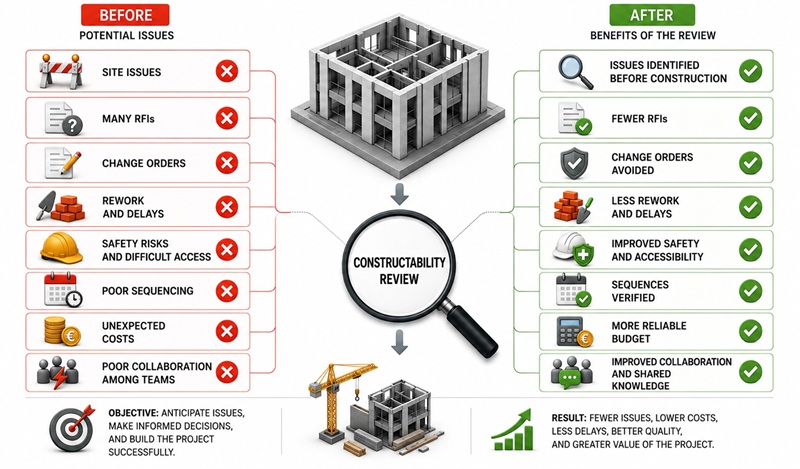
Why conduct a constructability review
How to perform a constructability review
An effective constructability review can be organized through a structured process that starts with defining the analysis scope and only ends after verifying and closing the identified critical issues.
The number and depth of activities depend on the design phase, the complexity of the project, and the project delivery system, but the process can be broken down into eight main steps.
1. Define the objectives and scope of the review
Before starting, it is essential to establish what needs to be verified and with what level of depth. The scope can concern the entire project or specific disciplines, areas, systems, or particularly critical tasks. At a minimum, the following must be defined:
- reference design phase;
- drawings and models to be examined;
- involved disciplines;
- constructability criteria;
- risk categories;
- methods of recording observations;
- responsible decision-makers.
This step prevents the review from turning into a generic revision of the entire project.
2. Define the document baseline
Before the review, the version of the documents that constitutes the baseline of the analysis must be identified. Drawings, BIM models, specifications, schedules, and technical documents must have a clearly recognizable revision status.
This way, each observation can be traced back to the version actually analyzed, and discussions on issues already resolved by subsequent modifications are avoided.
3. Involve the necessary competencies
The review group must include design competencies and competencies directly related to execution.
It is not necessary to involve all stakeholders in every session: it is more effective to select participants based on the aspects to be verified.
For a logistics review, for example, construction managers, site managers, and lifting specialists may be essential; for an analysis of the systems, MEP designers, installers, and BIM managers may be priorities.
4. Analyze the project from an execution standpoint
The project is then examined considering not only what needs to be constructed but, more importantly, how it will be constructed.
The analysis should check, among other aspects:
- construction methods;
- operational sequences;
- space required for tasks;
- accessibility;
- movement and lifting;
- logistics;
- tolerances;
- provisional works;
- safety;
- prefabrication and preassembly;
- procurement and delivery times;
- possibility for inspection and maintenance.
When available, the BIM model can be analyzed alongside the schedule and the site layout to assess not only the final configuration of the work but also its evolution during the various phases of construction.
5. Record and classify observations
Every critical issue must be recorded in a structured manner. A good issue should contain at least:
- unique identifier;
- element, area, or document concerned;
- problem description;
- justification;
- category;
- priority;
- expected impact;
- proposed solution, if any;
- responsible person;
- deadline;
- status.
Immediate recording reduces the risk that decisions and observations remain confined to meeting minutes.
6. Evaluate the solutions and make a decision
The identified critical issues must be discussed with the relevant stakeholders. The chosen solution should not only pursue ease of execution but also be verified against:
- client requirements;
- performance;
- quality;
- safety;
- timelines;
- costs;
- maintenance;
- design intent.
When multiple alternatives exist, it may be useful to also record the reasons for the decision.
7. Assign actions, responsibilities, and deadlines
A critical issue is not resolved simply because it has been discussed. Every decision must transform into an action assigned to a responsible person with a defined deadline.
Depending on the case, the action may involve updating a drawing, modifying the BIM model, requesting a detail, revising the construction sequence, or verifying a solution with a supplier or subcontractor.
8. Perform back-check and close the issues
The final step is to verify that the agreed solution has indeed been implemented. The back-check must check not only the specific modification but also any potential consequences on other disciplines, tasks, or documents.
Only after this verification can the issue be considered closed.
Constructability review, design review, and project verification: differences
Constructability review, design review, and project verification are related activities but have different objectives:
- the design review primarily examines the quality and consistency of design choices concerning the requirements, the client’s objectives, and the required performance. In BIM, it can include the analysis of the digital model by designers, clients, project managers, and other stakeholders;
- the project verification aims to determine the compliance of the documents with applicable requirements and the conditions stipulated for the specific design phase;
- the constructability review evaluates the practical feasibility of the design solutions, considering construction methods, operational sequences, accessibility, resources, and site conditions.
The same wall, for example, can be analyzed in the design review to verify the correctness of the design solution, during the project verification regarding the applicable requirements, and in the constructability review to check the possibility of correctly executing all the necessary work for its realization.
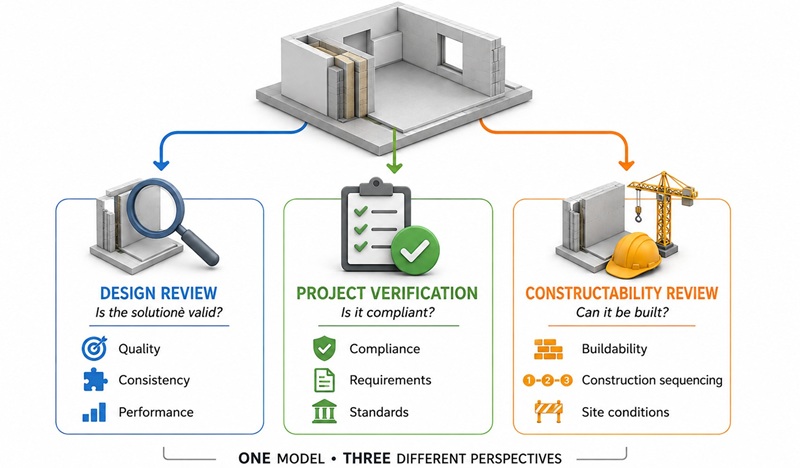
Difference between constructability review, design review, and project verification
When to perform the constructability review?
The constructability review should begin as early as possible during the project development and be repeated at key milestones, when there is still a tangible margin to modify choices without generating significant consequences on costs and timelines.
The analysis can be repeated during the project development, with varying content and levels of detail based on the phase:
- in the preliminary phases, the main construction systems, materials, layout, site constraints, accessibility, and logistical conditions are verified;
- during the design development, the focus is on construction details, interfaces between disciplines, installation methods, and operational sequences;
- in the executive design, the final solutions, interferences, workspaces, procurement methods, and necessary conditions for execution are analyzed;
- during procurement, it is useful to verify manufacturing times, component availability, transport constraints, prefabrication, and installation requirements;
- before starting the work, the focus is primarily on outstanding critical issues that could generate RFIs, changes, delays, rework, or safety problems;
- after significant design changes, the aspects affected by the change and any repercussions on the already planned work are verified.
The review, therefore, does not necessarily need to coincide with a single meeting, but can be organized into multiple cycles with different objectives.
The goal is to intervene when there is still a tangible margin to modify the project, avoiding that a critical issue identified too late requires complex interventions during construction.
Who participates in the review?
The review group must include the necessary skills to assess the technical, construction, and organizational aspects of the project.
Depending on the complexity of the work, the following may participate:
- project manager and contract manager;
- architectural, structural, and MEP designers;
- construction manager or production manager;
- executing company and main subcontractors;
- site manager;
- safety coordinator;
- BIM managers and discipline coordinators;
- procurement managers;
- prefabrication, logistics, or assembly specialists;
- suppliers of components or specialized systems, when manufacturing, transport, or installation methods impact constructability;
- facility manager, when the analysis includes management and maintenance conditions.
It is important that each participant is aware of the scope of the review in advance. A meeting with too many people and without well-defined criteria risks producing many comments, but few decisions.
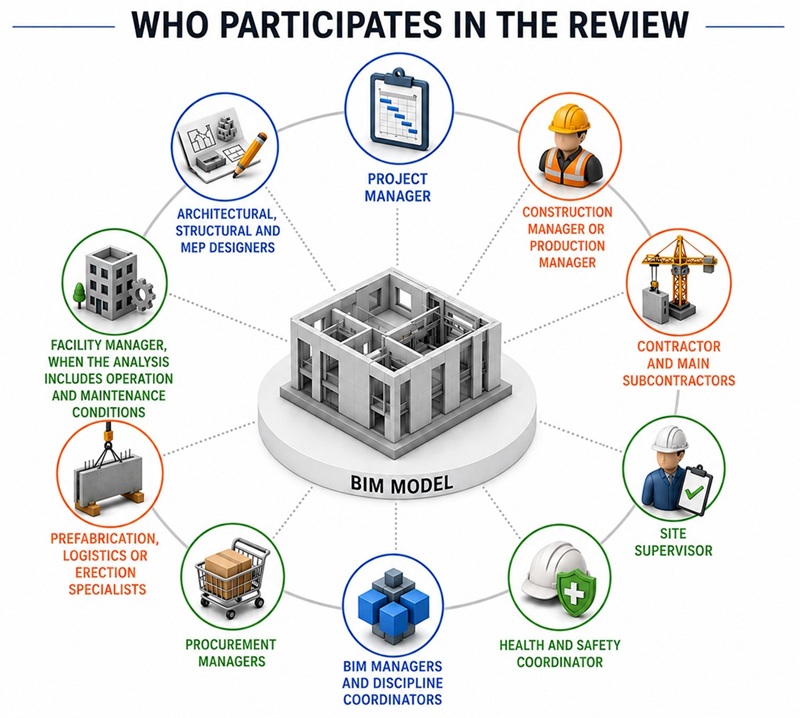
Who participates in the review
What documents are needed?
The constructability review must start from sufficiently updated and coherent information.
Among the most useful documents are:
- graphic elaborations and construction details;
- specifications and technical specifications;
- metric computation and available economic documentation;
- schedule;
- logistics plan and site layout;
- safety documentation;
- technical sheets and information on materials;
- data related to prefabricated components or special systems;
- BIM models of the various disciplines;
- BEP (BIM Execution Plan) and information requirements, when provided;
- previous RFIs, non-conformities, and issues already recorded;
- procurement plan and information on components with long delivery times;
- procedures or hypotheses related to lifting, temporary works, prefabrication, and assembly, when available.
The documentation must have an identifiable version. A review based on outdated documents may produce correct observations but no longer applicable.
What are the outputs of a constructability review?
The constructability review should produce verifiable results that can be used in the subsequent phases of the project, not just a meeting minutes.
Depending on the organization of the project, the outputs may include:
- constructability review report;
- issue and action log;
- mark-up of drawings and documents;
- views and snapshots of the BIM model;
- decision log with reasons for major choices;
- list of responsible parties and deadlines;
- list of open criticalities;
- updates required for documents, models, or schedules;
- back-check report and resolution of issues;
- lessons learned to be transferred to later phases or future projects.
The format may change from one project to another, but it must always be possible to reconstruct which critical issue was identified, what decision was made, who was supposed to intervene, and whether the solution was actually verified.
How to classify the observations?
Observations are the reports that emerge during the constructability review that highlight a problem, a request for clarification, or a possible improvement regarding the planned execution methods. They can concern technical, construction, organizational, economic, or safety aspects and may have very different priority levels.
The management of observations thus requires shared criteria. Without a classification, a criticality that can block a work process risks ending up in the same list as a simple improvement proposal.
Let’s see how to organize the issues in a way that is useful for decision-making.
Criticalities by risk
A simple classification can distinguish the observations based on the associated risk:
- high: it can prevent a work process, create a significant risk, or produce relevant consequences on time and costs;
- medium: it requires a modification or clarification but does not directly compromise progress;
- low: it concerns an improvement, a detail, or an aspect with limited consequences.
When the project requires a more structured assessment, priority can be determined through a probability-impact matrix or defined thresholds for safety, cost, expected delays, or possible work stoppages. The criteria must be defined prior to the review and applied consistently.
Classification by impact
A second level can describe the areas on which the issue produces an impact:
- costs;
- time;
- safety;
- quality;
- accessibility;
- logistics;
- maintenance;
- interdisciplinary coordination;
- supply.
The same issue can have multiple impacts. An accessibility problem for maintenance, for example, can concern both the quality of the work and the lifecycle costs.
Issue, query, recommendation, and value opportunity
A possible taxonomy, to be adapted to the procedures of the specific contract, distinguishes the comments produced during the constructability review into:
- an issue indicates a condition that requires a decision or correction;
- a query requests clarification;
- a recommendation proposes an improvement solution;
- a value opportunity instead signals a possible optimization with advantages on costs, time, quality, or execution methods.
This distinction prevents every observation from being treated as a design error.
How to avoid unmanageable comment lists
A good review does not produce the maximum number of comments possible. It produces useful, verifiable, and assignable observations.
Each observation should indicate at least the reference to the element or the relevant document, the identified problem, the reasoning, the expected impact, and the requested action.
Comments like “to be verified” or “attention to this detail” have little value if they do not explain what problem exists and who needs to intervene.
BIM and digital tools for the constructability review
BIM can support the constructability review through federated models, information associated with objects, views, annotations, and systems for managing issues.
Clash detection and clash management allow for identifying and managing geometric interferences, spatial interferences between elements and disciplines, and then classifying, assigning, and tracking these interferences until resolution.
Incompatibilities related to the sequence of operations and the use of spaces over time require analyses of the construction phases and, when available, 4D BIM simulations, where the model is linked to the schedule.
The project review in a BIM context allows for examining the 3D model together with stakeholders and associating observations with specific elements and views. This approach facilitates comparisons compared to merely consulting 2D drawings.
An additional support comes from model checking, which allows for performing automatic or semi-automatic checks on models and information requirements. These checks can highlight conditions that require a constructability verification, such as incompatible dimensions, unmet requirements, or missing information.
However, model checking and clash detection do not replace the constructability review: many constructability issues depend on execution methods, sequences, equipment, logistics, or operating conditions that cannot be identified through geometric model checks alone.
BCF and issue management
BCF (BIM Collaboration Format) is an openBIM standard developed by buildingSMART for the exchange and management of issues between different BIM applications.
Through a BCF workflow, an observation can be linked to the point of the relevant model, the involved elements, a view, comments, status, and responsible parties without having to transfer the entire model every time.
BCF can therefore support the constructability review, especially when parties using different software are involved, and it is necessary to maintain a structured and interoperable management of observations.
The connection between the model and issue management allows associating each observation with the interested element, view, or reference document and the responsible person for the action. The review thus maintains a direct link between the identified criticality, the decision made, and the subsequent verification of the solution.
Practical example: review of an interior fit-out project
Let us consider the interior fit-out, that is, the internal setup, of an office floor with partition walls, suspended ceilings, raised floors, electrical and HVAC (Heating, Ventilation and Air Conditioning) systems, fixed furnishings, and fire protection systems.
During the review, the group analyzes the model and the sequence proposed by the schedule.
Three critical issues emerge:
- the first concerns an HVAC terminal unit placed above a ceiling with insufficient space for the necessary maintenance access. The issue is classified as high priority and assigned to the mechanical designer;
- the second relates to the sequence of operations. The project provides for the installation of some fixed furnishings before closing a portion of the ceiling, but the dimensions of the furnishings make it difficult to access the equipment later. The sequence is modified before the work begins;
- the third pertains to the transport of a large equipped wall. The component is compatible with the destination room, but the necessary path to reach it has a curve that is incompatible with its dimensions. The review leads to the definition of a different delivery and assembly method.
None of the three problems necessarily arises from a geometric error in the design. They emerge when the model is viewed from the perspective of construction, maintenance, and logistics.
How to measure the effectiveness of the review?
The effectiveness of the constructability review must be evaluated through observable results. The mere number of identified issues is not sufficient: many observations may indicate an in-depth analysis but also particularly problematic documentation or excessively fragmented classification. Some useful indicators are:
- number and percentage of high-priority criticalities intercepted before the start of the works;
- percentage of issues resolved by the deadline;
- number of RFIs generated by criticalities that could have been intercepted during the review;
- variations arising from constructability deficiencies;
- rework and non-conformities attributable to constructability issues;
- delays associated with design or sequencing problems;
- number of high-priority criticalities left open at the start of the site;
- average time required to close an issue;
- percentage of reopened issues after a first closure;
- distribution of observations by category and discipline;
- cost of rework attributable to unaddressed constructability issues;
- normalized comparison of results relative to size, duration, or value of the project when comparing different contracts.
The comparison between different projects also helps to understand which types of problems occur more frequently. Recurring criticalities should feed a lessons learned system, so as to transform the acquired experience into criteria and checklists usable in subsequent projects.
An effective review does not therefore coincide with a final document full of comments. The most important result is to reduce the number of criticalities that reach the construction site and increase the predictability of time, costs, and execution methods.
To obtain measurable results, it is important that each observation remains available even after the review and can be verified over time. A BIM issues tracking platform allows for keeping track of issues, responsibilities, deadlines, and status of activities, creating continuity between the project analysis phase and execution phase. Thus, the review becomes part of a control process that accompanies decisions until their actual implementation. The review thus becomes part of a control process that accompanies decisions until their actual implementation.
FAQ – Constructability review
What is a constructability review?
A constructability review is an analysis of the project conducted from the perspective of its actual implementation. It verifies aspects such as construction methods, sequences, accessibility, logistics, workspaces, supplies, safety, and maintenance to identify criticalities before they reach the construction site.
When should it be performed?
The constructability review should begin during the early stages of project development and be repeated at key milestones. The earlier a criticality is identified, the greater the margin generally available for intervening without compromising already executed activities or consolidated decisions.
Who performs the constructability review?
There is no single responsible party valid for all projects. The review normally requires the contribution of designers, project or construction managers, contractors, specialists, BIM managers, and other figures with direct experience in execution methods.
Is constructability review and clash detection the same thing?
No. Clash detection primarily identifies geometric and spatial interferences in BIM models. The constructability review has a broader scope and also analyzes sequences, construction methods, accessibility, logistics, safety, procurement, and operational conditions.
What are the outputs of a constructability review?
Outputs can include a review report, an issue log, mark-ups, model views, decision logs, actions with responsibilities and deadlines, and verification and closure reports. The goal is to make the entire path from criticality to solution traceable.
Who conducts a constructability review?
Coordination can be assigned to the project manager, the construction manager, or a figure designated by the project management plan. It is still useful to involve the necessary expertise based on the aspects to be verified.
Can a constructability review be performed after the start of construction?
Yes. A review can also be useful during construction, especially in the case of:
- design changes;
- new site conditions;
- variations in operational sequences;
- recurring issues during execution.
How long should a constructability review last?
There is no standard duration. The time depends on the complexity of the project and the phase in which it is conducted. For complex works, it is preferable to organize multiple sessions dedicated to specific themes.
Is it possible to perform a constructability review without a BIM model?
Yes. The review can use 2D documents, specifications, timelines, and technical sheets. However, BIM offers additional tools for analyzing:
- geometries and interferences;
- construction sequences;
- accessibility;
- information associated with elements.
How is a constructability review documented?
Each observation should have at least:
- identifier;
- problem description;
- reference to the document or the concerned element;
- responsible person;
- deadline;
- action status.
Can a constructability review modify the project?
Yes. Observations can lead to design changes, but each proposal must follow the approval process established by the project and take into account the effects on costs, timelines, and requirements.
Does the constructability review also concern maintenance?
Yes. When the scope of the review allows it, accessibility to equipment, maintenance spaces, and possibilities for component replacement can be verified.


