
AI for Construction Project Management: Practical Applications, Benefits, and Future Perspectives
Discover how AI for construction project management improves quality, safety, and efficiency on site. Practical examples, benefits, and future prospects

In the construction sector, the increasing complexity of design and operations requires a more flexible and adaptive management approach. Today, project management can no longer be limited to static planning, Gantt charts, and cost control: a systemic vision is needed that connects people, processes, and data in real-time.
In this scenario, artificial intelligence (AI) takes on a strategic role, transforming from a simple support technology to a cognitive resource that enhances the entire project lifecycle. Through data analysis, predictive modeling, and automation of decision-making processes, AI helps prevent delays, reduce economic deviations, improve safety on site, and strengthen risk control.
To effectively tackle this evolution, it is essential to equip oneself with suitable digital tools. A construction management software is now an indispensable resource for planning, coordinating, and monitoring every phase of the project more efficiently. These systems allow for real-time management of activities and critical issues, optimizing workflows and transforming the complexities of the construction site into smoother, traceable, and manageable processes.
In the following paragraphs, we will analyze how AI is redefining project management in the construction sector, illustrating practical applications, operational advantages, and future prospects for a sector in deep transformation.
Contents
- The role of artificial intelligence in project management in the construction sector
- Key applications of AI in construction project management
- Advantages of Integrating AI in Construction Project Management
- Future Perspectives of AI Project Management in the Construction Sector
- FAQ – AI and Project Management in the Construction Sector
The role of artificial intelligence in project management in the construction sector
Project management in the construction sector today represents a strategic discipline, increasingly central to the success of a construction project. It is an approach that goes beyond coordinating activities on site, encompassing a complex system of processes that range from preliminary planning to project delivery, including the management of time, costs, safety, execution quality, procurement, and resources. In a context characterized by increasingly complex projects, stringent regulations, and operational dynamics that are difficult to predict, the need for advanced control and timely decision-making has become essential.
It is in this scenario that artificial intelligence comes into play, not as a mere support technology, but as a cognitive infrastructure capable of processing large volumes of data, recognizing recurring patterns, anticipating future scenarios, and guiding decisions in real-time. Unlike other digital tools, AI learns from the context, refines its models, and adapts to the specificities of each project, offering a concrete competitive advantage in a sector where every mistake can translate into delays, extra costs, or operational inefficiencies.
In construction project management, the adoption of artificial intelligence translates into a range of essential application solutions to optimize process efficiency and improve the quality of the final outcome. Among the most relevant are the automatic generation of dynamic schedules, capable of updating in real-time based on unforeseen events on site, and predictive management of costs and risks, which allows for anticipating critical issues rather than just limiting their damage. This is complemented by resource optimization (human, material, and temporal) and the ability to identify and prevent operational conflicts before they translate into blockages or inefficiencies.
The integration of AI in project management in the construction sector thus allows for transforming disaggregated data into intelligent operational information, supporting faster, targeted, and informed choices. It is precisely this ability to anticipate, optimize, and guide the entire construction process that marks the AI revolution in construction, where every phase, from conception to realization, becomes smoother, more predictable, and guided by informed decisions.
But the benefits of artificial intelligence are not limited to the operational dimension alone. Even in the design phase, the use of AI in architecture allows for generating and evaluating in real-time alternative spatial solutions, optimizing layouts, functional flows, and energy performance according to complex parametric criteria. Similarly, the use of generative AI in civil engineering enables the simulation of a wide range of structural scenarios, exploring innovative configurations in terms of materials, geometries, and environmental sustainability, often not achievable with traditional approaches.
Key applications of AI in construction project management
Artificial intelligence is transforming the way projects are managed in the construction sector, introducing increasingly advanced tools for planning, execution, and control of activities.
The integration of AI in construction project management is not limited to the automation of individual tasks but introduces a new operational logic. This technology is capable of analyzing large volumes of data, identifying correlations that are difficult to detect with traditional approaches, generating reliable forecasts, and proposing real-time solutions. The result is a more proactive, aware, and timely management of the project, capable of reducing waste, containing risks, and significantly improving the overall efficiency of the intervention.
What makes the adoption of artificial intelligence particularly significant is its ability to integrate into the various phases of a project’s lifecycle: from initial programming to operational management on site, to maintenance of the work. Its applications do not present themselves as isolated functions but contribute to building an integrated system, where every decision is supported by updated data, predictive analyses, and dynamic models.
In the following paragraphs, we will analyze some of the most significant applications of artificial intelligence in construction project management.
Automatic and dynamic generation of schedules
Time planning is one of the most complex challenges in managing construction projects. An effective schedule not only defines the operational sequences but also ensures the correct use of resources, coordination among suppliers, and compliance with contractual deadlines. However, the unpredictability of the construction site — weather conditions, material availability, execution errors — often renders static planning ineffective.
Artificial intelligence addresses this need with dynamic schedules, capable of automatically updating based on the actual progress of the project. By analyzing data from sensors, reports, and logistical flows, AI reworks the operational plan in real-time, suggesting corrective actions such as reallocating resources or modifying work sequences.
Thanks to continuous learning, predictive models become increasingly accurate, allowing the project manager to simulate alternative scenarios and make decisions based on objective data. This approach improves delivery punctuality and reduces costs and inefficiencies, making dynamic planning one of the most concrete contributions of AI to project management in the construction sector.
Predictive analysis of costs and risks
Cost control and risk management are central objectives in construction project management, but in complex works, the high number of economic and operational variables makes accurate assessment difficult with traditional tools alone.
Artificial intelligence introduces a predictive approach based on the analysis of large amounts of historical and real-time data — such as updated schedules, cost items, actual processing times, and supplier performance — to identify recurring patterns and anticipate potential critical issues.
In this way, AI can promptly signal budget overruns, delays, or operational anomalies, suggesting targeted corrective actions, from revising execution methods to reallocating resources.
In addition to prevention, it also allows for simulating alternative scenarios, assessing the economic impact of different design or operational choices.
Economic and risk management thus becomes an integral part of planning, transforming from a reactive activity to a predictive and data-driven process, capable of improving the overall stability and sustainability of the project.
This evolution towards a more predictive and data-based economic management also translates into next-generation operational tools.
A concrete example is the software for metric computation and work accounting that integrates an artificial intelligence chatbot, designed to simplify measurements and the drafting of computations on site. By employing advanced language models, it allows for voice interaction with the software, dictating measurements, logs, and work progress statuses. Like a true site assistant, it interprets the technician’s instructions and automatically generates measurement lines, reducing compilation times and manual errors.
An intelligent support that makes the transition between economic analysis and operational control smoother, integrating AI into the daily routine of construction project management.
Optimization of resource use
Resource management — human, material, and temporal — is one of the most complex and decisive aspects for the success of a construction project. The numerous operational constraints and variability of the construction site make it difficult to identify the most efficient configuration each day.
Artificial intelligence offers a concrete response through machine learning models and combinatorial optimization, which analyze in real-time workloads, material availability, and logistical constraints, simulating alternative scenarios to find the most advantageous solution.
In this way, the system can automatically recalculate assignments based on unforeseen events, improving productivity without increasing costs. At the same time, AI also supports procurement scheduling, predicting future needs and suggesting when to advance or postpone deliveries to avoid waste and bottlenecks.
This approach allows for a more streamlined, adaptive, and sustainable resource management, capable of maintaining operational coherence on site and increasing the overall efficiency of the project.
Automatic detection of anomalies and quality control
In the construction sector, quality control is essential to ensure compliance of the work with design and regulatory requirements. However, in complex construction sites, continuous monitoring is difficult if left solely to manual checks.
Artificial intelligence responds to this need by offering advanced tools for the automatic detection of anomalies and constant quality control. By integrating IoT sensors, drone images, 3D scans, and BIM data, AI compares the actual state of the construction site with the design model in real-time, signaling discrepancies, installation errors, or dimensional variations.
This approach ensures speed, reduces human errors, and provides complete traceability of checks, thanks to the automatic recording of every anomaly. For example, an AI system can identify a wrongly placed beam through drone images and immediately notify the site manager with the coordinates of the problem.
The result is a preventive and standardized quality control, allowing for timely interventions, reducing structural risks, and improving the overall reliability of the work.
Predictive maintenance planning
The maintenance phase represents a crucial moment in the lifecycle of a building or infrastructure. Traditional strategies — corrective or scheduled — show limitations in terms of costs, reliability, and operational continuity.
Thanks to artificial intelligence, it is now possible to adopt a predictive approach that anticipates failures and plans interventions only when truly necessary, based on real data from sensors installed in the work. These devices monitor parameters such as vibrations, temperatures, humidity, energy consumption, and system performance.
By continuously analyzing this information, AI recognizes anomalous patterns and signals potential malfunctions in advance. For example, a system can detect an abnormal increase in energy consumption of a pump and suggest a preventive replacement, avoiding sudden breakdowns or greater damage.
The benefits are evident: reduced costs, increased safety, prolonged useful life of structures, and more efficient resource planning. Integrated with the BIM model, predictive maintenance creates a constantly evolving digital system, supporting facility management throughout the entire lifecycle of the work.
Support for document and regulatory management
In construction project management, the management of technical, administrative, and regulatory documentation is a complex and constantly evolving activity. Among executive projects, variations, reports, and authorizations, the volume of data can become an obstacle to operational fluidity and legal compliance.
Artificial intelligence offers advanced tools to organize, analyze, and update this information more efficiently and structurally. AI systems can:
- automatically classify documents, speeding up the search for content;
- verify regulatory compliance, signaling any critical issues with current laws;
- manage versions and revisions, tracking changes and notifying involved parties;
- extract data from technical texts, feeding dashboards and control tools.
Thanks to these functions, AI simplifies document management, reduces the risk of error, and ensures greater transparency and traceability throughout the entire project lifecycle.
Let’s see a concrete example: during the preparation of a large contract, the safety coordinator finds themselves needing to develop a complex Safety Plan, integrating regulatory requirements and adapting them to the specificities of the construction site. The volume of documents, revisions, and cross-references makes the process lengthy and prone to possible omissions or inconsistencies.
In cases like this, artificial intelligence can intervene in a targeted manner, supporting the drafting and customization of safety plans. Today, dedicated software is available that, thanks to the use of advanced language models, assists the technician in creating the plan based on the description of the work.
With the dedicated chatbot, the safety plan drafting software suggests the most relevant preventive measures and helps produce complete, coherent, and compliant documents. In this way, technology alleviates the cognitive load of the professional, reduces the risk of error, and improves the transparency and traceability of the entire safety management process.
Forecasting the financial performance of the project
Economic sustainability is one of the most delicate aspects of project management in the construction sector. Variations in material costs, delays, or design changes can compromise the initial financial balance.
Artificial intelligence offers strategic support through machine learning models capable of monitoring and predicting cost trends throughout the project’s lifecycle. These systems analyze historical and real-time data to:
- estimate the evolution of expenses based on work progress and market conditions;
- detect anomalous deviations from the budget and propose corrective actions;
- assess the economic impact of variations or delays;
- simulate alternative scenarios to guide design decisions.
For example, an AI system can detect the anticipated increase in steel costs and suggest an alternative structural solution, less exposed to market fluctuations.
This approach allows for anticipating financial surprises, optimizing cash flows, and improving communication between clients, project management, and companies, integrating the economic dimension with the technical and operational aspects of the project.
Monitoring safety on site
Safety on construction sites remains one of the most complex challenges in the construction sector. Despite strict regulations and established procedures, the risk of accidents remains high, especially in more dynamic operational contexts.
Artificial intelligence today offers concrete support through intelligent monitoring systems capable of detecting potentially dangerous situations in real-time, reducing the margin for human error. Using technologies such as computer vision, machine learning, and behavioral analysis, AI can:
- identify behaviors that do not comply with safety regulations (absence of PPE, entry into restricted areas, risky postures);
- monitor personnel and vehicle flows, signaling interferences or overcrowding;
- predict risk scenarios by analyzing historical data on incidents and operational conditions;
- alert safety managers in real-time to enable immediate interventions.
This approach allows for a shift from reactive control to a preventive and dynamic management of safety.
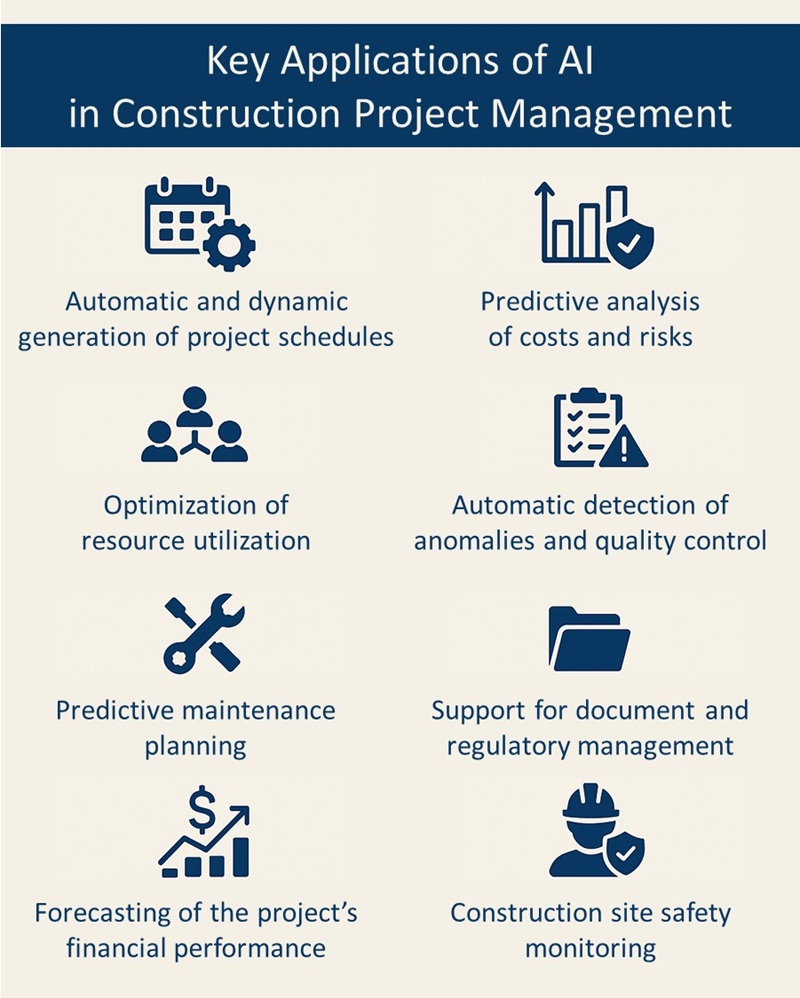
Key applications of AI for construction project management[/caption>
Advantages of Integrating AI in Construction Project Management
The integration of artificial intelligence in Construction Project Management is not just a technological advancement, but a true evolution in the way construction projects are planned, coordinated, and monitored.
Thanks to its ability to learn from data, predict critical issues, and adapt to operational conditions in real time, AI becomes a strategic tool for tackling the increasing complexity of the industry and improving the quality of decisions.
Compared to traditional digital tools that automate existing processes, artificial intelligence introduces more flexible and intelligent decision-making dynamics, capable of optimizing time, costs, and resources. The main advantages include:
- greater accuracy in planning: allows for the creation of realistic and dynamic project plans based on real data and reliable forecasts;
- reduction of delays and unforeseen costs: identifies critical issues in advance and suggests timely corrective actions;
- optimized resource management: efficiently allocates labor, materials, and equipment, reducing waste and downtime;
- proactive risk control: transforms management from reactive to predictive, thanks to the analysis of hidden patterns and correlations;
- automation of repetitive tasks: delegates bureaucratic and low-value activities, freeing up time for strategic functions;
- faster decisions based on objective data: provides real-time scenarios and simulations for more informed choices;
- greater transparency in project management: ensures complete traceability of data, events, and decisions, improving collaboration and governance.
The adoption of AI thus marks the transition to predictive and integrated management, where efficiency, control, and sustainability become central elements of the construction process.

Advantages of AI in Construction Project Management
Future Perspectives of AI Project Management in the Construction Sector
The evolution of artificial intelligence in the construction sector is just beginning. Current solutions are already showing concrete results, but the true potential will emerge with the increasingly deep integration between AI, operational processes, and digital tools.
Upcoming developments will lead to systems capable of learning from context, interacting in natural language, and making autonomous decisions, transforming project management into an intelligent and collaborative ecosystem.
Among the main evolving trends:
- AI-powered digital twins: digital twins will become dynamic models capable of simulating future scenarios and optimizing time, costs, and performance based on data collected in the field;
- Integration with robotics and advanced sensing: drones and robots will collaborate with AI systems, adapting behaviors in real-time and providing immediate data on progress, anomalies, and operational conditions;
- Collaborative decision-making systems: AI platforms will interact with professionals through natural language, processing voice requests and providing contextual responses and data-driven strategies;
- Multi-project contextual learning: algorithms will learn from entire portfolios of works, automatically transferring experiences and best practices between similar construction sites;
- Integrated predictive management: AI will anticipate complex events — such as market fluctuations, supply delays, or climate changes — integrating them into planning to build more resilient and stable projects.
These perspectives outline a future where artificial intelligence becomes an active part of the construction process, capable not only of analyzing and predicting but also of collaborating in defining strategies and continuously improving operational performance.
In light of emerging trends and the possibilities offered by artificial intelligence, equipping yourself with a construction management software that can easily integrate with AI-based solutions is a fundamental step to tackle the future challenges of construction project management. By using this system, you can:
- manage all site activities simply and organized, integrating them with the BIM model and attaching documents, images, and videos to each task;
- track the progress of activities, assign responsibilities, and monitor times and deadlines in real-time;
- centralize all project communication in a single shared space, improving collaboration among teams, companies, and professionals;
- promptly resolve critical issues, thanks to clear and automated workflows that reduce waiting times and resource waste.
Try this solution for free, designed to simplify site management and foster more effective collaboration among all parties involved. Leverage the potential of technology and improve your organization and control of your Construction Project Management processes.
FAQ – AI and Project Management in the Construction Sector
What role does artificial intelligence play in project management in the construction sector?
Artificial intelligence is now a strategic resource in construction project management. It not only speeds up processes but also makes them smarter and more adaptive, analyzing large amounts of data to optimize time, costs, resources, and safety. AI enables a shift from reactive management to predictive and data-driven management, improving the quality of decisions throughout the project lifecycle.
In which phases of a construction project lifecycle can AI be applied?
AI can intervene in all phases:
- planning, with the automatic generation of dynamic schedules;
- execution, through real-time monitoring and quality control;
- economic management, with predictive analysis of costs and risks;
- maintenance, through predictive maintenance models integrated with BIM.
This integration allows for a unified and continuous view of the entire construction process.
What concrete benefits does AI offer to construction professionals?
The main benefits are:
- greater accuracy in planning;
- reduction of delays and unexpected costs;
- optimized management of resources and risks;
- automation of repetitive tasks;
- improvement of safety on site;
- faster decisions based on objective data.
How does artificial intelligence improve safety on construction sites?
Through intelligent monitoring systems based on computer vision and machine learning, AI can detect risky behaviors, absence of PPE, interference between operations, or unauthorized access in real-time. This allows for immediate intervention and accident prevention, shifting from post-event control to preventive and predictive safety management.
How can AI support economic management and cost control in construction projects?
AI analyzes historical and real-time data to identify patterns that anticipate budget overruns or inefficiencies. It can estimate cost evolution, propose corrective actions, and simulate alternative scenarios to assess the economic impact of changes or delays. This approach strengthens financial control and promotes more stable and sustainable planning.
What role does artificial intelligence play in document and regulatory management?
In complex projects, AI simplifies document management by automatically classifying them, verifying regulatory compliance, and tracking revisions and updates. Additionally, thanks to advanced language models, it can assist in drafting technical documents such as safety plans, suggesting preventive measures and ensuring consistency with current regulations.
How does AI contribute to predictive maintenance of buildings and infrastructure?
Artificial intelligence analyzes data collected from sensors and IoT devices to identify anomalies and predict failures before they occur. This allows for targeted interventions to be planned only when truly necessary, reducing maintenance costs, increasing safety, and extending the useful life of the work.
What are the future prospects of AI project management in the construction sector?
Future developments will involve the integration of AI with digital twins, robotics, and collaborative decision-making systems. Future models will be able to learn from multiple projects simultaneously, anticipate complex events (such as cost fluctuations or supply delays), and communicate in natural language with professionals, making project management increasingly intelligent, predictive, and interconnected.


