
Construction Vibration Monitoring: Function, Tools, and Alarms
Discover how construction vibration monitoring works, which tools to use, how to assess thresholds, and manage alerts
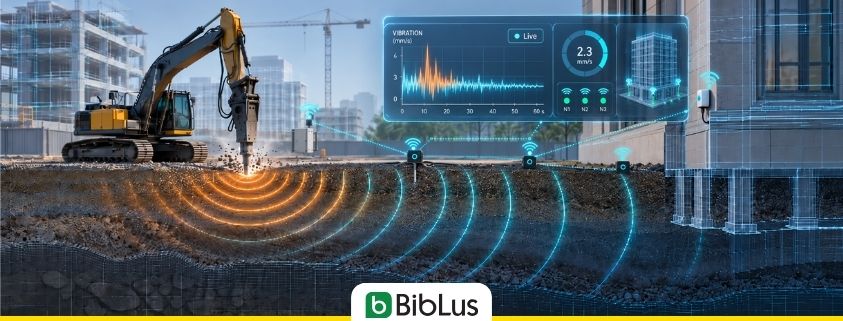
From a physical perspective, vibrations are mechanical oscillations of a body or system around an equilibrium position. On construction sites, they can be produced by machinery and processes and propagate through the ground and structures in the form of elastic waves.
In the context of a construction site, activities such as demolitions, piling, drilling, compaction, and the movement of heavy equipment can produce vibrations of varying intensity and frequency.
However, the effects must be distinguished based on the element intended to be protected. Monitoring can indeed involve:
- the effects of vibrations on buildings and infrastructure;
- the disturbance perceived by people inside buildings;
- the occupational exposure of workers to hand-arm or whole-body vibrations;
- the protection of equipment, systems, or processes that are particularly sensitive.
In this article, you will discover which construction activities generate the most vibrations, how monitoring works, which quantities are measured, which tools to use, how alarm thresholds are determined, and how to manage any exceedances.
Contents
- What is construction vibration monitoring?
- What is the purpose of construction vibration monitoring?
- Which construction activities generate the most vibrations?
- What effects can vibrations have on buildings and surrounding areas?
- How are construction vibrations measured?
- Which magnitudes are measured: PPV, frequency, and acceleration
- What are the vibration thresholds on construction sites?
- What instruments are used for monitoring?
- Where to install vibration sensors?
- What happens when a vibration threshold is exceeded?
- FAQ on construction vibration monitoring
What is construction vibration monitoring?
Construction vibration monitoring involves the measurement over time of the oscillations produced by activities, with the aim of assessing their effects on buildings, infrastructure, people, or other sensitive elements.
Monitoring can be used to assess the potential impact of vibrations produced by construction activities on surrounding buildings and structures, and to verify the effectiveness of any mitigation measures adopted.
A monitoring system can record various quantities, including vibration velocity, acceleration, frequency, and duration of the event. When necessary, the direction of the vibration and the three components along orthogonal axes are also considered.
The choice of quantities to measure depends on the purpose of the investigation: assessing potential damage to a building, for example, is not the same as evaluating a worker’s exposure or the disturbance perceived by occupants.
What is the purpose of construction vibration monitoring?
Monitoring allows for the understanding of the intensity and characteristics of the vibrations produced by activities and comparing the recorded values with thresholds or criteria defined in the monitoring plan and applicable technical references.
This way, it is possible to manage risk proactively:
- protecting nearby buildings and infrastructure;
- verifying compliance with established project criteria;
- documenting vibratory events objectively;
- providing useful data in case of disputes or controversies;
- evaluating the effectiveness of mitigation measures;
- consciously adapting methods and phases of construction;
- promptly identifying anomalous events or exceedances of attention and alarm thresholds.
Which construction activities generate the most vibrations?
Activities related to the excavation or demolition phase or involving the use of impact equipment generate vibratory levels of various degrees depending on the machinery and means employed.
The main high-vibration impact activities are:
- pile driving;
- demolitions;
- excavations and drillings;
- compactions;
- use of heavy machinery.
Let’s analyze them in detail.
Piling
Pile driving involves the use of heavy machinery called “pile drivers,” which are used to construct piles that support the foundations of buildings or other structures or to build bridges, dams, and other “pile” structures.
Piles can be made from different materials and technologies and are used, for example, to transfer the loads of the construction to deeper, more resistant ground layers.
In the case of driven pile techniques, repeated impacts can generate significant vibrations that propagate through the ground and reach any surrounding structures.
The intensity recorded at a specific point depends not only on the energy of the source but also on the distance, the geotechnical properties of the ground, and the ground-structure interaction.
Demolitions
The machinery used in demolitions, such as jackhammers and percussion equipment, can produce impulsive vibratory events characterized by high values over relatively short time intervals.
Under certain conditions, a structural response amplification may also occur when the frequency of the stress approaches one of the natural frequencies of the structure or its elements. However, it is not accurate to attribute a single universal frequency range to buildings, as these depend on mass, stiffness, geometry, height, and structural scheme.
Excavations and Drilling
Excavation activities in compact soils and rock drilling are fundamental and extremely effective methods used in various sectors for the controlled fragmentation and excavation of hard rock formations.
Hydraulic hammers and impact equipment can produce repeated impulses, while other excavation or drilling machines may generate more continuous vibrations.
The construction of tunnels and underground work may also require specific monitoring when sensitive buildings, infrastructure, or installations are nearby.
Soil Compaction
Soil compaction or the layers of a pavement can be performed using vibratory rollers or vibrating plates. The oscillatory movement transfers energy to the material, promoting a reduction of voids and greater densification.
Vibratory rollers and compacting plates therefore represent potentially relevant vibration sources, especially at short distances.
Heavy Machinery and Site Traffic
In a construction site, vibrations can also be generated by the transit of heavy vehicles and operating machines.
The movement of wheeled or tracked vehicles transmits dynamic stresses to the ground. The magnitude and frequency of the vibrations depend, among other factors, on the mass and speed of the vehicle, the suspensions, and especially the conditions of the transit surface.
Irregularities, potholes, or discontinuities in the pavement can also significantly increase the vibrations generated by the passage of vehicles.
What effects can vibrations have on buildings and surrounding areas?
The effects of vibrations must be evaluated by distinguishing at least three aspects: the response of buildings, disturbance perceived by people, and professional exposure of workers.
Effects on Buildings
Vibrations can cause different effects depending on the intensity and characteristics of the event, the structure involved, and its state of conservation.
In general terms, observable effects may concern:
- architectural and non-structural elements, with the appearance or evolution of small cracks or detachments;
- partitions, plasters, joints, and secondary elements;
- in more significant cases, elements that have a structural function.
However, the mere presence of a crack after a work operation does not automatically prove that it was caused by vibrations. For this reason, in more sensitive construction sites, instrumental monitoring may be associated with a preliminary survey of the state of the surrounding buildings, useful for documenting any pre-existing crack patterns.
Disturbance to People in Buildings
The perception of a vibration by occupants does not necessarily coincide with the existence of a risk of structural damage. Humans can indeed perceive vibrations of lesser magnitude compared to those associated with effects on buildings.
For this reason, comfort and disturbance must be assessed separately from structural protection, using appropriate criteria and magnitudes for the specific objective of the analysis.
Vibrations and Worker Safety
Workers can be primarily exposed to two types of vibrations:
- vibrations transmitted to the hand-arm system, for example during the use of jackhammers, drills, and other vibrating tools;
- vibrations transmitted to the whole body, for example during the operation of excavators, shovels, tracked vehicles, or other mobile machinery.
Hand-arm vibrations can be associated with vascular, neurological, and musculoskeletal disorders, while significant exposure to whole-body vibrations can contribute to musculoskeletal disorders, particularly affecting the lumbar area.
Thus, monitoring vibrations transmitted to buildings does not replace the specific assessment of professional exposure required by occupational safety regulations.
How are construction vibrations measured?
Vibrations are measured using sensors installed at representative points, which record magnitudes such as vibration velocity, acceleration, and event frequency. The monitoring configuration depends on the purpose of the investigation, the duration of the works, and the level of risk.
Three main modes can be distinguished:
- spot measurements, which involve the acquisition of short-term data for a limited period. They are generally used to assess vibration levels during a specific activity or to establish baseline conditions before construction;
- continuous vibration monitoring, which involves recording vibration levels for extended periods, ranging from several days to several months. This approach, widely used in construction projects where exposure to vibrations varies over time, allows for the detection of all vibration events, the analysis of long-term trends, and compliance verification throughout the duration of the project;
- real-time monitoring and alerts, which compare vibration levels against predefined thresholds and generate alerts when limits are exceeded. This allows for quick operational responses, such as modifying construction methods or interrupting certain activities.
Which magnitudes are measured: PPV, frequency, and acceleration
To correctly interpret monitoring, it is essential to distinguish the main magnitudes used:
- PPV – Peak Particle Velocity: is the maximum value of the vibration velocity detected during an event at a specific point and is generally expressed in mm/s. Vibration velocity is one of the most widely used magnitudes in evaluating vibrations transmitted to buildings. PPV should not be confused with maximum displacement or acceleration: these are different physical quantities;
- frequency: indicates the number of oscillations per second and is expressed in hertz (Hz). It is a fundamental parameter because a structure’s response depends not only on the amplitude of the vibration but also on its frequency content;
- acceleration: describes the change in velocity over time and is generally expressed in m/s². It is a particularly important magnitude in evaluating human exposure to vibrations, while magnitudes related to vibration velocity are frequently considered for evaluating effects on construction.
| Magnitude | Meaning | Typical Unit | Use |
| PPV / vibration velocity | maximum value of vibration velocity during the event | mm/s | assessment of effects on structures |
| Frequency | number of oscillations per second | Hz | characterization of the event and structural response |
| Acceleration | change in velocity over time | m/s² | dynamic assessments and human exposure |
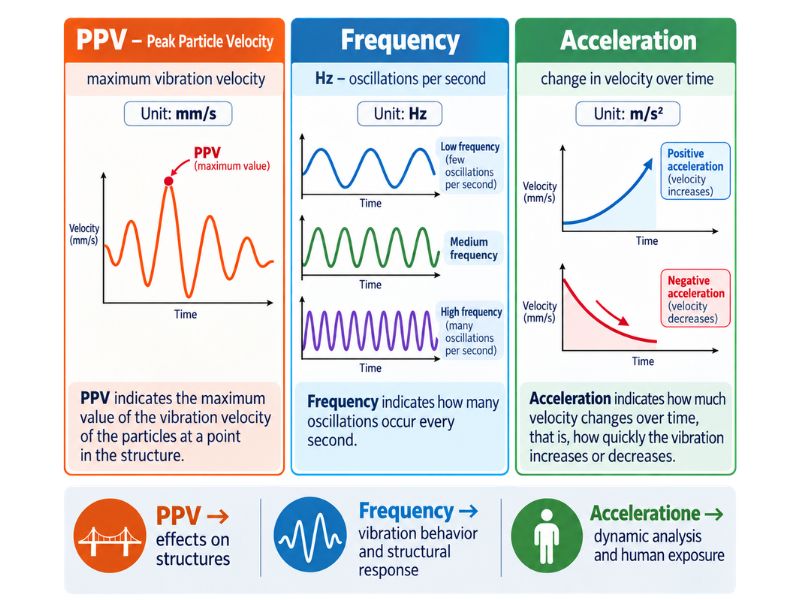
Difference between PPV, frequency, and acceleration in vibration monitoring
What are the vibration thresholds on construction sites?
There is no single vibration limit value that is valid for any construction site, building, and situation. The thresholds must be defined based on the monitoring objective, the characteristics of the structure, the frequency of the event, and the technical reference adopted.
A PPV value expressed in mm/s cannot be correctly interpreted without knowing at least the context of the measurement and, when required by the adopted criterion, the frequency content of the event.
In defining the thresholds, the following should be considered, for example:
- type and purpose of the construction;
- materials and structural system;
- state of preservation;
- presence of historic or particularly sensitive buildings;
- frequency of vibrations;
- duration and repetitiveness of events;
- impulsive, intermittent, or continuous nature;
- location of the measurement point;
- distance from the source;
- technical or regulatory criterion used.
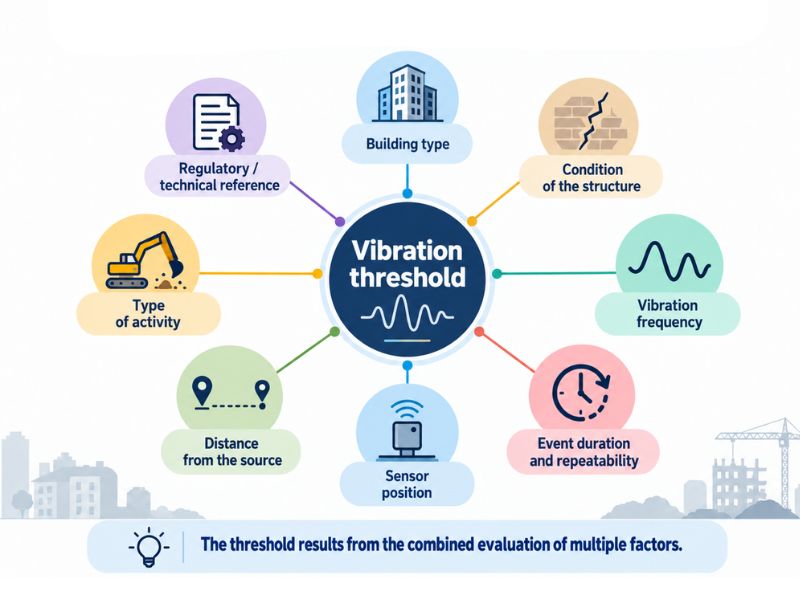
Factors affecting vibration thresholds on construction sites
For this reason, it is preferable to speak of “reference thresholds”, “alert levels”, and “alarm levels” defined in the specific monitoring plan, avoiding indicating a single number as a universal limit.
What instruments are used for monitoring?
Different types of vibration sensors are commonly used on construction sites:
- triaxial geophones;
- accelerometers;
- sismographs/vibration monitors;
- data loggers;
- IoT and cloud monitoring systems.
| Instrument | Main Magnitude | Typical Application |
| Geophone | vibration velocity | monitoring effects on structures |
| Accelerometer | acceleration | dynamic analysis and structural monitoring |
| Vibration monitor | PPV, frequency, and other parameters | automatic event monitoring |
| Data logger / IoT | data acquisition and transmission | continuous monitoring and alert management |
Tri-axial Geophones
Geophones are transducers used to measure the speed of vibrational motion. In triaxial systems, the motion is captured simultaneously along three orthogonal directions.
This feature allows for a better description of the motion and evaluation of the vibration components at the installation point.
Geophones are commonly used in vibration monitoring systems produced by construction activities when the quantity of interest is vibrational speed.
Accelerometers
Accelerometers measure the acceleration produced by vibrational movement.
There are different technologies of accelerometers, and the choice depends on the frequency range, the required sensitivity, the expected amplitude, and the measurement goal.
They can be used in dynamic analysis of structures, structural monitoring, and vibration exposure assessments, utilizing different configurations and criteria depending on the application.
Seismographs / Vibration Monitors
The vibration monitors used on construction sites generally integrate one or more sensors, an acquisition system, and functions for automatic event recording.
They can provide parameters such as:
- PPV;
- frequency;
- temporal trend of the event;
- vibration components on different axes;
- date and time of exceeding any thresholds.
Data Loggers, IoT and Cloud Monitoring Systems
IoT systems allow for remote transmission of data acquired from sensors. In a connected monitoring system, sensors detect vibrations and send data to an acquisition system or data logger, which transmits it via the network to a cloud platform; here, the information is stored, processed, and made available through dashboards, graphs, and automatic alert systems.
When a measurement exceeds a predefined threshold, the platform can send a notification via email, SMS, or other channels and record the event in the historical series.
Data can be viewed through graphs, dashboards, and reports useful for reconstructing the vibration trends during various construction phases.
However, a vibration sensor alone does not measure soil stability. In geotechnical monitoring systems, vibrational measurements can be integrated with other tools, such as inclinometers, piezometers, extensometers, GNSS systems, or total stations, depending on the phenomenon to be monitored.
Where to install vibration sensors?
Sensors must be placed at points where the measurement is representative of the actual vibration to be assessed; the position therefore depends on the source, the structure to be protected, and the purpose of the monitoring.
On construction sites, sensors are typically installed:
- on the foundations or at other significant points of nearby buildings;
- on the ground along the propagation path;
- near the most sensitive structures or systems;
- at points considered representative in the monitoring plan.
Incorrect positioning can lead to an underestimation or overestimation of vibration levels.
What happens when a vibration threshold is exceeded?
Exceeding a threshold does not automatically imply the presence of damage, but represents an event that must be assessed according to the procedures defined in the monitoring plan.
In a continuous system, the acquired data can be automatically compared with previously set thresholds.
When an exceedance is recorded, the system can:
- generate an alert;
- identify the date, time, and concerned sensor;
- record the values of the event;
- notify the responsible parties;
- start a verification workflow.
It is not correct to assert that any exceedance necessarily leads to an automatic suspension of work. The subsequent action depends on the procedures established by the project and may involve technical verification, modification of the operation, adoption of mitigation measures or, in specified cases, temporary suspension of activities.
From alert to non-compliance management
When a monitoring system detects reaching or exceeding a set threshold, an automatic alert may be generated.
The event can then be transformed into a notification or, when provided for by project procedures, into a non-compliance to be managed and documented.
The registration may contain:
- sensor location;
- date and time;
- detected value;
- affected threshold;
- ongoing operation;
- possible causes;
- corrective actions taken;
- verification following the intervention.
In this way, the exceedance does not remain a simple numerical data but becomes part of a documented process of site control.
Managing vibration issues on the BIM model
With a software for managing site issues like usBIM.resolver, the technician can report, assign, track, and close the issues associated with detected events.
- create the issue: within the BIM platform, the alert can be recorded with a title, description of the event, measured values, exceeded threshold, and priority level;
- georeference the alert in the BIM model: the notification can be linked to the 3D object or to the area of the site involved, allowing the team to quickly locate the point where the event was detected;
- assign the issue to the responsible party: the notification is entrusted to the designated technician, who can add reports, photographs, documents, and notes;
- track the intervention: the issue transitions from open to in progress, and once corrective actions have been applied and the vibration parameters have returned to normal, the coordinator validates the resolution and closes the issue, maintaining an immutable history of the entire process.
The process thus allows for the preservation of a history of reports, responsibilities, and interventions carried out, linking the data from monitoring to the operational workflow of site management.
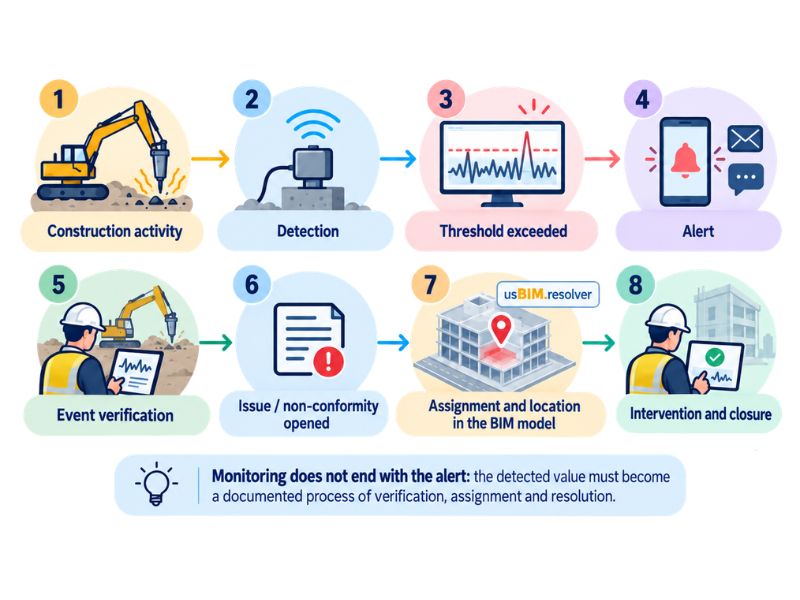
Workflow from vibration monitoring to issue management on site
When an alert needs to be quickly turned into an activity to manage, assign, and document, you can use usBIM.resolver to link the report to the BIM model, identify the responsible party for the intervention, and track its progress until resolution, preventing any threshold exceedance from remaining an isolated and unmanaged data point in the construction process.
FAQ on construction vibration monitoring
What is the limit for vibrations on construction sites?
There is no single limit that applies to all construction sites. The threshold depends on the structure in question, the characteristics of the vibration, the frequency, the condition of the building, and the technical reference used.
What is PPV?
PPV, Peak Particle Velocity, represents the maximum value of the vibrational velocity recorded during an event at a specific point and is usually expressed in mm/s.
What is the difference between a geophone and an accelerometer?
A geophone is primarily used to measure vibration velocity, while an accelerometer measures motion acceleration. The choice depends on the parameter being analyzed and the purpose of the monitoring.
Where should a vibration sensor be positioned?
The sensor should be installed at a representative point of the element to be monitored, for example, on a structure close to the source or at a significant point in the vibration propagation path.
When is it advisable to use continuous monitoring?
Continuous monitoring is particularly useful when the work extends over time, the vibration sources vary during the project, or when there are sensitive buildings and infrastructures that require constant monitoring.
Does exceeding the threshold mean the building has been damaged?
No. Exceeding a threshold indicates that a level has been reached that requires evaluation according to established procedures. It does not, by itself, constitute proof of the existence of damage.


