
Road Design: Methods, Materials, and Maintenance
The construction of roads requires specific knowledge in the field. Discover methods, materials, and maintenance strategies for safe and reliable infrastructures

Roads are an essential component of the infrastructure of every country as they ensure the mobility of people and goods and promote economic and social development. However, their construction is a complex process that requires specific technical skills and the integration of various disciplines, from civil engineering to geology, to environmental management.
In this article, we will see how a road is designed and constructed, analyzing the different phases of the construction process, the materials used, and the most commonly employed engineering techniques. We will also discover how dedicated digital tools—from building design software for modeling the layout, to structural monitoring solutions and infrastructure maintenance software—can support designers and technicians in the comprehensive management of the road lifecycle, improving the quality, accuracy, and timeliness of interventions.
Contents
- What is road construction and why is it important?
- Road design: criteria, tools, and techniques
- Stratigraphy of a road
- Types of Pavement
- Materials and Engineering Techniques in Road Design
- Phases of Road Construction: Excavation, Stabilization, and Layer Laying
- Sustainable Road Construction
- Importance of Road Maintenance
- FAQ on Road Construction
What is road construction and why is it important?
Road construction encompasses the set of activities related to design, construction, and maintenance of road infrastructures. It is a complex process that requires preliminary analysis of the territory, the selection of the most suitable materials, and the application of advanced engineering techniques to ensure safety, efficiency, and durability over time.
Roads are not just simple paved paths, but complex structural systems designed to withstand heavy loads, climatic variations, and continuous stresses due to traffic. Accurate construction is essential not only to ensure the daily mobility of people and goods but also to promote economic development, reduce environmental impact, and ensure the safety of those who travel on them.
Road design: criteria, tools, and techniques
The design of a road represents the most delicate and strategic phase of the entire construction process. It is in this phase that the functional, geometric, and structural characteristics of the road infrastructure are defined, taking into account the type of expected traffic, environmental conditions, and the morphology of the territory.
A well-conceived project must ensure safety, driving comfort, durability, and a reduced environmental impact. To achieve these objectives, the designer carefully analyzes the territorial context, chooses the most suitable materials, and applies technical criteria in accordance with current regulations.
Modern design employs advanced digital tools that allow for the simulation and optimization of every phase of the work. Technologies such as Digital twin and BIM-GIS integration for road management represent a significant evolution as they enable the monitoring of the entire lifecycle of the infrastructure, from design to maintenance, in a coordinated and efficient manner.
Road geometry
The definition of road geometry is the first step in the design process. It establishes the shape and dimensions of the road, articulated in three main elements:
- planimetric layout: defines the path in plan and the horizontal alignment of the road;
- altimetric profile: shows the elevation changes and determines slopes and vertical transitions;
- cross-sections: describe the configuration of the roadway (lane widths, shoulders, slopes) and affect drainage and stability.
A correct geometric setup allows for the definition of essential parameters such as:
- lane and shoulder widths;
- longitudinal and transverse slopes to ensure safety and water drainage;
- curvature radii and transitions to ensure smooth driving;
- visibility and stopping distances, crucial for safety;
- vertical transitions to maintain continuity and regularity of the layout.
Depending on the terrain morphology, the road can be:
- elevated, when it is above the natural ground level;
- in trench, when it is located below;
- half-slope, when one edge is elevated and the other is in trench.
All geometric elements must be calibrated based on design speed, visibility conditions, traffic type, and environmental and landscape constraints.

Main elements of road geometry
Geological Considerations
The geological and geotechnical conditions of the ground decisively influence the design and durability of the work. Before any intervention, geognostic investigations are carried out to determine the nature and strength of the soils, the depth of the water table, the presence of unstable or compressible materials, and the risks of landslides or subsidence.
This information allows to:
- choose the most suitable foundation;
- define drainage or consolidation works;
- adopt soil stabilization techniques in critical sections;
- prevent erosion and water infiltration that could compromise the pavement.
The analysis of geological conditions is therefore an essential phase of road design, as it allows for the early identification of soil criticalities and the adoption of effective technical solutions to improve the safety, efficiency, and sustainability of the work in the long term.
Designing a Road: The Example with Design Software
The design of a road can be significantly simplified through the use of a building design software, a tool that allows for the precise modeling of the alignment, slopes, cross-sections, and context elements with high accuracy.
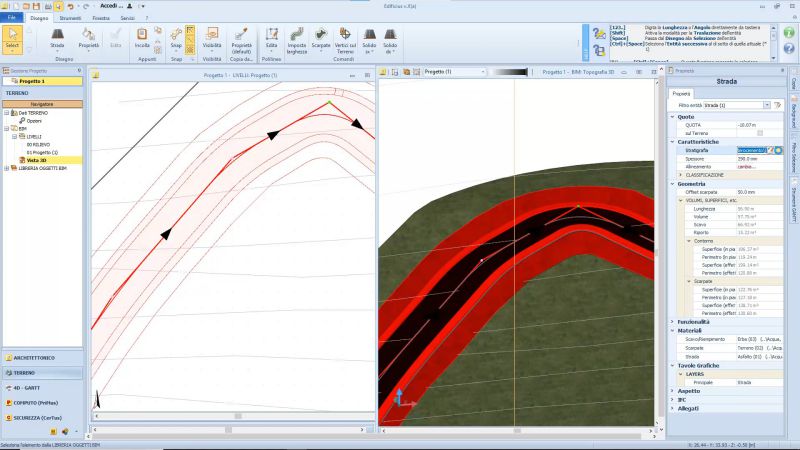
Insertion of the road element in the architectural design software Edificius
Although not specifically dedicated to road design, this type of software is particularly useful for engineers, architects, surveyors, and technicians involved in the planning of outdoor spaces or the construction of secondary infrastructures.
Among the main features offered are:
- three-dimensional terrain modeling, with the ability to import topographic surveys in DXF or DWG formats;
- design of accessory elements such as flower beds, curbs, walls, pavements, and irrigation systems;
- tools for photorealistic rendering, useful for previewing the project and effectively communicating the proposed solutions;
- integration with BIM platforms, allowing for coordinated design and more efficient management of the entire lifecycle of the work.
Watch the video below for more details:
Stratigraphy of a road
The stratigraphy of a road indicates the sequence of layers that make up the road pavement and that allow for the distribution of vehicle loads down to the foundation soil. Each layer serves a specific function and contributes to the stability, durability, and safety of the infrastructure.
A typical road structure consists of four main layers:
- wearing course (or surface pavement): this is the visible part of the road, directly exposed to traffic and weather conditions. It must ensure grip, impermeability, comfort, and noise reduction. Its thickness varies based on the type of pavement and traffic intensity. The most commonly used materials are:
- asphalt, which offers a flexible, smooth, and easily repairable surface, resistant to temperature variations;
- concrete, which is stiffer and more durable, ideal for heavy loads and intense traffic, although it requires longer laying and curing times;
- base layer: distributes loads to the lower layers and contributes to the mechanical strength and structural stability of the pavement. It is made up of stabilized granular materials or high-strength bituminous conglomerates;
- subgrade (or foundation layer): further distributes loads and provides uniform support to the upper layers. It consists of carefully selected and compacted natural or recycled aggregates (gravel, sand, crushed stone) capable of ensuring drainage and preventing water stagnation;
- subgrade layer: this is the natural base on which the entire structure rests. Its geotechnical characteristics significantly affect the performance of the road, which is why it may be necessary to proceed with compaction or stabilization using hydraulic binders.
The combination of these layers determines the road’s ability to withstand loads, resist climatic stresses, and maintain safety, comfort, and functionality over time for users.

Stratigraphy of a road
Types of Pavement
If the stratigraphy describes the sequence of layers that make up a road, the types of pavement concern how these layers are assembled and which materials are chosen based on traffic, climatic conditions, and performance requirements. Among the various types, we have:
- flexible pavements – this type of structure includes various layers, which consist of:
- bituminous conglomerate surface – made up of two layers, one wearing course (matt) and one binder;
- bituminous conglomerate base – can be made of bituminous mix or granular mix;
- foundation – usually composed of granular mix;
- subgrade – an integral part of the system;
- semi-rigid pavements – similar to flexible ones, with the exception of a cement-bound base layer (cemented mix);
- rigid pavements – made up of a concrete slab laid on one or more foundation layers composed of cemented mix and/or granular mix. Sometimes, they can be placed directly on the subgrade if the bearing capacity is adequate;
- composite pavements – consist of a rigid pavement on which a bituminous conglomerate layer, generally draining, is laid;
- modular pavements – made with elements of natural stone or manufactured products (for example, brick, concrete, etc.) placed on a bed of sand or cement mortar, with a base layer and a foundation layer;
- earth pavements – composed of a bearing layer of unbound or granulated stabilized granular material, sometimes superficially treated with bituminous emulsion.
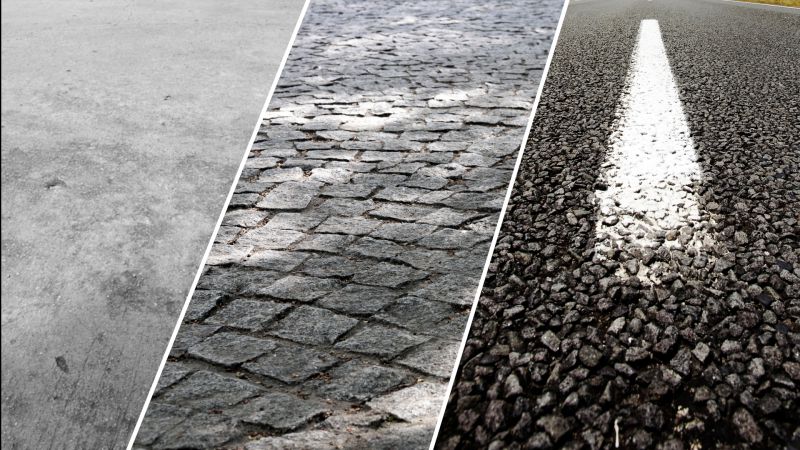
Types of road pavement
Materials and Engineering Techniques in Road Design
The quality of a road depends not only on correct design but also on the materials used and the construction techniques adopted. Every component of the pavement contributes to ensure load resistance, durability, safety for users, and comfort.
The materials used in road design are chosen based on structural functions, environmental conditions, and the type of expected traffic. Among the most common, we find:
- bituminous conglomerate (asphalt): composed of bitumen and mineral aggregates, it is the most widespread solution. It ensures impermeability, grip, and comfort, but can deform under high temperatures or heavy loads;
- concrete: used for rigid pavements, offers high resistance and long durability, although it requires longer laying and curing times;
- fiber-reinforced concrete: contains metallic or synthetic fibers that improve tensile strength and reduce cracking, ideal for roads subjected to heavy traffic;
- natural stone: materials such as granite, porphyry, or basalt are used in historic centers or in prestigious contexts. Natural stone combines durability and aesthetic value but implies higher costs and times;
- granular materials: sand, gravel, and crushed stone make up the base and foundation layers, ensuring stability and drainage;
- recycled materials and binders: asphalt milling, demolition aggregates, lime, or cement improve the cohesion of the layers and reduce the environmental impact of the work.
The effectiveness of the materials is closely linked to the engineering techniques adopted during the construction phase. Modern methodologies aim to improve infrastructure performance, optimize time and costs, and reduce the consumption of natural resources. Among the most common solutions:
- soil stabilization: using hydraulic or bituminous binders to increase load-bearing capacity and reduce deformability;
- drainage and filtration systems: ensure the proper outflow of water and prevent subsidence;
- cold or hot recycling: allows for the reuse of existing materials, reducing the use of new raw materials;
- digital control and 3D modeling: allows real-time monitoring of levels, thicknesses, and regularity of the layers during laying;
- geosynthetics and innovative materials: geogrids, geotextiles, and membranes are used to reinforce, separate, or stabilize the layers of the road pavement.
Phases of Road Construction: Excavation, Stabilization, and Layer Laying
The construction of a road involves several operational phases, each essential to ensure the resistance, durability, and safety of the work. Each phase requires the use of suitable materials, accurate technical controls, and the use of specific equipment.
Excavation and Ground Preparation
The initial phase involves the excavation, leveling, and preparation of the natural ground that will support the road structure. The main operations include:
- removal and disposal of the excavated material;
- leveling and profiling the ground according to the project layout;
- compaction of the laying surface to limit differential settlement;
- construction of drainage works (ditches, drainage pipes) to prevent waterlogging;
- geotechnical checks and, if necessary, interventions to improve or stabilize the ground.
Accurate preparation of the ground is crucial since any defects at this stage can compromise the stability of the entire road structure.
Stabilization and Layer Laying
After ground preparation, work proceeds with the construction of the base and intermediate structural layers. The main activities include:
- soil stabilization where it is not sufficiently resistant;
- laying of supporting materials (granular, cement-treated, or stabilized) according to the specified thicknesses and slopes;
- compaction of each layer with static or vibrating rollers to achieve the required density;
- control of the flatness and continuity between layers;
- possible treatments with hydraulic or bituminous binders to increase cohesion and durability.
During this phase, quality control of the materials (gradation, moisture, density) and compliance with the specified geometric tolerances are fundamental.
Asphalt Layer Laying
The final phase concerns the creation of the wearing layer in bituminous conglomerate or, alternatively, in cement concrete for rigid pavements. The main operations are:
- preparation and supply of the bituminous mixture according to the composition and temperature specifications;
- mechanized spreading using pavers, in compliance with the project thickness;
- immediate compaction with static, vibrating, or pneumatic rollers until the required density is achieved;
- final verification of regularity, adherence, and thickness to ensure durability and safety.
In the case of concrete pavements, the formation of joints, possible laying of reinforcements, and surface finishes to improve adherence and wear resistance are carried out. Errors at this stage, particularly in compaction, can significantly reduce the useful life of the pavement.
Equipment for Road Construction
The effectiveness of the operations depends on the use of adequate machinery that can ensure efficiency and precision at every stage. The main road construction equipment includes:
- excavators, graders, and backhoe loaders for excavation and ground shaping;
- compactor rollers (static, vibrating, pneumatic) for the compaction of the layers;
- pavers for the uniform laying of the bituminous conglomerate;
- trucks, concrete mixers, and asphalt spreaders for the transportation and distribution of materials;
- vibrating plates and compactors for finishing small or difficult-to-access areas;
- control and measurement instruments (laser levels, GPS, densimeters, profilometers) to ensure compliance with project specifications.

Phases of road construction
Sustainable Road Construction
In recent years, road design has evolved towards a more sustainable approach, where planning and execution aim to reduce environmental impact, optimize resources, and ensure durability and safety over time.
The main strategies adopted include:
- use of recycled materials: aggregates derived from asphalt milling, reclaimed concrete, and demolition waste are used in base layers or paving, reducing the consumption of raw materials and waste production;
- low-impact laying techniques: cold mix and efficient compaction procedures decrease energy consumption and CO₂ emissions on site;
- innovative pavements: photovoltaic asphalts, permeable surfaces, and high-reflectance materials improve energy efficiency, reduce the heat island effect, and promote sustainable stormwater management;
- integrated design and resource management: greater attention to reducing earth movements, eco-friendly drainage, protecting natural areas, and monitoring emissions during construction.
The adoption of these techniques allows for the creation of more resilient, efficient, and environmentally friendly roads, capable of meeting the needs of contemporary mobility without compromising the balance of the territory.
Importance of Road Maintenance
Road maintenance is an essential activity to ensure that road infrastructures remain safe, efficient, and durable over time. It can be:
- preventive, aimed at preventing future problems, including periodic interventions such as cleaning drains, maintaining signage, and restoring surface pavement;
- corrective, aimed at repairing localized damage that may manifest over time, such as potholes, cracks, or deformations of the road surface.
These operations are truly effective only if supported by advanced technological tools. Today, structural monitoring solutions for roads and infrastructure maintenance software are available, allowing for constant monitoring of pavement conditions and timely, targeted interventions.
The integration of AI in road maintenance also allows for predicting degradation phenomena, optimizing intervention planning, and reducing operational costs, while improving the safety and durability of infrastructures.
The adoption of advanced technologies for monitoring and maintaining roads offers numerous benefits, including:
- safety: sensors and predictive analysis systems identify structural defects or signs of abnormal wear in advance, reducing the risk of accidents. Constant maintenance allows for the timely elimination of hazards such as potholes, subsidence, or loss of grip;
- efficiency: real-time monitoring allows for targeted and scheduled maintenance, avoiding unnecessary interventions and ensuring smooth traffic flow, with reduced travel times and fuel consumption;
- durability: early intervention helps extend the useful life of pavements. Innovative technologies, such as self-healing or thermoreactive materials, reduce the formation of cracks and improve resistance to overheating;
- economic sustainability: preventive maintenance incurs lower costs compared to extraordinary repair interventions. Preventing damage means avoiding higher expenses related to structural degradation;
- aesthetic and urban value: well-maintained roads improve the image of the territory, promote tourism, and increase the perception of quality of life in urban areas.
Although implementing these technologies requires initial investments, in the long run, it guarantees significant economic savings and better overall performance of infrastructures, contributing to safer, more sustainable, and durable mobility.
FAQ on Road Construction
What is meant by road construction?
Road construction includes all activities necessary to design, build, and maintain a road infrastructure. It requires analysis of the territory, selection of materials, advanced engineering techniques, and checks to ensure safety, durability, and functionality over time.
What aspects are evaluated in road design?
Design takes into account expected traffic, terrain morphology, environmental conditions, and regulatory constraints. It includes defining road geometry, slopes, alignment, support structures, and drainage systems.
Why is road geometry important?
Correct geometry ensures smooth driving, water drainage, and adequate safety levels. Parameters such as curvature radii, slopes, and sight distances are calibrated based on design speed and environmental context.
What role do geological conditions play in road construction?
Geological surveys allow for identifying characteristics and issues of the terrain, determining the most suitable solutions for foundations, drainage, consolidations, and stabilization interventions, which are essential to prevent subsidence and infiltration.
What layers make up a road pavement?
A road is generally composed of:
- wearing course, exposed to traffic and weather;
- base layer, with structural function;
- subgrade, which provides support and drainage;
- laying plane, i.e., the properly prepared ground.
What types of pavement can be constructed?
Pavements can be flexible, semi-rigid, rigid, composite, modular, or earthen. The choice depends on traffic, climate, required performance, and available materials.
What materials are most commonly used in road construction?
Among the most common materials are: asphalt concrete, concrete, fiber-reinforced concrete, natural stone, granular materials, and recycled aggregates. The selection is guided by strength, durability, and environmental conditions.
What are the main operational phases in road construction?
The process includes:
- preparation of the ground with excavation, leveling, and drainage;
- construction of base layers;
- laying and compacting asphalt concrete or concrete;
- use of specific machinery to ensure precision and efficiency.
How can road construction be made more sustainable?
The sustainable approach involves using recycled materials, low-impact laying techniques, innovative pavements, efficient resource management, and reducing earth movements. The goal is to lower energy consumption and emissions.
Why is road maintenance important?
Regular maintenance improves safety, durability, and mobility quality. Preventive and corrective interventions help avoid structural degradation, reduce future costs, and keep the territory more welcoming and functional.


