
What Solar Greenhouses Are and Their Benefits
Solar greenhouses are structures designed to offer agricultural and electrical production. Discover the advantages and requirements
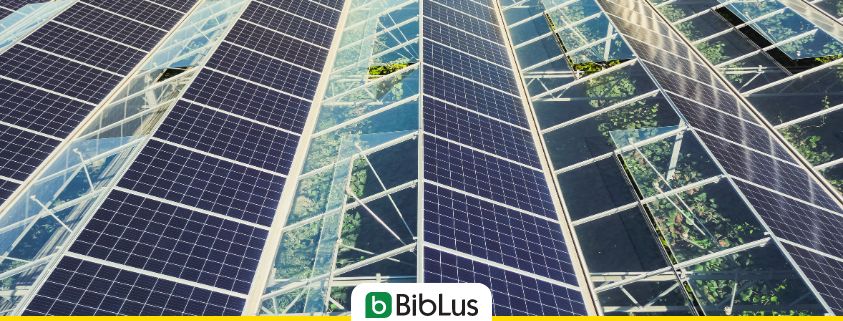
Solar greenhouses integrate agricultural production with solar energy production. By using semi-transparent photovoltaic panels, they allow the plants underneath to grow while producing clean energy. This innovative approach enables dual land use, optimizing space and maximizing yields.
There are numerous aspects to consider for the construction of a solar greenhouse. The shadow projection of the photovoltaic panels on the ground, the amount of photosynthetically active radiation inside the structure, and the design of protected systems capable of ensuring sufficient flexibility to adapt to changing crop needs in response to market variations are all factors that significantly influence the design of a solar greenhouse.
With a photovoltaic software, you have a valid BIM modeler at your disposal to assist you in the design, sizing, and calculation of the photovoltaic system most suitable for your greenhouse.
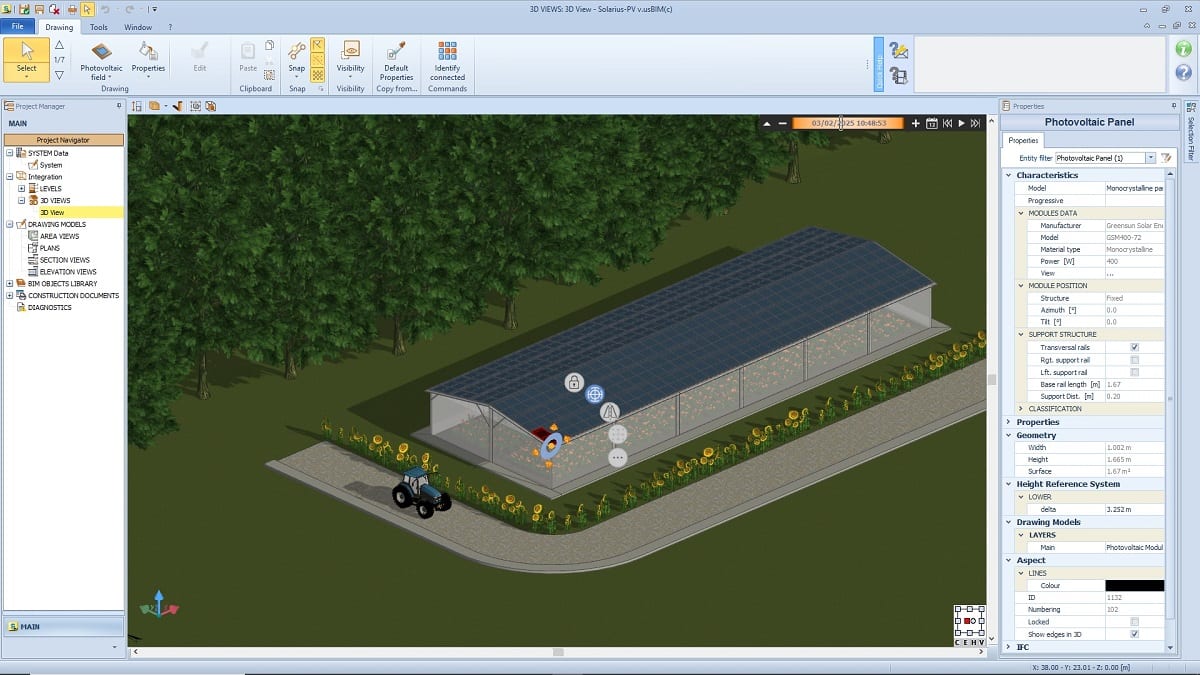
Solar greenhouse – Solarius PV software
Contents
What are solar greenhouses
Solar greenhouses are fixed structures that are anchored to the ground and are capable of providing, in addition to electricity production, also agricultural production. They therefore serve two purposes simultaneously:
- to provide agricultural and/or floricultural products;
- to produce electrical energy from photovoltaic sources.
Greenhouses have the prerogative of being able to create the ideal environment for the type of cultivation intended. Their structure can be made from various materials: iron, structural wood, masonry, or aluminum.
They usually rest on a masonry base or on mobile supports anchored in the ground, with walls and roofs made of transparent material with fixed or seasonally removable closures.
Depending on the needs, light can be let in, heat can be regulated, and humidity levels can be varied inside. The walls are made of transparent glass, and the roof can be sloped on one or both sides and is equipped with windows that open outward to allow for ventilation.
Types of greenhouses
Based on structural and geometric solutions, greenhouses can be classified into:
- tunnel greenhouse: they have an arch sector structure, the covering is usually made of plastic film, and they are generally mobile structures. Their distinctive features are low cost and reduced technology for climate control;
- curvilinear roof greenhouse: they have a roof with a curvilinear profile, supported by vertical posts, and the covering is usually made with plastic film or sheets. There are openings in the walls and on the roof for ventilation;
- pavilion greenhouse: they have a flat-pitched roof supported by vertical walls, and the covering is made using glass or plastic sheets. Openings for air circulation are positioned along the sides and at the ridge. This type includes venlo greenhouses: vertical columns and a horizontal beam constitute the primary load-bearing structure, on which the secondary structure of the roof rests; generally, the covering is made of glass.
Characteristics of a solar greenhouse
As we have seen, there are various types of solar greenhouses, designed according to the available space and the type of cultivation planned.
However, some structural characteristics must always be respected to ensure the full efficiency of the photovoltaic system:
- dimensions: greenhouses must have a minimum width of 9 meters and a height of at least 2 meters. If multiple solar greenhouses are to be built, a distance of at least 6-7 meters must be maintained between them;
- exposure: solar panels must be installed on the part of the greenhouse most exposed to the south to maximize the capture of sunlight. They can be arranged in a checkerboard pattern to allow for greater light penetration through the covering;
- power: there is no predefined standard power for solar greenhouses. Each system must be sized according to specific needs, similar to what happens for residential solar systems.
What are the advantages of a solar greenhouse
One of the main advantages of integrating photovoltaics into greenhouses is the ability to design the optimal orientation of the panels from the early planning stages, as greenhouses are not fixed buildings with foundations.
The construction of a greenhouse intended to host a photovoltaic system requires a covering designed to accommodate the panels with an ideal inclination and oriented towards south.
Unlike installation on buildings, warehouses, or storage facilities, the mounting system for the panels on a greenhouse can be much more versatile, being semi-removable. This enables optimization of the inclination and orientation of the photovoltaic modules based on the seasons or the ventilation needs of the plant nursery.
Another significant advantage is the direct use or storage of the energy produced by the panels for the operation of the greenhouse itself. Thanks to sensors and actuators, it is possible to automate various aspects of the greenhouse. For example, humidity and temperature sensors, powered by solar energy, can automatically and self-regulate ventilation systems. The same applies to irrigation, light management, monitoring of internal and external humidity, and the operation of harvesting machinery.
Cost of a solar greenhouse
The design of a solar greenhouse must first meet the agronomic needs of the farm. Therefore, the associated costs will depend on the type of project to be realized.
Specifically, costs can vary significantly and include several components to consider, such as:
- cost of the land;
- cost of the structure;
- cost of the integrated photovoltaic system;
- installation.


