
IFC Example: Implementation of the IFC 4.4 Standard
Discover an IFC example for tunnels with the IFC 4.4 standard; geometric details, interoperability, and integration with GIS for an advanced openBIM model

The implementation of the new IFC 4.4 standard is a great opportunity for the design, construction, and operational management of infrastructures. In this article, we will explore how the technology of ACCA software, in accordance with the reports from buildingSMART International, makes it possible to achieve a accurate and efficient modeling of tunnels by creating a complete example of an IFC model.
We will see how this process allows for the management of every single component of the tunnel, from geometry to data management, with a focus on how to achieve an IFC example of an openBIM model with accuracy, efficiency, and interoperability.
The IFC example is supported by three important attachments that allow for a detailed exploration of the described content and detailed interaction with the data generated in the example:
- IFC example to navigate directly online on a cloud-based IFC viewer;
- buildingSMART International report to download for free in PDF regarding how to create an IFC example (IFC-Tunnel Project – Report WP2: Requirements analysis report (RAR))
- the video that illustrates the IFC example and how it was produced.
Contents
- Infrastructure Modeling: A Comprehensive Overview
- The subdivision of the tunnel into special zones
- Decomposition Approach and Object Creation
- Modeling of Drainage and New Use Cases
- Navigation and control of the model: from the first floor to GIS
- The advantages of implementing the IFC standard for tunnels
Infrastructure Modeling: A Comprehensive Overview
The implementation of the new IFC 4.3 (Industry Foundation Classes) standard aims to improve collaboration between engineers and designers during the various phases of the project. Using the buildingSMART International report, ACCA software has developed an IFC example that allows for the visualization of a tunnel in every detail and, above all, a model that allows for seeing the IFC 4.3 standard in action.

Report buildingSMART International for tunneling with the IFC 4.3 standard
The initial phase of the process included the modeling of two different alignments: one for the railway and one for the tunnel itself.

Modeling of two different alignments: railway and tunnel
The subdivision of the tunnel into special zones
A fundamental step was to subdivide the tunnel into different special zones. To determine the best structure to use, the report from buildingSMART International was adopted, which proposes three different scales: large, medium, and small scale.

Report buildingSMART International large scale approach

Report buildingSMART International medium scale approach
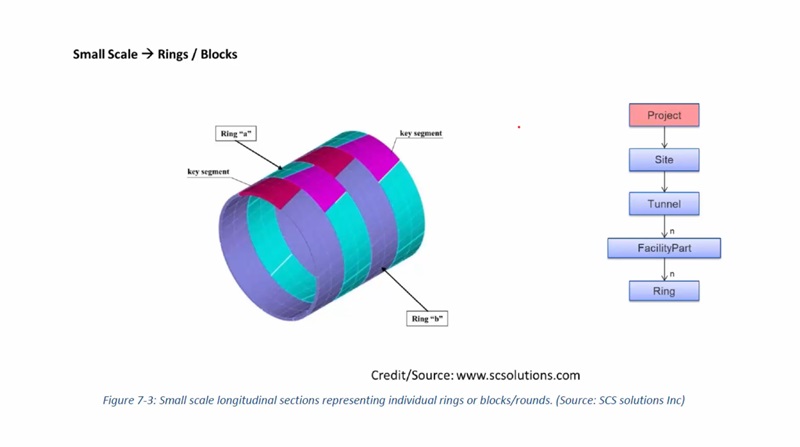
Report buildingSMART International medium scale approach
For our practical IFC example, we opted for the medium scale. This allowed us to divide the tunnel into the following sections:
- tunnel portal;
- partial thrust behavior;
- total thrust behavior.
Each part of the tunnel was further divided into “spaces,” as suggested by the buildingSmart report, which include lining, internal drainage, and rail spaces. These spaces are further detailed down to specific objects, such as individual tunnel bolts.

Spaces modeled in the IFC example

Example of the IFC 4.4 file structure to achieve the geometric and informational detail representation of each entity in the model
What is demonstrated with this IFC example is that, thanks to the use of the new IFC 4.4 standard, it is possible to start from the drawings, create and model the tunnel very accurately. In addition to appreciating the geometric detail, we must not forget that each single object is also rich in information, with all its properties.

Geometric and informational detail of each object in the IFC example of the openBIM model
Decomposition Approach and Object Creation
To achieve a detailed representation, ACCA has employed a decomposition-based approach. Each component of the object has been created as an “assembly of assemblies,” allowing for very accurate geometry. This approach also provides the possibility of having a detailed and precise quantity survey.

Object decomposition approach in IFC example creation
Modeling of Drainage and New Use Cases
In addition to the tunnel structure, the drainage system has also been modeled. Here too, we can see that each individual object has been modeled separately, down to the single bolt of the tunnel.

Detail of drainage system modeling in IFC example
This detailed modeling opens up new usage opportunities, including code checking and clash detection, thus ensuring a high level of accuracy at every stage of the project.
One of the most innovative features is the ability to navigate the tunnel in first person to verify the evolution of the construction.

Navigate in first person the IFC example to verify construction systems with Virtual Reality technologies directly in the cloud
Moreover, the use of the grouping mechanism allows for the combination of similar objects, simplifying the visualization and management of information, but also breaking down the tunnel in different ways.

How to group similar objects in different ways in the IFC example
Another key element is the ability to distribute the OpenBIM IFC model directly on a GIS system.

Integration of the IFC example with GIS for geospatial queries of all the information entered in the openBIM tunnel model
This is very important because it allows the GIS system to query the necessary information for spatial queries directly from the IFC model, to obtain highly accurate results.
The examples given in this article are based on developments related to the IFC 4.4 version, which is currently not an officially approved standard. The version is still under review and approval, and the contents may be subject to future changes during the integration and validation process by the stakeholders involved.
The advantages of implementing the IFC standard for tunnels
The adoption of the IFC 4.3 standard represents a turning point for the design and management of infrastructure. Thanks to increasingly precise modeling and data integration, it is possible to obtain models that not only meet high interoperability standards, but also improve the overall quality of the project.
Below, we explore the main advantages that this implementation offers for tunnels, redefining the way we conceive and manage infrastructure works:
- model accuracy: every single object, down to the bolt, has been modeled with a high level of geometric detail and property information;
- data integration: the ability to manage the model at different levels of decomposition allows for a complete and detailed overview;
- new use cases: in addition to structural design, modeling allows for checks such as code checking and clash detection;
- support for GIS: the ability to distribute the model on a GIS system allows for complete integration between the project and spatial analysis.
The implementation of the new IFC 4.4 standard for tunnels allows for increasingly detailed and interoperable modeling and enables the transition from drawings to the creation of extremely accurate and information-rich models, useful not only for construction but also for future analysis and management of the infrastructure.


