
Automatically Recognizing Entities in DXF/DWG for BIM Projects
How is the import and recognition of entities from a DXF/DWG file performed in a BIM project? How to do it with BIM Authoring software
Is it possible to generate a BIM model directly from a DWG file? Can this process be automated to save time and improve accuracy?
In this short in-depth guide, we will explore how to import DWG/DXF files into Edificius, the BIM software for architectural design, and transform traditional 2D CAD drawings into intelligent BIM models.
Thanks to dedicated automation features, you will see how easy it is to convert a 2D project into a complete 3D BIM model, automatically generating architectural entities from DXF/DWG drawings and significantly streamlining the modeling workflow.
Contents
Why convert 2D CAD drawings into BIM objects
The conversion of 2D CAD drawings into BIM objects is a crucial step toward integrating geometric information and technical data into a single intelligent digital model. While traditional CAD is limited to graphical representation, BIM enriches every element with informative properties related to all phases of the building lifecycle, including materials, performance, costs, maintenance, and construction planning.
Converting a 2D DWG drawing into BIM objects means transforming simple lines and symbols into structured, parametric, and intelligent elements such as walls, slabs, doors, and windows.
This process enables:
- greater coordination among disciplines;
- more accurate energy and structural analyses;
- automatic metric calculations;
- more efficient building lifecycle management.
Read also:
How to easily convert a DWG file into IFC
The complete guide to converting IFC files to DXF
Typical use cases for the conversion from DWG to BIM
The conversion from DWG to BIM is particularly useful in various operational scenarios.
Let’s see some of them:
- retrieval of existing buildings: digitization of historical CAD archives;
- renovation projects: 2D base transformed into an informative model;
- facility management: creation of BIM models from existing floor plans;
- regulatory verification: updating legacy drawings to BIM standards;
- interdisciplinary coordination: integration with structural and plant models.
Common issues when importing DWG/DXF files into BIM environments
During the import of CAD files into BIM environments, various critical issues may arise:
- dirty geometries (overlapping lines, broken segments);
- incorrect scales or inconsistent units;
- disorganized or unused layers;
- exploded or unrecognized blocks;
- texts and dimensions that cannot be converted into BIM objects.
These problems can compromise the quality of the model and require manual interventions.
Best practices for preparing a CAD file before BIM import
To optimize the conversion, it is essential to properly prepare the CAD file:
- clean the drawing by removing unnecessary elements;
- unify and rename layers according to a clear logic;
- use consistent and standardized blocks;
- verify measurement units and scale;
- close polylines (e.g. for walls and rooms);
- simplify complex geometries.
Good preparation drastically reduces time and errors in the BIM phase.
Importing a DXF/DWG file with BIM Authoring software
Now let’s see how to proceed operationally with the automatic recognition of the DWG using BIM authoring software.
From the drawing toolbar of Edificius, go to 2D Graphics and select the DXF/DWG Drawing function.
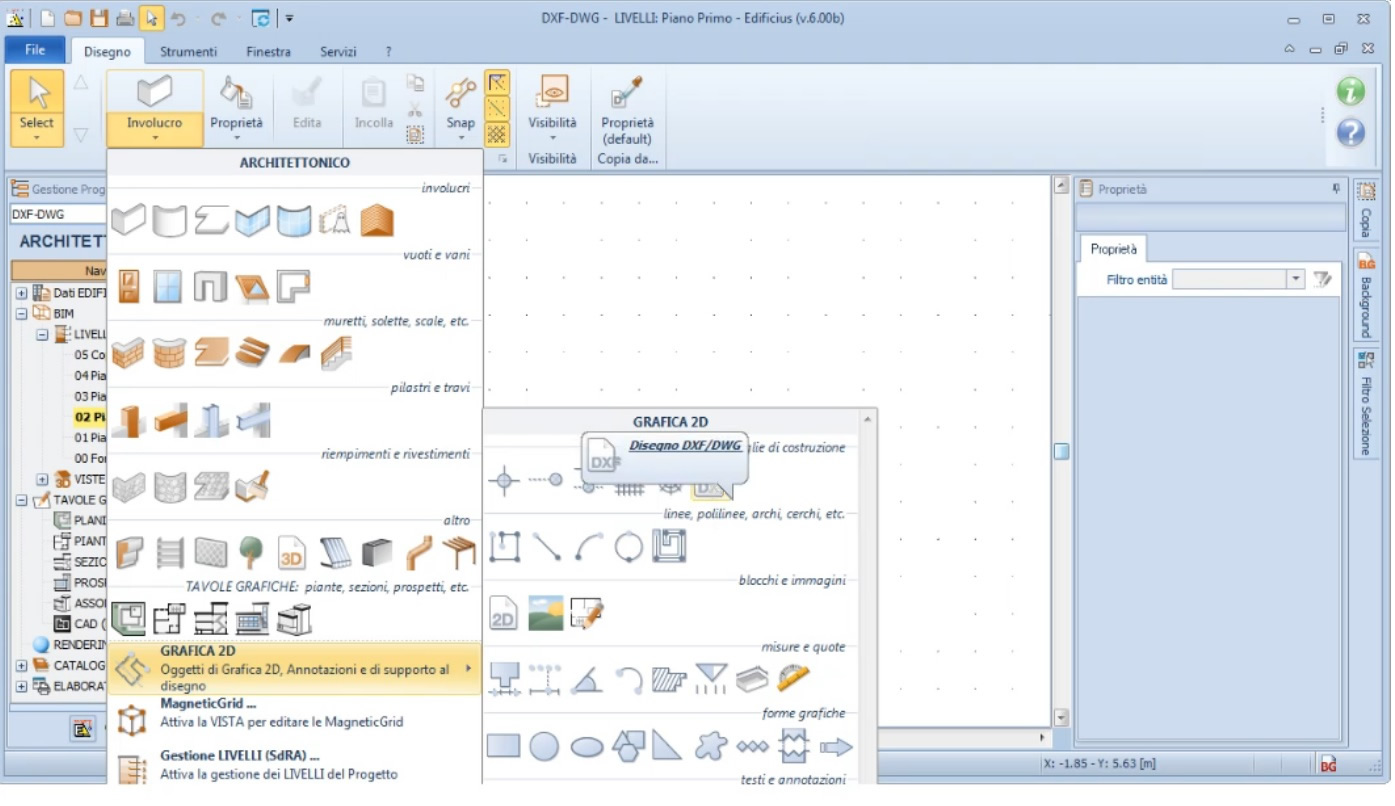
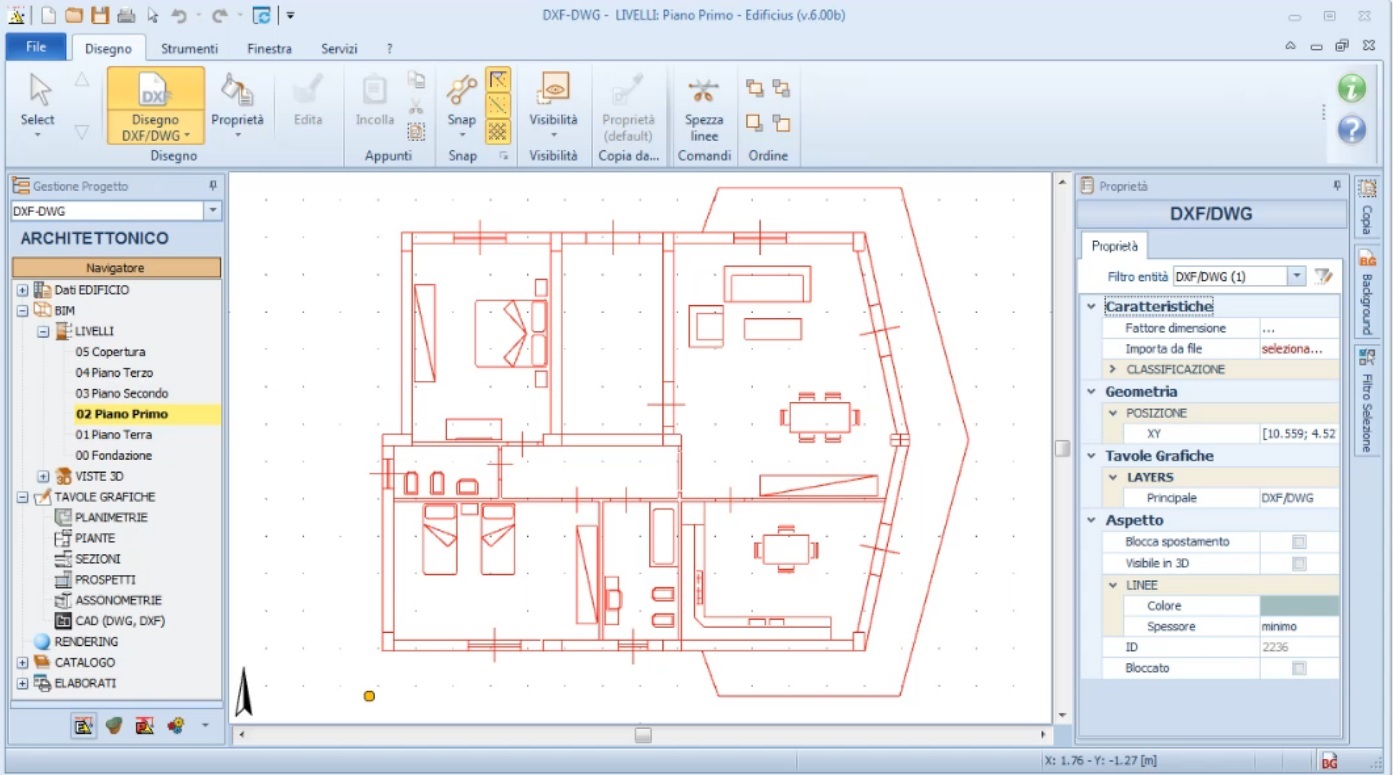
Let’s choose the drawing to upload, and before the import process starts, we need to enter the dimensional factor necessary to convert the various units of the DXF/DWG drawing into meters.
We position the drawing within the project.
Let’s start by selecting the object we want to draw (enclosures, walls, slabs, stairs, and more) and then using the DXF/DWG wand tool we automatically generate the various entities.
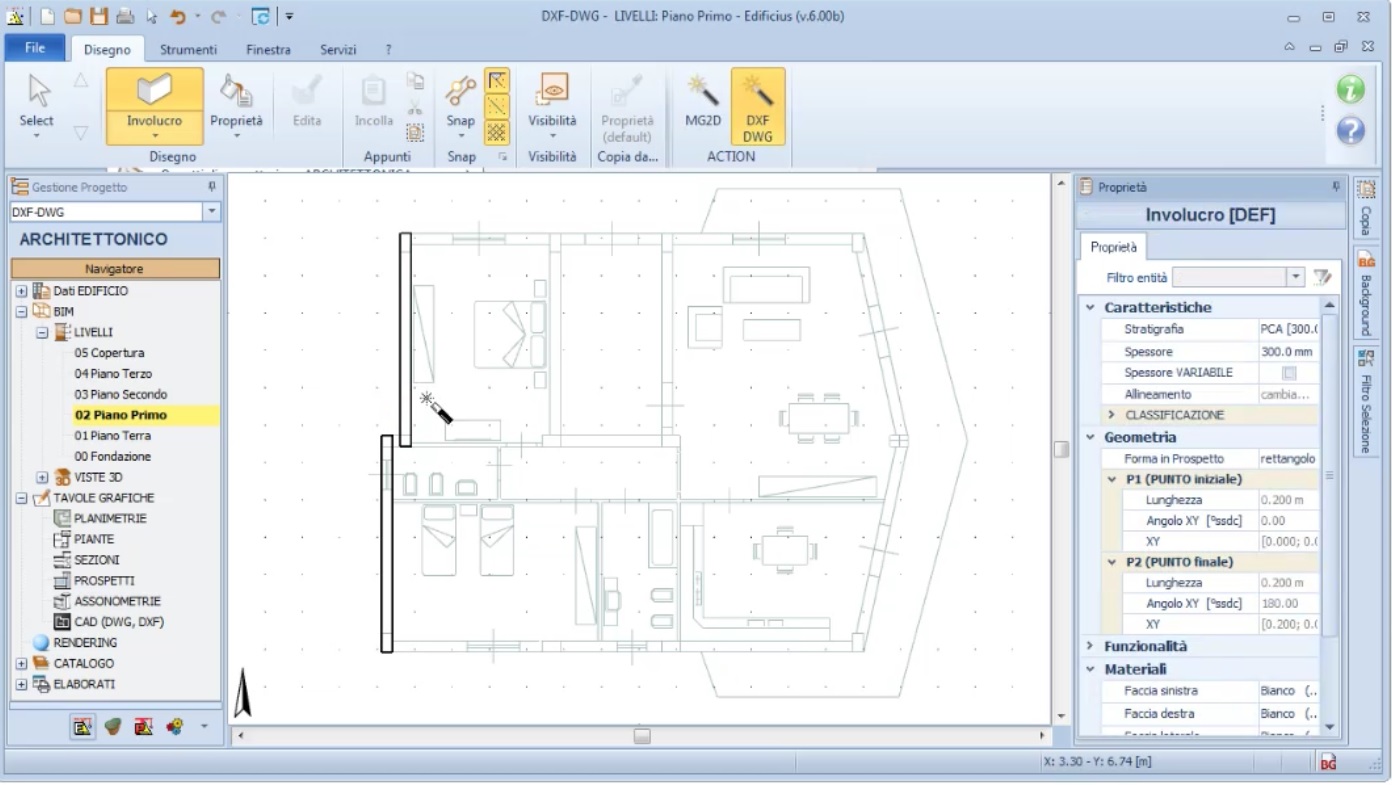
We proceed in the same way for all the various entities present in the project.
In no time, and in an absolutely intuitive manner, the CAD drawing transforms into a BIM model.
FAQ
Is it possible to obtain a BIM model from a DWG drawing?
Yes, it is possible to obtain a BIM model from a DWG or DXF drawing thanks to import functions and automation present in BIM authoring software. The 2D drawing is transformed into intelligent 3D entities such as walls, floors, doors, and windows, integrating geometric information and technical data.
Why convert 2D CAD drawings into BIM objects?
The conversion of 2D CAD drawings into BIM objects allows for the transformation of graphical representations into parametric and informative elements. This enables greater coordination between disciplines, more accurate energy and structural analyses, automatic quantity takeoffs, and better management of the building’s life cycle.
What are the common problems when importing DWG or DXF files into BIM?
During the import process, issues such as unclean geometries, incorrect scales, disorganized layers, unrecognized blocks, and non-convertible texts or dimensions may arise. These issues can compromise the quality of the model and require manual corrections.
How do you prepare a CAD file before importing it into BIM?
To properly prepare a CAD file, it is necessary to clean the drawing by removing unnecessary elements, organizing the layers coherently, using standardized blocks, checking units and scale, closing polylines, and simplifying geometries. This reduces errors and conversion times.
How do you import a DWG or DXF file into a BIM software?
In BIM software like Edificius, you can import a DWG or DXF file using the DXF/DWG Drawing function. After selecting the file and setting the scale factor, the drawing is positioned within the project. Using automatic tools like the DXF/DWG wand, it is possible to generate BIM entities from 2D elements.
What advantages does automatic conversion from CAD to BIM offer?
Automatic conversion from CAD to BIM allows for the rapid transformation of 2D drawings into informative 3D models. This enhances productivity, reduces manual errors, speeds up modeling, and allows the immediate integration of technical and design information within the BIM model.


