
BIM SROI: Measuring Social Value of Construction and Infrastructure
What is SROI, how is it calculated, and why BIM can help measure the social value of buildings, infrastructures, and urban regeneration projects

For decades, the construction industry has measured the success of a project with two metrics: adherence to costs and adherence to timelines. In recent years, a third metric has been added, environmental, supported by LCA, EPD, and sustainability criteria. However, in daily practice, the fourth question is still missing — perhaps the most important one for projects funded by the community: how much social value does this intervention truly generate for the people who will use it and for the territory that hosts it?
SROI (Social Return on Investment) is one of the most established methodologies to answer this question, and BIM, with the informational structure it produces throughout the entire life cycle, is the data infrastructure that can make that measure credible, repeatable, and verifiable.
Let’s see how the two worlds meet and why this convergence closely concerns those who design, build, and manage the built environment.
Contents
What is SROI (Social Return on Investment)?
SROI is a method, based on principles, that measures and assigns a monetary value to the extra-financial value — social, environmental, and economic — generated by a project, organization, or policy and is normally not recorded by traditional accounting. It originated in the United States in the mid-nineties through the efforts of the Roberts Enterprise Development Fund, was later developed by the New Economics Foundation, and finally standardized internationally by Social Value International.
The result of the analysis is an SROI report: for every euro invested, how many euros of social value are created. A ratio of 3:1, for example, indicates that for every euro invested, three euros of social value are generated. It is a number with strong communicative effectiveness — it summarizes quality, effectiveness, and impact in a single figure — and it is precisely this readability that makes it appreciated by public administrations, funding bodies, and impact investors.
SROI and ROI: what is the difference
Traditional ROI measures only the financial return of an investment. SROI broadens the perspective: it also monetizes what the market does not price — well-being, health, inclusion, community cohesion, public space quality — using evaluation techniques that assign value to otherwise “invisible” outcomes in financial statements. It does not replace financial analysis: it complements it, offering a complementary perspective on the overall value of a project.
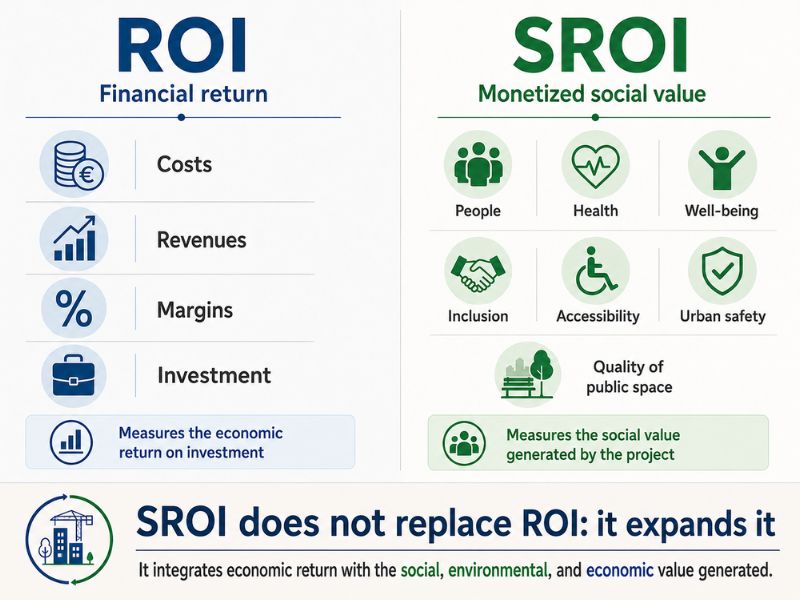
ROI vs SROI
Principles and Six Stages of SROI Analysis
The credibility of the method relies on the principles codified by Social Value International: involve stakeholders; understand what changes; value what matters; include only what is material; do not overestimate your contribution; be transparent; verify the outcome. Without adherence to these principles, the SROI report risks becoming a marketing number rather than a defensible measure.
The analysis is practically structured into six stages:
- Define the scope and identify stakeholders. What is the purpose of the analysis, for whom, over what time frame and with what resources. Who benefits, who is involved, who is affected by the work.
- Map the outcomes (theory of change). The chain input → activities → output → outcomes is constructed, clearly distinguishing what is produced (a civic center built) from what changes in people’s lives (more social interaction, less isolation).
- Provide evidence for the outcomes and assign a value to them. Data is collected and a financial proxy is associated with each outcome.
- Establish the actual impact. Four adjustments are applied to avoid overestimation: deadweight (what would have happened anyway), attribution (how much is due to others), displacement (effects transferred to other groups), decay (how the effect fades over time).
- Calculate the SROI. The value of the impacts, discounted, is related to the investment.
- Report, use, and integrate. The result is communicated and — above all — it is used to improve decisions.
From Financial Value to Social Value: The Proxies
The technical — and most delicate — heart of the SROI is the financial proxy: a rough monetary value assigned to a benefit that does not have a market price. Reducing travel times of a new connection, lowering the accident rate at a traffic junction, providing a neighborhood with a safe and accessible space: all real effects that the SROI attempts to express in euros to make them comparable to the investment. The quality of the proxies and the robustness of the evidence matter more than the final number: a poorly conducted analysis produces misleading reports.
IN SUMMARY
The SROI answers a question that ROI does not pose: how much is the change produced in people’s lives and the territory worth in monetized terms? It is a rigorous but data-intensive method — and this is exactly where the BIM changes the rules of the game.
Why SROI is a New Frontier for the Construction Sector
The construction sector is undergoing a gradual evolution in the criteria used to evaluate the success of an intervention. Alongside economic and environmental indicators, there is increasing attention towards the effects that buildings, infrastructures, and public spaces have on people and communities. In this context, the SROI offers a concrete tool to measure and make visible that value which often remains outside traditional reporting systems.
The possibility of translating social impacts into monetary terms makes the method particularly interesting for public administrations, investors, funding bodies, and operators in the construction supply chain, who are increasingly called upon to demonstrate not only what they achieve but also what benefits they generate over time.
From Building Performance to Outcomes for People
The literature on the built environment has shown how the evaluation of a work must shift from measuring the building’s performance to measuring the outcomes experienced by people. The SROI is indicated as the most developed method for bridging this gap, as it produces monetized results that are therefore transferable and communicable among the various stakeholders in the design and construction supply chain. It represents a paradigm shift: the work is not assessed for what it is, but for what it changes in those who inhabit it.
ESG, Public Procurement, and Impact Investing: The Regulatory Context
The push towards measuring social value is not only cultural. The growing attention to the social dimension of ESG criteria, to the development of impact finance, and to the evolution of procurement systems towards results-oriented models is making the ability to measure and demonstrate social impacts a competitive factor in an increasing number of markets.
In the construction and infrastructure sector, this evolution translates into the need to demonstrate not only the technical quality of the work but also the value generated for users, communities, and territories. More and more frequently, public and private clients require evidence that investments produce measurable benefits from a social, environmental, and economic standpoint.
In this context, SROI (Social Return on Investment) is located, a methodology that allows not only for the evaluation of a project’s outputs but also the change generated over time for the involved stakeholders. Its goal is to translate social impacts into a comprehensible and comparable measure, supporting more informed decisions and more transparent reporting.
The interest in SROI arises from the increasingly widespread need to demonstrate with recognized data and methodologies the social value created by an investment, an infrastructure, or a service. Although its use is not generally mandated by regulations, it represents an effective tool to respond to the demands for accountability coming from investors, financial institutions, public administrations, international organizations, and other stakeholders.
The evolution of sustainability policies and investment evaluation criteria in fact highlights a growing attention to the social effects of interventions and the ability of economic operators to document them. In many procurement systems and funding programs, the evaluation of proposals increasingly considers, alongside economic and technical aspects, also qualitative, environmental, and social elements. At the same time, ESG standards and international reporting frameworks are strengthening the demand for reliable indicators capable of measuring impacts generated over the long term.
In this scenario, SROI is not only a valuation tool but also a strategic support for project management, communication with stakeholders, and demonstration of created value. Its ability to integrate quantitative and qualitative evidence enhances the credibility of organizations and supports decisions aimed at sustainability and the creation of shared value.
Urban Regeneration and Social Infrastructures
One of the areas where measuring social impact finds its most significant application is urban and territorial development. Internationally, public investment programs aimed at urban regeneration and social infrastructure seek to reduce inequalities, combat urban decay, strengthen social cohesion, and improve the quality of public spaces. In this context, the Italian National Recovery and Resilience Plan (PNRR) represents a concrete example, having allocated significant resources to interventions for social inclusion, urban regeneration, and community development.
Since the objectives of these investments are predominantly social, their evaluation requires methodologies capable of measuring the value generated for citizens and territories. In this sense, Social Return on Investment (SROI) constitutes a particularly effective tool to demonstrate how public resources have produced concrete benefits not only in economic terms but also from a social and environmental perspective.
The same principle applies to infrastructure investments. Beyond the benefits related to mobility, such interventions can generate positive effects on accessibility, safety, territorial cohesion, and the quality of life in communities. An evaluation based on SROI allows making these broader impacts visible, offering public decision-makers and investors a measurement of the created value that goes beyond traditional cost-benefit analyses.
The Role of BIM in Measuring Social Value
The historical limitation of SROI is operational: it is a data-intensive methodology with many stakeholders, expensive to conduct, and difficult to update over time. This is exactly the gap that BIM can fill because it transforms the work into a structured, queryable, and persistent information asset throughout its life cycle.
The Informational Model as Data Source for SROI
In BIM, elements and spaces are not simple geometries but objects endowed with properties and relationships that explicitly integrate all the information regarding the work. This means that many of the data necessary for an SROI analysis — surface areas of public and communal spaces, accessibility, facilities, functional relationships between environments, performance — are already present, and qualified, in the model. Rather than reconstructing them retrospectively with costly surveys, SROI can draw from the source, reducing costs and arbitrariness in estimating the proxies.
From BIM Model to Digital Twin: Monitoring Outcomes Over Time
SROI does not end at the project phase. It distinguishes between predictive analysis (what we expect) and evaluative (what has actually happened), and the latter requires tracking the work over the years. This is where the model evolves into the digital twin: enriched with data from operations — sensors, usage flows, maintenance — it becomes the basis for a longitudinal and evaluative measurement of social impact, capable of confirming or correcting initial estimates. Social value ceases to be a one-time forecast and becomes a monitorable indicator.
openBIM, IFC, and Data Interoperability for Impact
For all this to work, data must be able to circulate between different tools and stakeholders without proprietary constraints. The openBIM approach — with open formats like IFC and process standards like ISO 19650 — ensures that project, construction, and operation information remain readable and reusable over time, even by the external stakeholders that
An example of SROI calculation for urban regeneration
The following example does not provide official benchmarks but demonstrates how to establish a simplified SROI calculation for an urban regeneration intervention.
To make the method concrete, let’s assume an intervention: the recovery of a decommissioned public building transformed into a civic and social hub for the neighborhood, alongside the redevelopment of the adjacent public space, serving a neighborhood of about 8,000 inhabitants. The numbers that follow are simplified and purely illustrative: they serve to illustrate the logic, not to provide reference values.
Investment (input): € 2,000,000. By involving stakeholders and building the theory of change, four main outcomes are identified, and a financial proxy is associated with each one:
| Stakeholder | Outcome (what changes) | Financial proxy | Gross value / year |
| Elderly and vulnerable people | Reduction of isolation, more social interaction | Avoided social-health costs | € 560,000 |
| Youth | Inclusion, educational outcomes, and employability | Cost avoided from drop-out + higher employability | € 460,000 |
| Entity and community | Greater safety, less degradation | Lower maintenance, surveillance, restoration costs | € 230,000 |
| Local economic activities | Vitality and attractiveness of proximity | Higher local income and employment | € 320,000 |
| Total annual gross value | € 1,570,000 | ||
However, the gross value needs to be adjusted to avoid overestimating the contribution of the project, applying the four adjustments of the method. In this example: deadweight 20% (part of the change would have occurred anyway), attribution 25% (credit due to other programs or local actors), displacement 5% (effects transferred to other areas). The combined net factor is:
0.80 × 0.75 × 0.95 = 0.57
€ 1,570,000 × 0.57 ≈ € 895,000 of net social value per year
Projecting the benefit over a 10-year horizon, with a 10% annual drop-off and a discount rate of 3.5%, the net present social value stands at around € 5.0 million. Related to the investment:
SROI ≈ € 5,000,000 / € 2,000,000 = 2.5 : 1
for every euro invested, about 2.5 euros of social value generated

SROI in urban regeneration
It is here that the link with BIM becomes operational. The physical and functional dimensions upstream of the proxies — surface areas of aggregation spaces, facilities, accessibility, capacity — are read directly from the IFC model; the usage data that feed the verification over the years (attendance, hours of activity, actual use) come from the monitoring connected to the digital twin; and every piece of evidence remains tracked in the CDE, guaranteeing transparency and verifiability. Without this data foundation, the same figures would remain estimates difficult to defend.
The construction and infrastructure sector is finally equipping itself with tools to demonstrate not only what it builds but what value it produces. SROI provides the method; BIM, with its models, digital twins, and data sharing environments, offers the informational infrastructure that makes it feasible on a large scale. For engineers, architects, surveyors, companies, and public administrations, mastering this convergence means speaking the language of the overall value of the work — that which clients, financiers, and communities will increasingly demand to account for.
FAQ on BIM and SROI
What is SROI?
SROI (Social Return on Investment) is a methodology that measures and assigns a monetary value to the social, environmental, and economic impact generated by a project or work, expressing it as a ratio to the investment (for example, 3 euros of social value for every euro invested).
How is SROI calculated and what is the SROI ratio?
It is calculated by discounting the monetized value of impacts — net of adjustments for deadweight, attribution, displacement, and decay — and relating it to the investment made. The result is the SROI ratio: a value greater than 1:1 indicates a positive social return. There is no universal benchmark for a “good” ratio: context and the quality of evidence matter more than the number.
What is the difference between ROI and SROI?
ROI measures only financial return; SROI adds social and environmental value, monetizing outcomes that the market does not price. SROI does not replace ROI but complements it.
What are the financial proxies in SROI?
They are approximated monetary values attributed to benefits without a market price (health, safety, inclusion, quality of public space), which allow for the comparison of social impact with investment.
Is SROI mandatory in public procurement?
There is no generalized obligation for SROI analysis. However, the evaluation of social impact is increasingly present as an award criterion, reporting requirement, and ESG lever, particularly for urban regeneration interventions and social infrastructure funded with public resources.
What is a good SROI value?
There is no universal threshold. A ratio greater than 1:1 indicates a positive social return, and many projects fall within a range of about 2:1 to 10:1, but the value strongly depends on context, time horizon, and the conservativeness of assumptions. A rigorous analysis, with credible proxies and well-applied adjustments, is worth more than a high number achieved with optimistic estimates.
How does BIM relate to SROI?
BIM provides the structured and interoperable data foundation (informational model, IFC, ISO 19650) from which SROI draws the necessary dimensions to estimate proxies, while the digital twin allows for monitoring outcomes over time. A CDE like usBIM.platform brings together models, documents, and specialized apps, making the analysis traceable and repeatable.
What is Social Impact Assessment (SIA)?
SIA measures and describes the changes generated by a project on people, the community, and the environment. SROI is its dimension that translates those impacts into economic value, making them comparable to the investment.


