
Solar Panel Wiring: Connecting Solar Panels in Parallel or Series?
The connection of solar panels in a photovoltaic system can be in series or in parallel. Discover the main differences and installation methods
The connection of solar panels is an important phase in the design of a photovoltaic system, as it directly affects the system’s performance and overall efficiency. There are mainly two connection modes for solar panels: in series or in parallel. Each of these has advantages and disadvantages that must be considered based on the specific needs of the system, the characteristics of the panels, the charge controller, and the inverter.
To correctly configure the series and parallel connections of solar panels, so that the electrical parameters comply with the operating specifications of the inverters, you can rely on the photovoltaic system design software.
Contents
- Connection of solar panels
- Difference between current and voltage
- Parallel connection of solar panels: how it works
- Advantages and Disadvantages
- Connecting Solar Panels in Series: How It Works
- Advantages and Disadvantages
- Combined Solar Panel Wiring
- Differences Between Series or Parallel Wiring of Solar Panels
Connection of solar panels
A single photovoltaic cell is not able to generate a current and a voltage sufficient to power the loads typically used. For this reason, to effectively harness the solar source, it is necessary to connect multiple cells together to achieve useful voltages and currents.
The cell is the basic element of every photovoltaic system: a set of cells forms a module, and multiple modules, connected in series or in parallel, form a photovoltaic string. More strings connected in parallel form a generator or photovoltaic field.
The panels of a photovoltaic field can be connected:
- in series;
- in parallel;
- in combination.
Difference between current and voltage
Voltage, or potential difference, is the difference in electric potential between two points in a circuit. It is measured in volts (V) and represents the force that pushes electrons through the circuit. Current, on the other hand, is the flow of electrons through a circuit, measured in amperes (A), and represents the amount of charge flowing through the circuit at a given moment.
Parallel connection of solar panels: how it works
The parallel connection involves connecting all the positive terminals of the solar panels together, as well as the negative terminals. Therefore, parallel connections are made by connecting the positive pole of one module (or string) to the positive pole of another module (or string).
In this configuration, the overall voltage of the system remains unchanged, while the currents produced by the individual panels add up. This type of connection is ideal when you want to increase the current without changing the system’s voltage.

Series and parallel connection – Solarius PV software
Advantages and Disadvantages
Among the advantages of connecting solar panels in parallel are:
- greater reliability: if one panel is damaged or partially shaded, the other panels continue to operate without affecting the overall production of the system;
- ease of expansion: adding new panels to the system is simplified, as it does not significantly affect the overall voltage of the system.
A potential disadvantage is represented by high currents: the increase in total current may require the use of larger gauge wires to prevent energy losses and overheating. Additionally, charge controllers and inverters must also be able to handle higher currents, which can lead to increased complexity and expense in purchasing equipment.
Connecting Solar Panels in Series: How It Works
Series connection involves connecting the positive terminal of one photovoltaic panel to the negative terminal of the next, forming a string of modules connected in series. This type of configuration is used to increase the overall voltage of the system while keeping the current unchanged. As panels are added in series, the total voltage of the system increases. However, it is essential to consider that a failure or shading on a single panel can reduce the performance of the entire string.
In these cases, the use of optimizers helps monitor any malfunctions and adjust the voltage, thereby improving the efficiency of the overall production.
Each photovoltaic panel has a nominal voltage and a nominal current. By connecting the panels in series, the voltages of each panel add up, while the current remains unchanged compared to the value of a single panel.
For example, if three panels with a nominal voltage of 40 V and a current of 8 A are connected, the system will have a total voltage of 120 V and a current of 8 A.
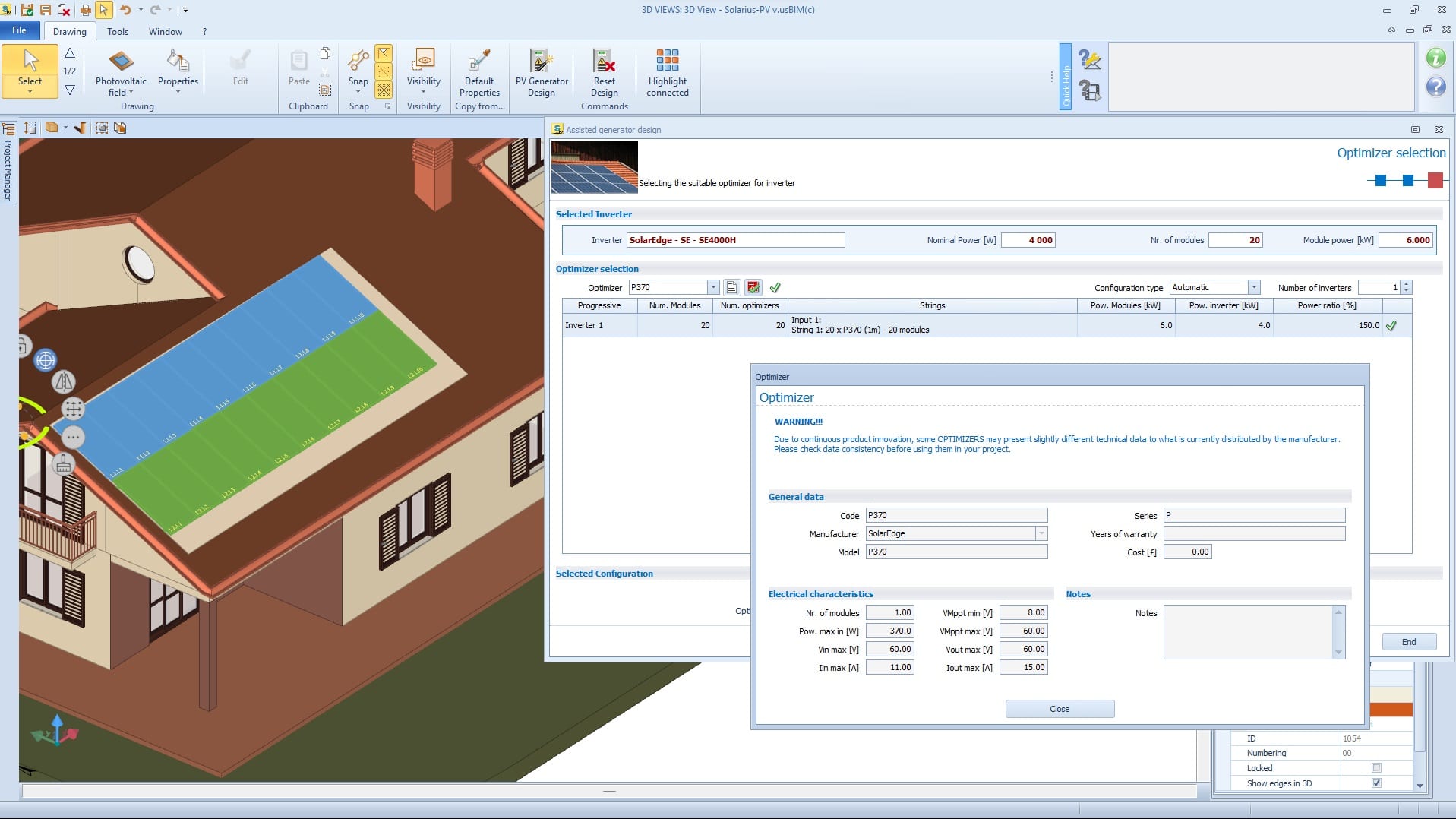
Optimizers – Solarius PV software
Advantages and Disadvantages
The main advantage of series wiring lies in the fact that the overall voltage of the system is the sum of the voltages of each panel. For example, by connecting three 12V panels, a total voltage of 36V is obtained. This configuration is particularly useful for systems that require higher voltages. An increase in voltage results in a reduction of the current needed to generate the same power, thus reducing energy losses in the cables, especially over long distances.
Among the disadvantages of wiring solar panels in series, the following aspects can be highlighted:
- sensitivity to shading: even partial shading on a single panel can significantly affect the efficiency of the entire string. This happens because the total current of the system is limited by the panel that receives less sunlight;
- greater risk of malfunction: if one panel fails, the entire string may stop producing energy, compromising production until the faulty panel is repaired or replaced;
- limited flexibility: all panels connected in series must have similar characteristics in terms of current and voltage. This makes it more complex to expand the system, as new panels must be compatible with existing ones.
Combined Solar Panel Wiring
Most residential photovoltaic systems use a mixed configuration, combining series and parallel connections. In this case, multiple strings of panels connected in series, with the aim of increasing the output voltage, are then connected in parallel. This configuration allows for an increase in overall current, thus optimizing the total power generated in watts by the system.
The combined wiring allows for an increase in both voltage and current. For example, if there is a system with two strings of three panels each connected in series, and then the two strings are connected in parallel, the voltage will be equal to the sum of the voltages of the panels in series and the current will be equal to the sum of the currents of the two parallel strings.
Differences Between Series or Parallel Wiring of Solar Panels
The main differences between series and parallel wiring concern the voltage and current that the system can generate. The choice between these two configurations depends on the specific needs of the application, such as voltage and current requirements, the structure of the system, and the environmental conditions in which it will be used.
Therefore, the main variables that influence the choice are:
- MC4 connectors: MC4 connectors are essential for connecting solar panels both in series and in parallel, providing a secure and simple connection between the positive and negative terminals of the panels;
- key components: the choice between series or parallel wiring depends on various factors, such as the type of panel (monocrystalline or polycrystalline) and the size of the modules. The number of solar cells in the panels affects the type of connection. Series wiring increases the system voltage, while parallel wiring increases the current;
- shading: shading can significantly affect the performance of solar panels. In a parallel configuration, a partially shaded panel only reduces its output, leaving the other panels intact. In contrast, in a series configuration, shading on a single panel can compromise the efficiency of the entire circuit;
- battery charging: considering the system as a whole, including battery charging, parallel wiring provides lower voltages, while series wiring can generate much higher voltages, depending on the specifications of the panels used. This affects the choice based on the needs of the storage system.


