
Transparent Solar Panels: definition and function
Transparent solar panels represent a solution that combines functionality, utility, and design. Discover the advantages and types of these panels

The field of renewable energies, thanks to technological evolution, has pursued three fundamental objectives: increasing the efficiency of modules, reducing costs, and ensuring perfect integration with any material or structure. In this context, the development of transparent photovoltaics stands out, characterized by a more appealing design compared to traditional solar panels and the ability to adapt to any environment, whether residential, industrial, or commercial.
Transparent solar panels, as their name suggests, are modules that allow the passage of sunlight and, at the same time, capture solar rays to convert them into electrical energy.
The main disadvantage of this technology lies in the lower energy efficiency compared to traditional panels. There is a risk of installing an element with specific expectations and obtaining a different and less satisfying result. To evaluate this aspect, you may find useful a solar software that allows designing any type of installation, obtaining in-depth economic analyses on the actual profitability of the system, and assessing the real benefits of the investment.
Contents
- Transparent Solar Panels: What Are They
- How Transparent Solar Panels Work
- Transparent Solar Panels for Architectural Design
- Completely Transparent Solar Panels: Are They the Future of Building Integration?
- Efficiency of Transparent Solar Panels: Pros and Cons
- Overview of Transparent Photovoltaic Technologies for the Built Environment
- Applications of transparent solar panels in architecture, infrastructure, and agrivoltaics
- FAQ about transparent photovoltaic panels
Transparent Solar Panels: What Are They
Transparent solar panels represent an evolution in design in the field of renewable energies. These are special photovoltaic panels made of glass or other synthetic materials that allow sunlight to pass through while still retaining the energy present in solar rays. Solar radiation is thus utilized twice: both for electricity production and for lighting spaces.
Transparent solar panels are an innovative technology that enables the generation of electricity while still allowing natural light to pass through. This unique combination of functionality and transparency makes them an excellent choice for integrating into the architecture of buildings, especially in Building Integrated Photovoltaics (BIPV). With these panels, everyday building elements like windows, curtain walls, and roofs can be transformed into active energy-producing surfaces.
Their sleek design and adaptability make them suitable for a wide range of applications, from residential homes to industrial and commercial buildings, offering a perfect blend of aesthetics and sustainability.
Common uses include solar facades and windows, which are just a few examples of the growing trend in energy-efficient architectural solutions. You can explore more about different types of photovoltaic systems and the potential of solar windows in related articles.
How Transparent Solar Panels Work
The operation of a photovoltaic panel is based on the ability to absorb solar energy and convert it into electricity, transforming photons into electrons.
Transparent solar panels allow sunlight to pass through them, like regular glass, allowing the sunlight to enter indoor spaces.
Once through the panel, the rays are filtered: only the solar rays pass through, while ultraviolet and infrared rays, invisible to the human eye, are captured by the panels. It is these invisible rays that make the panel appear transparent. This captured luminescence is then directed towards the edges of the panel, where thin strips of conventional photovoltaic cells transform it into electrical energy.
These innovative panels are constructed with plastic or glass materials and can have different levels of transparency.
From a technical standpoint, transparent solar panels operate thanks to special semiconductor materials that absorb only a part of the solar spectrum — specifically ultraviolet (UV) and infrared (IR) rays — while allowing visible light to pass through.
This technology is based on organic or inorganic photovoltaic cells integrated within glass or transparent polymer films.
The energy captured from UV and IR rays is transported to the edges of the panel, where conventional micro photovoltaic cells convert the radiation into electric current. The result is a transparent and productive surface, usable as a replacement for traditional glass, without compromising the brightness of indoor environments.
In some cases, the panels are installed vertically (at 90° to the ground), generating about 10–20% less energy compared to traditional inclined panels, but offering greater architectural and aesthetic advantages.
To delve deeper into the principle of converting light into electricity, it may be useful to read the article on how photovoltaic cells work.

Operating scheme of a transparent solar panel
Transparent solar panels vs. traditional modules: key differences
There are two main configurations of transparent solar panels on the market:
- the glass-glass modules, structured like a “sandwich,” with both surfaces made of glass that allow light to pass through;
- the completely transparent solar glasses, devoid of visible cells, where the glass material itself generates photovoltaic energy.
These solutions differ from traditional photovoltaic panels in the way they manage solar radiation.
Classic crystalline silicon modules almost completely absorb light, resulting in opacity, while transparent versions selectively filter the solar spectrum: they capture the ultraviolet and infrared components and allow visible light to pass through, ensuring natural brightness and simultaneous energy production.
From a technical standpoint:
- glass-glass modules are ideal for structural applications (such as roofs or railings), thanks to their mechanical strength and durability;
- transparent solar glasses are more commonly used in facades and windows, where architectural integration is particularly important.
Their energy yield is lower compared to traditional modules, but the reduced visual impact and application versatility make them particularly suitable for contemporary buildings and restoration contexts.
For a more in-depth comparison of the different technologies, see also types of photovoltaic panels and their differences.
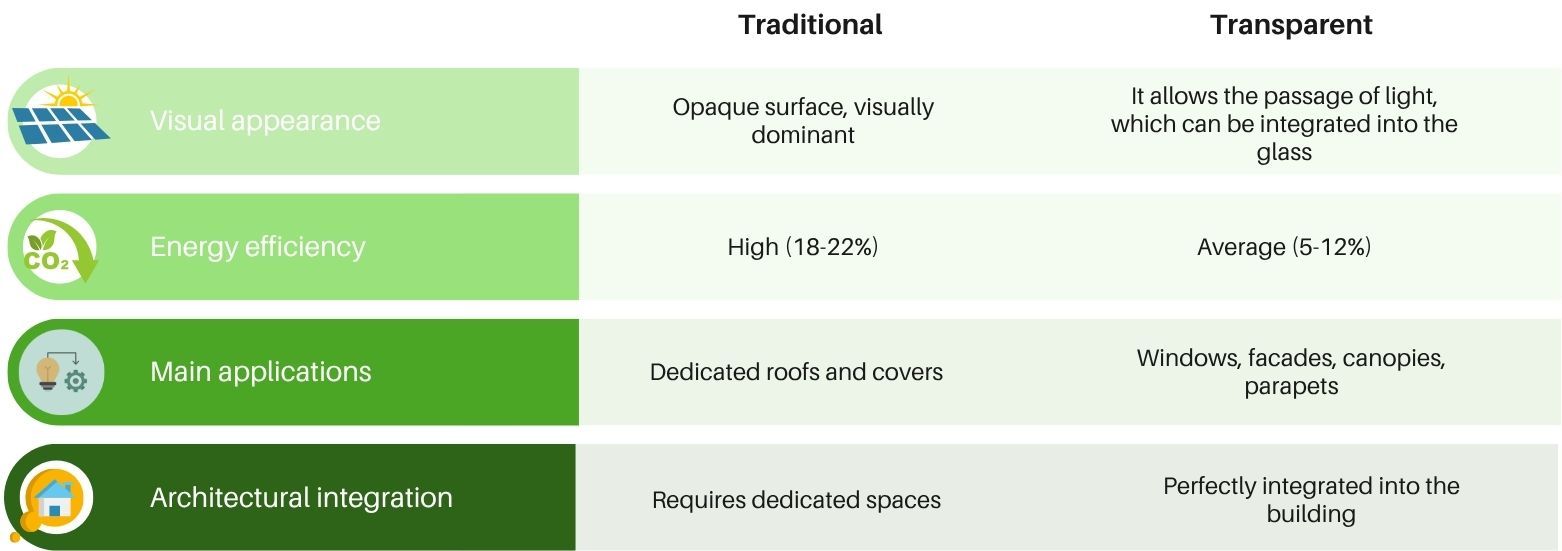
Comparison between traditional and transparent photovoltaic panels
Transparent Solar Panels for Architectural Design
Transparent solar panels are today one of the most interesting solutions for integrating photovoltaics into architecture. Thanks to their ability to modulate light transmission, they allow for the creation of surfaces that partially filter sunlight, ensuring both energy production and luminous comfort.
Transparent modules have significant aesthetic and functional qualities: the installation of glass-glass modules on a canopy allows natural lighting inside buildings, creating a bright and comfortable environment. This helps save energy while simultaneously producing clean energy.
This feature makes them particularly suitable for projects where design and sustainability must coexist harmoniously.
In contemporary architecture, semi-transparent panels are used for:
- continuous facades and curtain walls, where they reduce glare and thermal load;
- canopies, awnings, and sunshades, where they replace passive elements with active photovoltaic components;
- greenhouses and glass roofs, where partial transparency allows for light management and improves the internal microclimate.
In addition to their aesthetic value, semi-transparent modules contribute to the energy efficiency of the building, limiting the need for artificial lighting and reducing cooling demand. A useful in-depth look at these applications can also be found in the article dedicated to photovoltaics in facades.
Completely Transparent Solar Panels: Are They the Future of Building Integration?
Completely transparent solar panels represent the most advanced frontier of research in the field of integrated renewable energies.
Unlike semi-transparent modules, where the photovoltaic cells remain visible, this technology allows for the creation of completely transparent glass surfaces, indistinguishable from traditional glass, but capable of generating electricity.
This result is made possible by innovative materials such as organic photovoltaic polymers, amorphous silicon, and, more recently, graphene, which combine transparency, flexibility, and electrical conductivity.
Although the efficiency is still lower than that of traditional panels, interest in transparent solar glass is constantly growing:
- they allow any window, facade, or display case to be transformed into an energy source;
- they guarantee maximum aesthetic integration in historic or high-value buildings;
- they contribute to achieving zero energy building goals without altering architectural language.
The most interesting perspective is that of completely invisible photovoltaics, capable of revolutionizing the way we conceive building envelopes and extending the use of solar energy to vehicles, urban furniture, and mobile devices.
Efficiency of Transparent Solar Panels: Pros and Cons
Efficiency is currently one of the most delicate aspects of transparent photovoltaic technology.
Unlike traditional panels, the new modules are exposed to the sun at a 90° angle, as opposed to the usual 45°. The result is an energy production that is about 10 to 20% lower compared to traditional systems.
This vertical configuration, typical of photovoltaic facades or integrated glazing, inevitably leads to a lower direct capture of solar radiation compared to inclined modules, but offers architectural and functional advantages that justify their use.
In general, the efficiency of transparent panels varies from 5 to 12%, compared to values of 18–22% for traditional modules.
Performance depends on several factors:
- type of active material (amorphous silicon, organic cells, or graphene);
- degree of transparency required by the project;
- orientation and shading of the glazed surface;
- coating techniques and transparent conductors used to improve electrical conduction.
The main disadvantage of this technology, therefore, lies in its lower energy efficiency compared to traditional panels, with an output around 12%. This means that only 12% of the solar energy received is converted into usable electricity.
However, the evolution of nanostructured materials, conductive thin films, and flexible photovoltaic polymers is significantly improving yields, paving the way for solutions that combine efficiency, transparency, and durability.
For architectural design, this means being able to use large active glazed surfaces as an integral part of the building envelope, contributing to the energy class of the building and distributed production.
To explore the different technologies available and their average yields, see also the article dedicated to types of photovoltaic systems.

Efficiency vs Transparency in Photovoltaic Panels
Overview of Transparent Photovoltaic Technologies for the Built Environment
In recent years, research in the field of transparent photovoltaic materials has led to the development of various technological solutions designed to integrate energy production into buildings without compromising their aesthetic and functional quality.
These technologies aim to combine transparency, efficiency, and sustainability, opening new possibilities for BIPV (Building Integrated Photovoltaics). Let’s take a look at the 3 main types of transparent solar panels:
- with silicon gel, capable of producing energy up to 100 W/m². They are obtained by placing a thin layer of amorphous silicon directly on the glass sheet or inserting it in the cavity in the form of a transparent gel;
- organic-based, derived from light-reactive polymers due to the presence of carbon; they are cheaper to produce and can generate up to 300 W/m², about three times more than amorphous silicon;
- graphene-based, still in the experimental phase but extremely promising. This material, lightweight and as strong as diamond, can increase production by 50% compared to conventional modules.
This variety of solutions allows for the adaptation of transparent solar panels to different design needs:
- amorphous silicon ensures good durability and stability over time, suitable for facades and roofs;
- organic modules offer maximum lightness and flexibility, ideal for curved surfaces or mobile structures;
- graphene, still in the experimental phase, promises to revolutionize the efficiency and transparency of future BIPV systems.

The main types of transparent photovoltaic panels
Parallelly, the evolution of TCO — transparent conductive oxides — represents one of the most promising research fronts for improving the performance of transparent solar panels. These materials serve a dual function: they must be sufficiently transparent to allow visible light to pass through while simultaneously being electrically conductive to transport the electrons generated by the photovoltaic process.
To achieve this balance, TCOs are designed and optimized by intervening on parameters such as layer thickness, which affects electrical resistance and transmittance, surface morphology, which influences light scattering and thus efficiency, and thermal and chemical stability, crucial to ensure the longevity of the panel over time.
Flexible thin-film transparent solar panels: characteristics and use cases
Among the most promising technologies in the field of transparent photovoltaics are flexible thin-film panels, based on materials such as amorphous silicon, organic polymers, and graphene.
These technologies allow the realization of ultra-thin, lightweight, and semi-transparent modules, easily applicable to curved or movable surfaces, where rigid panels cannot be installed.
In thin-film modules, the photovoltaic layer has a thickness of a few micrometers and is deposited on flexible plastic or tempered glass substrates.
This approach allows for high visual uniformity, good light transmission, and mechanical resistance even under extreme conditions.
The main advantages of this technology are:
- reduced weight and greater adaptability to architectural shapes;
- low aesthetic impact, ideal for historic buildings or design structures;
- good performance in diffuse light conditions, thanks to the ability of amorphous silicon to absorb even indirect radiation;
- simplified installation, with lower structural loads compared to glass-to-glass modules.
The most common application of transparent thin-film panels is in continuous facades, curved canopies, and lightweight coverings, but they are also becoming widespread in mobile devices, smart glass, and intelligent urban furniture.
Transparent solar panels represent one of the most interesting innovations in the renewable energy sector: they combine efficiency, aesthetics, and architectural integration, opening new possibilities for the sustainable design of buildings and infrastructures.
Discover how to professionally design and size a photovoltaic system with the photovoltaic software specific for calculating, verifying, and optimizing solar energy production in any building context.
Applications of transparent solar panels in architecture, infrastructure, and agrivoltaics
Transparent photovoltaic panels find applications in numerous architectural and infrastructural contexts due to their ability to combine energy production, transparency, and aesthetic integration.
In buildings, they can be used in glazed facades, curtain walls, skylights, lightweight roofs, canopies, and balustrades, replacing traditional elements with active surfaces that allow natural light to enter and contribute to internal comfort.
In urban and infrastructural settings, they are used in canopies for stations and stops, transparent noise barriers, walkways, and coverings for public spaces, improving environmental quality by reducing glare and enabling distributed energy production.
Semi-transparent technology, in particular, allows filtering part of the solar radiation, reducing summer thermal loads and improving natural lighting, benefiting visual comfort and energy efficiency. This integration is ideal for modern buildings and NZEB, where integrated photovoltaic production is a strategic requirement.
In agrivoltaics and solar greenhouses, transparent panels also offer significant advantages: they allow the passage of light necessary for crop growth, limit UV and IR radiation, improve the internal microclimate, and reduce the need for artificial shading. The transparent photovoltaic greenhouses thus combine natural lighting, crop protection, and energy production into a single solution, increasing the economic and environmental sustainability of farms.
FAQ about transparent photovoltaic panels
What are transparent photovoltaic panels?
Transparent photovoltaic panels are modules made of glass or synthetic materials that allow natural light to pass through while simultaneously capturing part of the solar radiation to produce electricity. Thanks to their transparency, they easily integrate into windows, facades, and coverings, contributing to the architectural design of buildings.
How does a transparent photovoltaic panel work?
These panels filter the solar spectrum: visible light passes through the surface, while UV and IR rays are absorbed and directed towards photovoltaic microcells placed at the edges, which convert them into electrical energy. All this occurs without reducing internal brightness.
What are the differences between transparent panels and traditional photovoltaic modules?
Unlike classic modules, which are opaque and absorb almost all radiation, transparent panels selectively filter UV and IR rays while allowing visible light to pass through. The yield is lower, but the visual impact is much less, and the architectural integration is significantly superior.
What types of transparent photovoltaic panels exist?
The main solutions are:
- glass-glass modules, more durable and suitable for roofs or balustrades;
- fully transparent solar glass with invisible cells, ideal for facades and fixtures;
- organic and amorphous silicon modules, lightweight and flexible;
- experimental graphene solutions, highly promising for efficiency and transparency.
What is the efficiency of transparent photovoltaic panels?
Efficiency typically ranges from 5% to 12%, lower than traditional modules. The vertical installation typical of facades and glazed areas can further reduce production compared to inclined panels, but it offers architectural and functional advantages that are difficult to achieve with opaque solutions.
What technologies improve the performance of transparent panels?
In addition to innovative semiconductor materials (organic polymers, amorphous silicon, graphene), a key role is played by TCOs — transparent conductive oxides, designed to maintain high transmittance and good electrical conductivity, ensuring productivity and durability over time.
What are transparent thin-film photovoltaic panels?
They are ultra-light and flexible modules in which the photovoltaic material is deposited on plastic or glass substrates. They offer good performance in diffuse light and can adapt to curved surfaces, making them ideal for continuous facades, canopies, and lightweight coverings.
In what areas are transparent photovoltaic panels used?
They are applied in:
- architecture (facades, curtain walls, canopies, skylights, lightweight coverings);
- urban infrastructure (canopies, noise barriers, walkways);
- greenhouses and agrivoltaic systems, where they allow the passage of light necessary for crop growth and simultaneous energy production.
Are transparent photovoltaic panels suitable for NZEB buildings?
Yes. Thanks to their aesthetic integration and ability to produce energy without altering the appearance of glazed surfaces, they are an effective solution for nearly zero-energy buildings, contributing to reduced thermal loads and natural lighting.


