
Climate Change and Construction: Complete Guide to Solutions and Technologies
Construction and climate change drive energy renovation and innovation. Discover tools and technologies for sustainable buildings

In the current context, characterized by increasing environmental awareness and the need to reduce the impact of human activities, the construction sector plays a crucial role.
The concepts of eco-sustainable buildings and sustainable construction are becoming key elements in addressing the environmental impact of the construction sector, one of the most polluting and emitting industries globally.
The focus on energy renovation, the use of sustainable materials, life cycle, integration with renewable energies, the concept of resilience, and innovative technologies has led to a shift towards more attentive and conscious building design.
For professionals in the sector, this also means being able to manage projects precisely from an energy perspective, ensuring compliance with regulations and the realization of NZEB buildings. Understanding the dynamics of climate change is not enough; it is necessary to have thermotechnical software that translates the principles of sustainability into data, simulations, and concrete technical verifications.
In this article, we will analyze in detail all the technical solutions and emerging technologies in the construction sector to combat climate change.
Contents
- Construction and climate change: current context, environmental impacts, and challenges for a sustainable future
- Mitigation strategies in construction and climate change
- Adaptation and resilience in construction and climate change
- Benefits of a Sustainable Approach in Construction and Climate Change
- Strategies, Case Studies, and Tools for Sustainable and Low-Emission Construction
- FAQ – Construction and Climate Change
Construction and climate change: current context, environmental impacts, and challenges for a sustainable future
In the current context, the statistics provided by the EEA “European Environment Agency” are alarming:
- buildings account for about 42% of total energy consumption;
- the construction sector produces about 35% of greenhouse gas emissions in the European Union;
- the construction sector uses 1/3 of the materials employed in the EU.
The goal of the EPBD directive is to stimulate the energy renovation of private and public buildings throughout Europe, in order to reduce energy consumption and CO2 emissions from the real estate stock of the 27 member states.
At the same time, models for energy certifications and standards for evaluating building performance have also evolved. Certification programs such as the LEED Protocol are becoming increasingly common, contributing to raising awareness among people and directing the market in the direction required by regulations.
Indeed, there is an effort to aim for a participatory approach that involves local communities in the decision-making process, promoting urban regeneration with innovative and social solutions.
Among the future challenges of the construction sector is also the promotion of a greater circular economy in the supply chain. Another critical element is the management of construction waste, given the low reuse of recycled materials.
Mitigation strategies in construction and climate change
To mitigate climate change and alleviate the severity of its impacts by reducing greenhouse gas emissions into the atmosphere, a series of strategies in construction can be implemented, such as:
- the development of energy renovation interventions for buildings;
- the use of sustainable and low-impact materials;
- the integration with renewable energies.
1. Energy renovation of buildings
Energy renovation interventions aim to improve the energy performance of a building by ensuring:
- reduction of energy consumption;
- economic savings;
- improvement of living comfort;
- increase in property value.
Among the main energy renovation interventions are those for:
- improving the building envelope such as thermal insulation, which involves applying a layer of insulating material to all opaque external closure elements, such as external walls, roofs, and floors, replacing windows, such as transparent closure elements, or adding solar shading elements;
- improving systems, such as replacing the existing boiler with more innovative and less energy-consuming solutions or incorporating VMC systems.
2. Sustainable and low-impact materials
The choice of eco-sustainable materials represents a tool to create eco-sustainable homes that respect the environment and are highly energy-efficient.
A material can be defined as eco-sustainable when, throughout its life cycle, from production to disposal, it minimizes environmental impact. This means limiting the use of natural resources, reducing pollution, and contributing to the conservation of biodiversity.
Among the eco-sustainable building materials, we can mention:
- brick;
- concrete with expanded clay;
- natural stone;
- raw earth;
- cork;
- wood fiber;
- natural paints.
3. Integration with renewable energies
The integration with renewable energies represents a crucial step for reducing the environmental impact of a construction.
Among the main renewable sources are:
- solar energy, where photovoltaic systems convert solar energy into electricity, while solar thermal systems can directly produce domestic hot water;
- wind energy, where wind turbines, either horizontal or vertical axis, convert the kinetic energy of the wind into electricity;
- geothermal energy, where geothermal systems generate heating and cooling by exploiting the constant temperature present below the Earth’s surface;
- hydroelectric energy, which harnesses the flow of water through turbines and water wheels connected to generators that convert mechanical energy into electricity;
- biomass energy, where the combustion of organic materials such as wood pellets or agricultural waste generates heat and energy for buildings.
Adaptation and resilience in construction and climate change
Adaptation and resilience in construction are concepts inherent to resilient architecture that combines robust construction with the ability to flexibly adapt to new climatic needs.
With a forward-looking perspective, resilient construction utilizes bioclimatic design, smart systems and technologies, high-strength materials, and structural systems that help limit the effects of heat, heavy rains, or storms.
Bioclimatic design and passive house
Since the concept of Passivhaus was born in 1988, it has never been abandoned.
A passive house has a very low energy requirement and can be self-sufficient by using its own methods to create energy, heating the house or water.
When designing a passive house, it is necessary to follow 7 key principles to achieve optimal bioclimatic design:
- orientation;
- form ratio;
- use of thermal insulation;
- use of thermal windows;
- absence of thermal bridges;
- use of ventilation systems;
- attention to air tightness.
Resilience to extreme climate events
A building resilient to extreme climate events is one that can maintain its essential functions while adapting to new conditions induced by the climate.
With climate resilience, it is possible to achieve:
- environmental protection, to safeguard both critical infrastructure and natural systems such as coastal or forest areas;
- greater environmental sustainability, in the long term for all structures and ecosystems;
- reduced vulnerability, with anticipation and preparation for extreme environmental impacts, reducing climate-related risks;
- increased adaptive capacity, allowing adaptation to changing conditions and recovery from climate-related shocks;
- continuity of essential functions, such as food production, water supply, and healthcare.
Smart buildings and innovative technologies
Innovative technologies such as advanced IoT sensors, energy management systems, building automation, and artificial intelligence enable the creation of a smart building, an intelligent building designed to be connected, integrated, and interactive.
Smart buildings allow for optimizing energy consumption and improving internal comfort, while simultaneously reducing the environmental impact of buildings and management costs.
They also enhance the comfort and well-being of occupants: indoor air quality, temperature, lighting, and acoustics are optimized to create a healthy and productive environment.
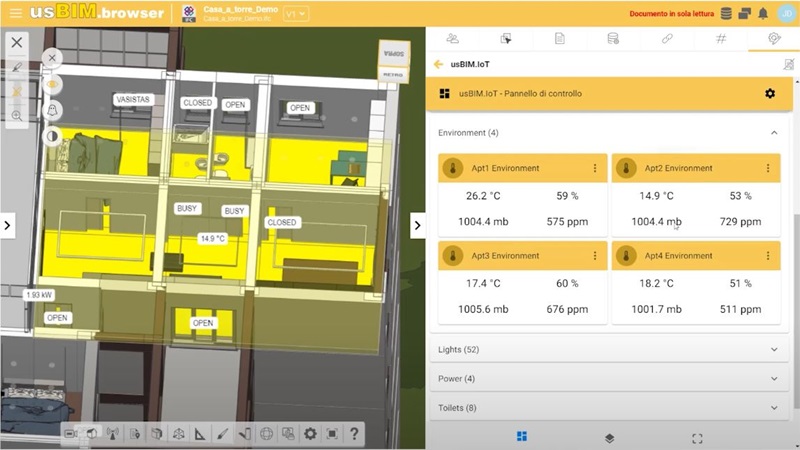
Management of a home’s systems with usBIM.IoT
Benefits of a Sustainable Approach in Construction and Climate Change
A sustainable approach in construction allows for improved environmental and energy performance of buildings, with positive effects also on the economic front and residential well-being.
Energy efficiency interventions reduce consumption, limit land use, and enhance the existing building stock. This results in a tangible environmental advantage: lower impact on the territory, reduced use of natural resources, and significant reduction in greenhouse gas emissions.
The economic benefits are equally significant. Energy costs decrease, access to incentives and tax breaks increases, the market value of properties rises, and maintenance costs decrease.
All of this also contributes to the health and comfort of the people living in the buildings: better thermal and acoustic insulation, healthier indoor air, and more comfortable environments improve the quality of daily life.
Strategies, Case Studies, and Tools for Sustainable and Low-Emission Construction
Combating climate change in construction requires a set of best practices and design strategies oriented towards sustainability.
Among the main actions to be undertaken are:
- the implementation of thermal insulation interventions with sustainable materials;
- installation of high-efficiency windows with solar shading systems;
- improving the efficiency of systems;
- installing control systems;
- the conscious management of natural resources.
Among the most famous Italian case studies, one cannot fail to mention the Ca’ Granda Complex (Milan).
The intervention concerning it, which began in November 2021 and is nearing completion, consists of the energy refurbishment of six towers, arranged with a 90° rotation over a total habitable area of approximately 30,000 m2.
This intervention will involve the installation of approximately 4,200 m2 of ventilated facades, the inclusion of green roofs, rooftop gardens, heat pumps for thermal systems, and photovoltaic systems.
This will allow the towers to fall within the framework of decarbonization and energy transition interventions.
However, the path towards truly sustainable construction does not end with the adoption of best practices or the application of efficient technologies. For professionals in the sector, it becomes essential to rely on calculation and analysis tools that allow for designing, verifying, and optimizing every intervention in energy terms.
A dynamic energy analysis and simulation software is today an indispensable support for managing NZEB new building projects.
Only through the integration of technical knowledge, environmental awareness, and advanced digital tools is it possible to successfully tackle the challenge of climate change in the construction sector.
FAQ – Construction and Climate Change
What is the role of construction in the fight against climate change?
The construction sector has a significant impact on the environment: it is responsible for a large part of energy consumption and greenhouse gas emissions in Europe. For this reason, it represents one of the main fronts of the ecological transition. Energy refurbishment interventions, sustainable materials, and innovative technologies can drastically reduce the environmental footprint of buildings.
What are the main mitigation strategies in the construction sector?
Mitigation strategies are based on reducing consumption and emissions. Among the most effective are the energy refurbishment of the existing building stock, the use of low-impact environmental materials, and the integration of renewable sources, such as photovoltaic, geothermal, or biomass systems.
What is meant by resilient construction and why is it important?
Resilient construction is capable of adapting to new climatic conditions without compromising the safety and functionality of buildings. It uses bioclimatic design, durable materials, intelligent systems, and adaptation strategies to face extreme weather events such as heatwaves, heavy rains, or flooding.
How do digital technologies contribute to sustainability in construction?
Digital technologies — such as BIM, IoT, and artificial intelligence — allow for integrated management of project data, optimization of consumption, performance monitoring, and improved maintenance. Smart buildings, for example, thanks to sensors and automated systems, ensure comfort and energy savings while simultaneously reducing environmental impact.
What advantages does a sustainable approach bring from an economic and social perspective?
In addition to reducing emissions, sustainable construction brings concrete benefits: decreased energy bills, access to tax incentives, increased property values, and improved living comfort. In the long term, it also contributes to people’s health and quality of life by creating more efficient and healthy environments.
Why is it useful to use dynamic energy analysis and simulation software in sustainable design?
A dynamic energy analysis and simulation software allows for planning refurbishment interventions and designing new NZEB buildings. It is an indispensable tool for translating sustainability principles into measurable and verifiable technical solutions.


